

Complex numbers 221
= (1.732 + j 1.000) +(3.536 − j 3.536)
− (−2.000 + j 3.464)
= 7.268 − j 6.000, which lies in the fourth quadrant
=
[(7.268) 2 + (6.000) 2 ]∠ tan −1
−6.000
7.268
= 9.425∠−39.54 ◦
Now try the following exercise
Exercise 88 Further problems on polar
form
1. Determine the modulus and argument of
(a) 2 + j 4 (b) −5 − j 2 (c) j (2 − j ).
⎡
⎢
⎣
(a) 4.472, 63.43 ◦
(b)5.385, −158.20 ◦
(c) 2.236, 63.43 ◦
⎤
⎥
⎦
In Problems 2 and 3 express the given Cartesian
complex numbers in polar form, leaving answers
in surd form.
2. (a) 2 + j 3 (b) −4 (c) −6 + j
(a)
√
13∠56.31 ◦ (b)4∠180 ◦
(c)
√
37∠170.54 ◦
3. (a) − j 3 (b) (−2 + j ) 3 (c) j 3 (1 − j )
(a) 3∠−90 ◦ (b)
√
125∠100.30 ◦
(c)
√
2∠−135 ◦
In Problems 4 and 5 convert the given polar complex numbers into (a + j b) form giving answers
correct to 4 significant figures.
4. (a) 5∠30 ◦ (b) 3∠60 ◦ (c) 7∠45 ◦
⎡
⎢
⎣
(a) 4.330 + j 2.500
(b)1.500 + j 2.598
(c) 4.950 + j 4.950
⎤
⎥
⎦
5. (a) 6∠125 ◦ (b) 4∠π (c) 3.5∠−120 ◦
⎡
⎢
⎣
(a) −3.441 + j 4.915
(b) −4.000 + j 0
(c) −1.750 − j 3.031
⎤
⎥
⎦
In Problems 6 to 8, evaluate in polar form.
6. (a) 3∠20 ◦ × 15∠45 ◦
(b) 2.4∠65 ◦ × 4.4∠−21 ◦
[(a) 45∠65 ◦ (b) 10.56∠44 ◦ ]
7. (a) 6.4∠27 ◦ ÷ 2∠−15
◦
(b) 5∠30 ◦ × 4∠80 ◦ ÷ 10∠−40 ◦
[(a) 3.2∠42 ◦ (b) 2∠150 ◦ ]
8. (a) 4∠
π
6
+ 3∠
π
8
(b) 2∠120 ◦ + 5.2∠58 ◦ − 1.6∠−40 ◦
[(a) 6.986∠26.79 ◦ (b) 7.190∠85.77 ◦ ]
20.8 Applications of complex
numbers
There are several applications of complex numbers
in science and engineering, in particular in electrical
alternating current theory and in mechanical vector
analysis.
The effect of multiplying a phasor by j is to rotate
it in a positive direction (i.e. anticlockwise) on an
Argand diagram through 90 ◦ without altering its length.
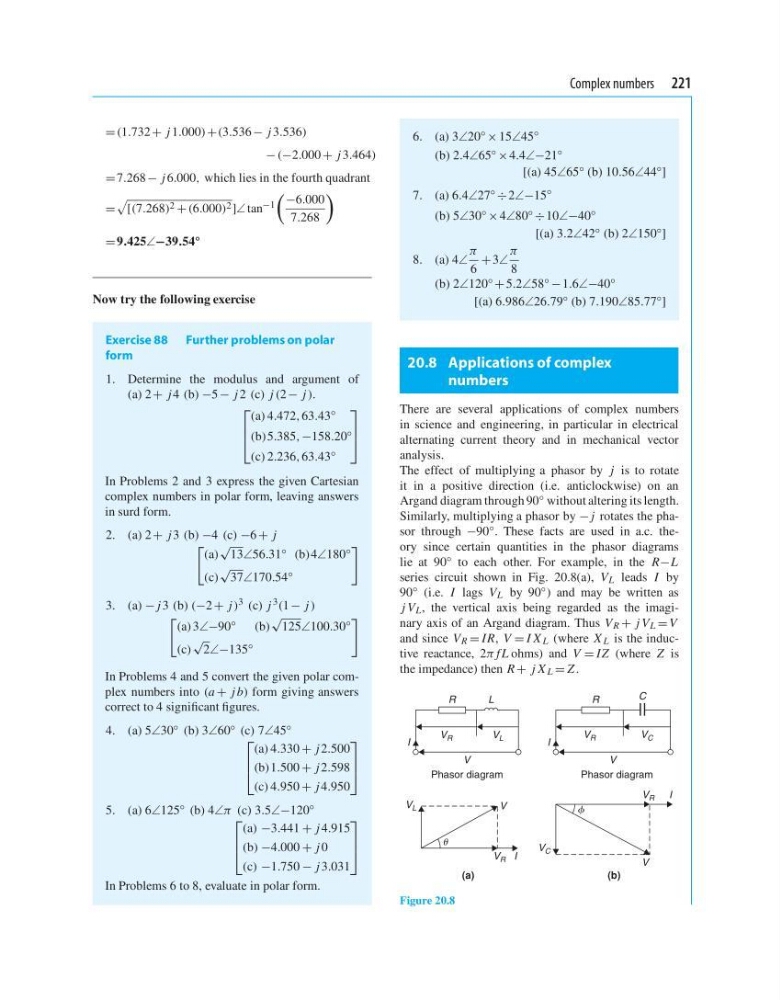
Similarly, multiplying a phasor by − j rotates the phasor through −90 ◦ . These facts are used in a.c. theory since certain quantities in the phasor diagrams
lie at 90 ◦ to each other. For example, in the R−L
series circuit shown in Fig. 20.8(a), V L leads I by
90 ◦ (i.e. I lags V L by 90 ◦ ) and may be written as
j V L , the vertical axis being regarded as the imaginary axis of an Argand diagram. Thus V R + j V L = V
and since V R = IR, V = I X L (where X L is the inductive reactance, 2π fL ohms) and V = IZ (where Z is
the impedance) then R + j X L = Z .
Phasor diagram
Phasor diagram
V R
V L
R
V
I
L
(a)
V R
V
I
V L
V R
V C
R
V
I
C
(b)
V R
V C
V
I
Figure 20.8
= (1.732 + j 1.000) +(3.536 − j 3.536)
− (−2.000 + j 3.464)
= 7.268 − j 6.000, which lies in the fourth quadrant
=
[(7.268) 2 + (6.000) 2 ]∠ tan −1
−6.000
7.268
= 9.425∠−39.54 ◦
Now try the following exercise
Exercise 88 Further problems on polar
form
1. Determine the modulus and argument of
(a) 2 + j 4 (b) −5 − j 2 (c) j (2 − j ).
⎡
⎢
⎣
(a) 4.472, 63.43 ◦
(b)5.385, −158.20 ◦
(c) 2.236, 63.43 ◦
⎤
⎥
⎦
In Problems 2 and 3 express the given Cartesian
complex numbers in polar form, leaving answers
in surd form.
2. (a) 2 + j 3 (b) −4 (c) −6 + j
(a)
√
13∠56.31 ◦ (b)4∠180 ◦
(c)
√
37∠170.54 ◦
3. (a) − j 3 (b) (−2 + j ) 3 (c) j 3 (1 − j )
(a) 3∠−90 ◦ (b)
√
125∠100.30 ◦
(c)
√
2∠−135 ◦
In Problems 4 and 5 convert the given polar complex numbers into (a + j b) form giving answers
correct to 4 significant figures.
4. (a) 5∠30 ◦ (b) 3∠60 ◦ (c) 7∠45 ◦
⎡
⎢
⎣
(a) 4.330 + j 2.500
(b)1.500 + j 2.598
(c) 4.950 + j 4.950
⎤
⎥
⎦
5. (a) 6∠125 ◦ (b) 4∠π (c) 3.5∠−120 ◦
⎡
⎢
⎣
(a) −3.441 + j 4.915
(b) −4.000 + j 0
(c) −1.750 − j 3.031
⎤
⎥
⎦
In Problems 6 to 8, evaluate in polar form.
6. (a) 3∠20 ◦ × 15∠45 ◦
(b) 2.4∠65 ◦ × 4.4∠−21 ◦
[(a) 45∠65 ◦ (b) 10.56∠44 ◦ ]
7. (a) 6.4∠27 ◦ ÷ 2∠−15
◦
(b) 5∠30 ◦ × 4∠80 ◦ ÷ 10∠−40 ◦
[(a) 3.2∠42 ◦ (b) 2∠150 ◦ ]
8. (a) 4∠
π
6
+ 3∠
π
8
(b) 2∠120 ◦ + 5.2∠58 ◦ − 1.6∠−40 ◦
[(a) 6.986∠26.79 ◦ (b) 7.190∠85.77 ◦ ]
20.8 Applications of complex
numbers
There are several applications of complex numbers
in science and engineering, in particular in electrical
alternating current theory and in mechanical vector
analysis.
The effect of multiplying a phasor by j is to rotate
it in a positive direction (i.e. anticlockwise) on an
Argand diagram through 90 ◦ without altering its length.
Similarly, multiplying a phasor by − j rotates the phasor through −90 ◦ . These facts are used in a.c. theory since certain quantities in the phasor diagrams
lie at 90 ◦ to each other. For example, in the R−L
series circuit shown in Fig. 20.8(a), V L leads I by
90 ◦ (i.e. I lags V L by 90 ◦ ) and may be written as
j V L , the vertical axis being regarded as the imaginary axis of an Argand diagram. Thus V R + j V L = V
and since V R = IR, V = I X L (where X L is the inductive reactance, 2π fL ohms) and V = IZ (where Z is
the impedance) then R + j X L = Z .
Phasor diagram
Phasor diagram
V R
V L
R
V
I
L
(a)
V R
V
I
V L
V R
V C
R
V
I
C
(b)
V R
V C
V
I
Figure 20.8