

220 Higher Engineering Mathematics
(a)
(b)
Real axis
4
0
308
Imaginary
axis
x
jy
␣
Real axis
1458
7
x
jy
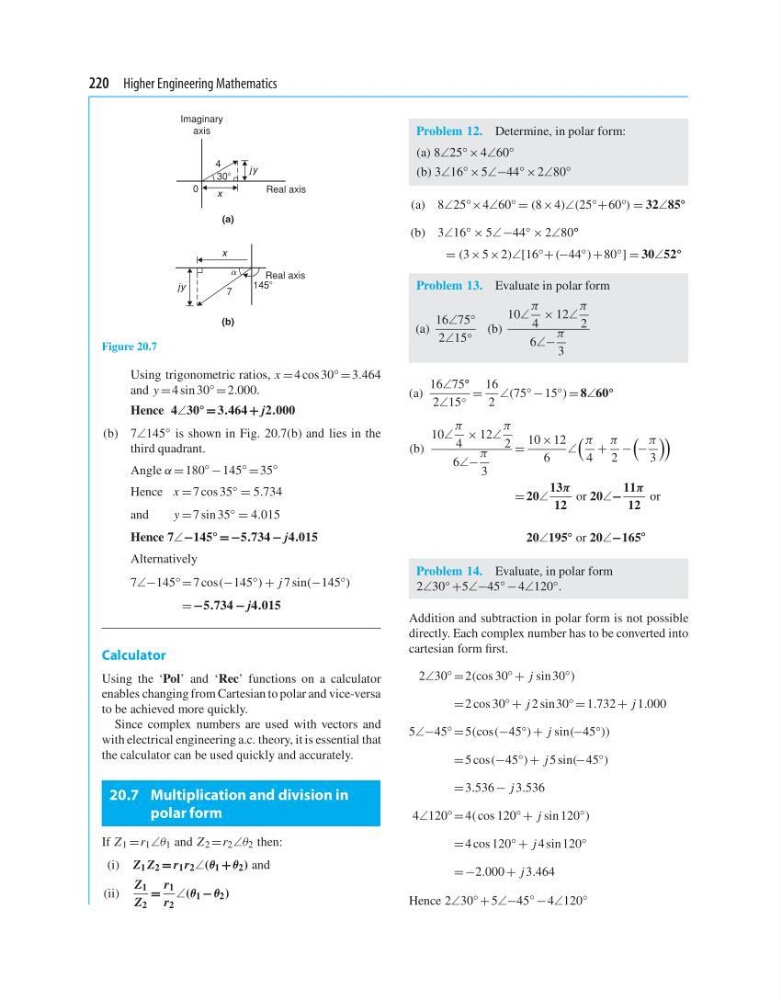
Figure 20.7
Using trigonometric ratios, x = 4 cos 30 ◦ = 3.464
and y = 4 sin 30 ◦ = 2.000.
Hence 4∠30 ◦ = 3.464 + j2.000
(b) 7∠145 ◦ is shown in Fig. 20.7(b) and lies in the
third quadrant.
Angle α = 180
◦
− 145
◦
= 35
◦
Hence x = 7 cos 35 ◦ = 5.734
and
y = 7 sin 35 ◦ = 4.015
Hence 7∠−145 ◦ =−5.734 − j4.015
Alternatively
7∠−145 ◦ = 7 cos(−145 ◦ ) + j 7 sin(−145 ◦ )
= −5.734 − j4.015
Calculator
Using the ‘Pol’ and ‘Rec’ functions on a calculator
enables changing from Cartesian to polar and vice-versa
to be achieved more quickly.
Since complex numbers are used with vectors and
with electrical engineering a.c. theory, it is essential that
the calculator can be used quickly and accurately.
20.7 Multiplication and division in
polar form
If Z 1 =r 1 ∠θ 1 and Z 2 =r 2 ∠θ 2 then:
(i) Z 1 Z 2 = r 1 r 2 ∠(θ 1 + θ 2 ) and
(ii)
Z 1
Z 2
=
r 1
r 2
∠(θ 1 − θ 2 )
Problem 12. Determine, in polar form:
(a) 8∠25 ◦ × 4∠60 ◦
(b) 3∠16
◦
× 5∠−44
◦
× 2∠80
◦
(a) 8∠25 ◦ ×4∠60 ◦ = (8 × 4)∠(25 ◦ +60 ◦ ) = 32∠85 ◦
(b) 3∠16 ◦ × 5∠ −44 ◦ × 2∠80 ◦
= (3 × 5 × 2)∠[16 ◦ + (−44 ◦ )+ 80 ◦ ] = 30∠52 ◦
Problem 13. Evaluate in polar form
(a)
16∠75 ◦
2∠15 ◦ (b)
10∠
π
4
× 12∠
π
2
6∠−
π
3
(a)
16∠75 ◦
2∠15 ◦ =
16
2
∠(75 ◦ − 15 ◦ ) = 8∠60 ◦
(b)
10∠
π
4
× 12∠
π
2
6∠−
π
3
=
10 × 12
6
∠
π
4
+
π
2
−
−
π
3
= 20∠
13π
12
or 20∠−
11π
12
or
20∠195 ◦ or 20∠−165
◦
Problem 14. Evaluate, in polar form
2∠30 ◦ +5∠−45
◦
− 4∠120 ◦ .
Addition and subtraction in polar form is not possible
directly. Each complex number has to be converted into
cartesian form first.
2∠30 ◦ = 2(cos 30 ◦ + j sin 30 ◦ )
= 2 cos 30 ◦ + j 2 sin30 ◦ = 1.732 + j 1.000
5∠−45
◦
= 5(cos(−45 ◦ ) + j sin(−45 ◦ ))
= 5 cos(−45 ◦ ) + j 5 sin(−45 ◦ )
= 3.536 − j 3.536
4∠120 ◦ = 4( cos 120 ◦ + j sin 120 ◦ )
= 4 cos 120 ◦ + j 4 sin 120 ◦
=−2.000 + j 3.464
Hence 2∠30
◦
+ 5∠−45
◦
− 4∠120
◦
(a)
(b)
Real axis
4
0
308
Imaginary
axis
x
jy
␣
Real axis
1458
7
x
jy
Figure 20.7
Using trigonometric ratios, x = 4 cos 30 ◦ = 3.464
and y = 4 sin 30 ◦ = 2.000.
Hence 4∠30 ◦ = 3.464 + j2.000
(b) 7∠145 ◦ is shown in Fig. 20.7(b) and lies in the
third quadrant.
Angle α = 180
◦
− 145
◦
= 35
◦
Hence x = 7 cos 35 ◦ = 5.734
and
y = 7 sin 35 ◦ = 4.015
Hence 7∠−145 ◦ =−5.734 − j4.015
Alternatively
7∠−145 ◦ = 7 cos(−145 ◦ ) + j 7 sin(−145 ◦ )
= −5.734 − j4.015
Calculator
Using the ‘Pol’ and ‘Rec’ functions on a calculator
enables changing from Cartesian to polar and vice-versa
to be achieved more quickly.
Since complex numbers are used with vectors and
with electrical engineering a.c. theory, it is essential that
the calculator can be used quickly and accurately.
20.7 Multiplication and division in
polar form
If Z 1 =r 1 ∠θ 1 and Z 2 =r 2 ∠θ 2 then:
(i) Z 1 Z 2 = r 1 r 2 ∠(θ 1 + θ 2 ) and
(ii)
Z 1
Z 2
=
r 1
r 2
∠(θ 1 − θ 2 )
Problem 12. Determine, in polar form:
(a) 8∠25 ◦ × 4∠60 ◦
(b) 3∠16
◦
× 5∠−44
◦
× 2∠80
◦
(a) 8∠25 ◦ ×4∠60 ◦ = (8 × 4)∠(25 ◦ +60 ◦ ) = 32∠85 ◦
(b) 3∠16 ◦ × 5∠ −44 ◦ × 2∠80 ◦
= (3 × 5 × 2)∠[16 ◦ + (−44 ◦ )+ 80 ◦ ] = 30∠52 ◦
Problem 13. Evaluate in polar form
(a)
16∠75 ◦
2∠15 ◦ (b)
10∠
π
4
× 12∠
π
2
6∠−
π
3
(a)
16∠75 ◦
2∠15 ◦ =
16
2
∠(75 ◦ − 15 ◦ ) = 8∠60 ◦
(b)
10∠
π
4
× 12∠
π
2
6∠−
π
3
=
10 × 12
6
∠
π
4
+
π
2
−
−
π
3
= 20∠
13π
12
or 20∠−
11π
12
or
20∠195 ◦ or 20∠−165
◦
Problem 14. Evaluate, in polar form
2∠30 ◦ +5∠−45
◦
− 4∠120 ◦ .
Addition and subtraction in polar form is not possible
directly. Each complex number has to be converted into
cartesian form first.
2∠30 ◦ = 2(cos 30 ◦ + j sin 30 ◦ )
= 2 cos 30 ◦ + j 2 sin30 ◦ = 1.732 + j 1.000
5∠−45
◦
= 5(cos(−45 ◦ ) + j sin(−45 ◦ ))
= 5 cos(−45 ◦ ) + j 5 sin(−45 ◦ )
= 3.536 − j 3.536
4∠120 ◦ = 4( cos 120 ◦ + j sin 120 ◦ )
= 4 cos 120 ◦ + j 4 sin 120 ◦
=−2.000 + j 3.464
Hence 2∠30
◦
+ 5∠−45
◦
− 4∠120
◦