

204 Higher Engineering Mathematics
(iii) Accurately measure ordinates y 1 , y 2 , y 3 , etc.
(iv) Area ABCD = d(y 1 + y 2 + y 3 + y 4 + y 5 + y 6 )
In general, the mid-ordinate rule states:
Area =
width of
interval
sum of
mid-ordinates
(d) Simpson’s rule
To determine the area PQRS of Fig. 19.1:
(i) Divide base PS into an even number of intervals, each of width d (the greater the number
of intervals, the greater the accuracy).
(ii) Accurately measure ordinates y 1 , y 2 , y 3 , etc.
(iii) Area PQRS =
d
3
[(y 1 + y 7 ) + 4(y 2 + y 4 +
y 6 ) + 2(y 3 + y 5 )]
In general, Simpson’s rule states:
Area =
1
3
width of
interval
first + last
ordinate
+ 4
sum of even
ordinates
+ 2
sum of remaining
odd ordinates
Problem 1. A car starts from rest and its speed is
measured every second for 6 s:
Time t (s)
0 1 2 3
4
5
6
Speed v (m/s) 0 2.5 5.5 8.75 12.5 17.5 24.0
Determine the distance travelled in 6 seconds (i.e.
the area under the v/t graph), by (a) the trapezoidal
rule, (b) the mid-ordinate rule, and (c) Simpson’s
rule.
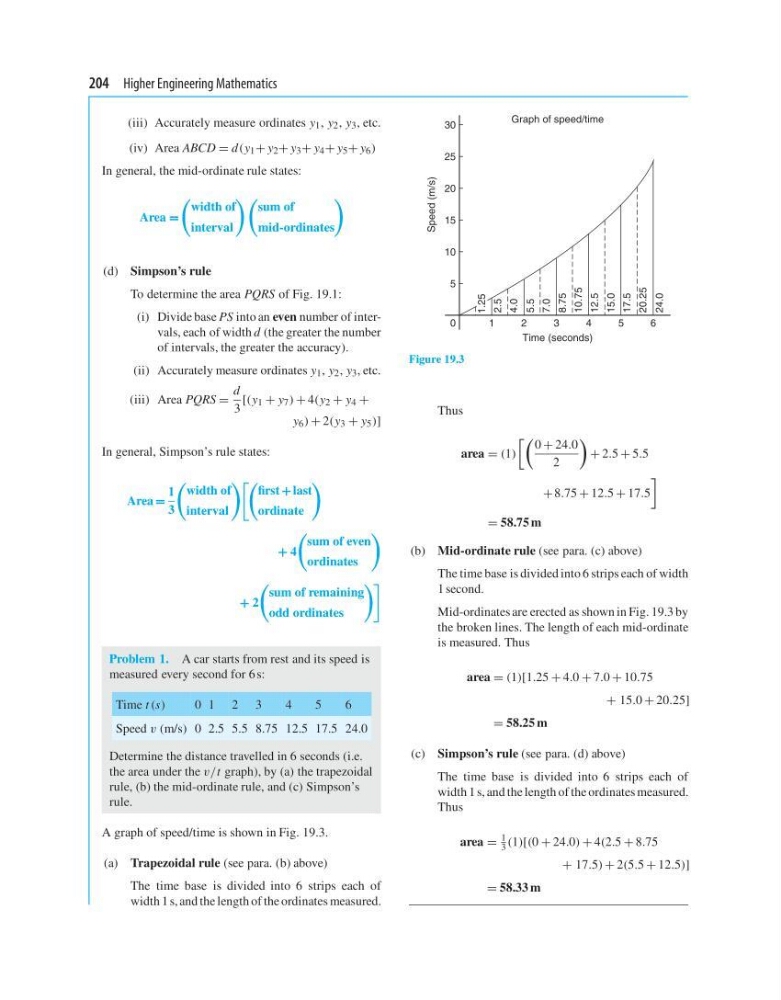
A graph of speed/time is shown in Fig. 19.3.
(a) Trapezoidal rule (see para. (b) above)
The time base is divided into 6 strips each of
width 1 s, and the length of the ordinates measured.
30
25
Graph of speed/time
20
15
Speed (m/s)
10
5
0
1
2
3
4
5
6
Time (seconds)
4.0
7.0
15.0
5.5
8.75
10.75
12.5
17.5
20.25
24.0
1.25
2.5
Figure 19.3
Thus
area = (1)
0 + 24.0
2
+ 2.5 + 5.5
+ 8.75 + 12.5 + 17.5
= 58.75 m
(b) Mid-ordinate rule (see para. (c) above)
The time base is divided into 6 strips each of width
1 second.
Mid-ordinates are erected as shown in Fig. 19.3 by
the broken lines. The length of each mid-ordinate
is measured. Thus
area = (1)[1.25 + 4.0 + 7.0 + 10.75
+ 15.0 + 20.25]
= 58.25 m
(c) Simpson’s rule (see para. (d) above)
The time base is divided into 6 strips each of
width 1 s, and the length of the ordinates measured.
Thus
area =
1
3 (1)[(0 + 24.0) + 4(2.5 + 8.75
+ 17.5) + 2(5.5 + 12.5)]
= 58.33 m
(iii) Accurately measure ordinates y 1 , y 2 , y 3 , etc.
(iv) Area ABCD = d(y 1 + y 2 + y 3 + y 4 + y 5 + y 6 )
In general, the mid-ordinate rule states:
Area =
width of
interval
sum of
mid-ordinates
(d) Simpson’s rule
To determine the area PQRS of Fig. 19.1:
(i) Divide base PS into an even number of intervals, each of width d (the greater the number
of intervals, the greater the accuracy).
(ii) Accurately measure ordinates y 1 , y 2 , y 3 , etc.
(iii) Area PQRS =
d
3
[(y 1 + y 7 ) + 4(y 2 + y 4 +
y 6 ) + 2(y 3 + y 5 )]
In general, Simpson’s rule states:
Area =
1
3
width of
interval
first + last
ordinate
+ 4
sum of even
ordinates
+ 2
sum of remaining
odd ordinates
Problem 1. A car starts from rest and its speed is
measured every second for 6 s:
Time t (s)
0 1 2 3
4
5
6
Speed v (m/s) 0 2.5 5.5 8.75 12.5 17.5 24.0
Determine the distance travelled in 6 seconds (i.e.
the area under the v/t graph), by (a) the trapezoidal
rule, (b) the mid-ordinate rule, and (c) Simpson’s
rule.
A graph of speed/time is shown in Fig. 19.3.
(a) Trapezoidal rule (see para. (b) above)
The time base is divided into 6 strips each of
width 1 s, and the length of the ordinates measured.
30
25
Graph of speed/time
20
15
Speed (m/s)
10
5
0
1
2
3
4
5
6
Time (seconds)
4.0
7.0
15.0
5.5
8.75
10.75
12.5
17.5
20.25
24.0
1.25
2.5
Figure 19.3
Thus
area = (1)
0 + 24.0
2
+ 2.5 + 5.5
+ 8.75 + 12.5 + 17.5
= 58.75 m
(b) Mid-ordinate rule (see para. (c) above)
The time base is divided into 6 strips each of width
1 second.
Mid-ordinates are erected as shown in Fig. 19.3 by
the broken lines. The length of each mid-ordinate
is measured. Thus
area = (1)[1.25 + 4.0 + 7.0 + 10.75
+ 15.0 + 20.25]
= 58.25 m
(c) Simpson’s rule (see para. (d) above)
The time base is divided into 6 strips each of
width 1 s, and the length of the ordinates measured.
Thus
area =
1
3 (1)[(0 + 24.0) + 4(2.5 + 8.75
+ 17.5) + 2(5.5 + 12.5)]
= 58.33 m