

Chapter 19
Irregular areas, volumes and
mean values of waveforms
19.1 Areas of irregular figures
Areas of irregular plane surfaces may be approximately
determined by using (a) a planimeter, (b) the trapezoidal
rule, (c) the mid-ordinate rule, and (d) Simpson’s rule.
Such methods may be used, for example, by engineers
estimating areas of indicator diagrams of steam engines,
surveyors estimating areas of plots of land or naval
architects estimating areas of water planes or transverse
sections of ships.
(a) A planimeter is an instrument for directly measuring small areas bounded by an irregular curve.
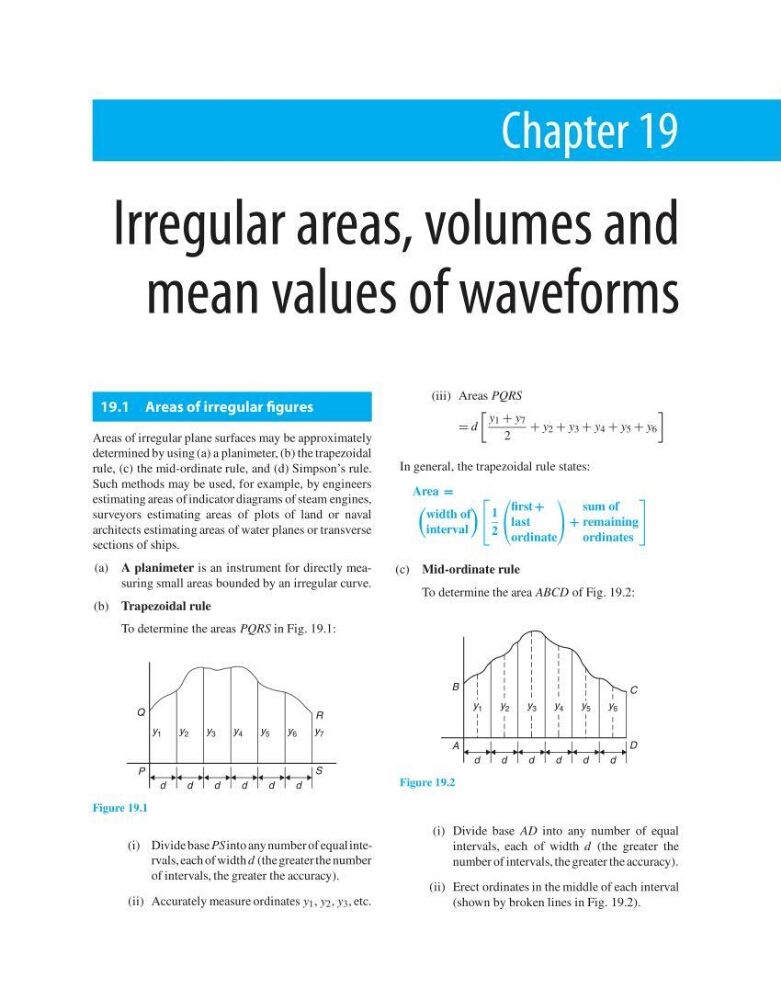
(b) Trapezoidal rule
To determine the areas PQRS in Fig. 19.1:
Q
R
S
P
d
d
d
y 1
y 2
y 3
y 4
y 5
y 6
y 7
d
d
d
Figure 19.1
(i) Divide base PSinto any number of equal intervals, each of width d (the greater the number
of intervals, the greater the accuracy).
(ii) Accurately measure ordinates y 1 , y 2 , y 3 , etc.
(iii) Areas PQRS
= d
y 1 + y 7
2
+ y 2 + y 3 + y 4 + y 5 + y 6
In general, the trapezoidal rule states:
Area =
width of
interval
⎡
⎣
1
2
⎛
⎝
first +
last
ordinate
⎞
⎠ +
sum of
remaining
ordinates
⎤
⎦
(c) Mid-ordinate rule
To determine the area ABCD of Fig. 19.2:
B
C
D
A
d
d
d
y 1
y 2
y 3
y 4
y 5
y 6
d
d
d
Figure 19.2
(i) Divide base AD into any number of equal
intervals, each of width d (the greater the
number of intervals, the greater the accuracy).
(ii) Erect ordinates in the middle of each interval
(shown by broken lines in Fig. 19.2).
Irregular areas, volumes and
mean values of waveforms
19.1 Areas of irregular figures
Areas of irregular plane surfaces may be approximately
determined by using (a) a planimeter, (b) the trapezoidal
rule, (c) the mid-ordinate rule, and (d) Simpson’s rule.
Such methods may be used, for example, by engineers
estimating areas of indicator diagrams of steam engines,
surveyors estimating areas of plots of land or naval
architects estimating areas of water planes or transverse
sections of ships.
(a) A planimeter is an instrument for directly measuring small areas bounded by an irregular curve.
(b) Trapezoidal rule
To determine the areas PQRS in Fig. 19.1:
Q
R
S
P
d
d
d
y 1
y 2
y 3
y 4
y 5
y 6
y 7
d
d
d
Figure 19.1
(i) Divide base PSinto any number of equal intervals, each of width d (the greater the number
of intervals, the greater the accuracy).
(ii) Accurately measure ordinates y 1 , y 2 , y 3 , etc.
(iii) Areas PQRS
= d
y 1 + y 7
2
+ y 2 + y 3 + y 4 + y 5 + y 6
In general, the trapezoidal rule states:
Area =
width of
interval
⎡
⎣
1
2
⎛
⎝
first +
last
ordinate
⎞
⎠ +
sum of
remaining
ordinates
⎤
⎦
(c) Mid-ordinate rule
To determine the area ABCD of Fig. 19.2:
B
C
D
A
d
d
d
y 1
y 2
y 3
y 4
y 5
y 6
d
d
d
Figure 19.2
(i) Divide base AD into any number of equal
intervals, each of width d (the greater the
number of intervals, the greater the accuracy).
(ii) Erect ordinates in the middle of each interval
(shown by broken lines in Fig. 19.2).