

198 Higher Engineering Mathematics
x
3
y
1
14
24
x
y
x
y
(a) x 5 (92y 2 )
!
(b) y
2 516x
(c) xy 5 5
Figure 18.37
Problem 15. Sketch the curves depicting the
following equations:
(a) 4x 2 = 36 −9y 2 (b) 3y 2 + 15 =5x 2
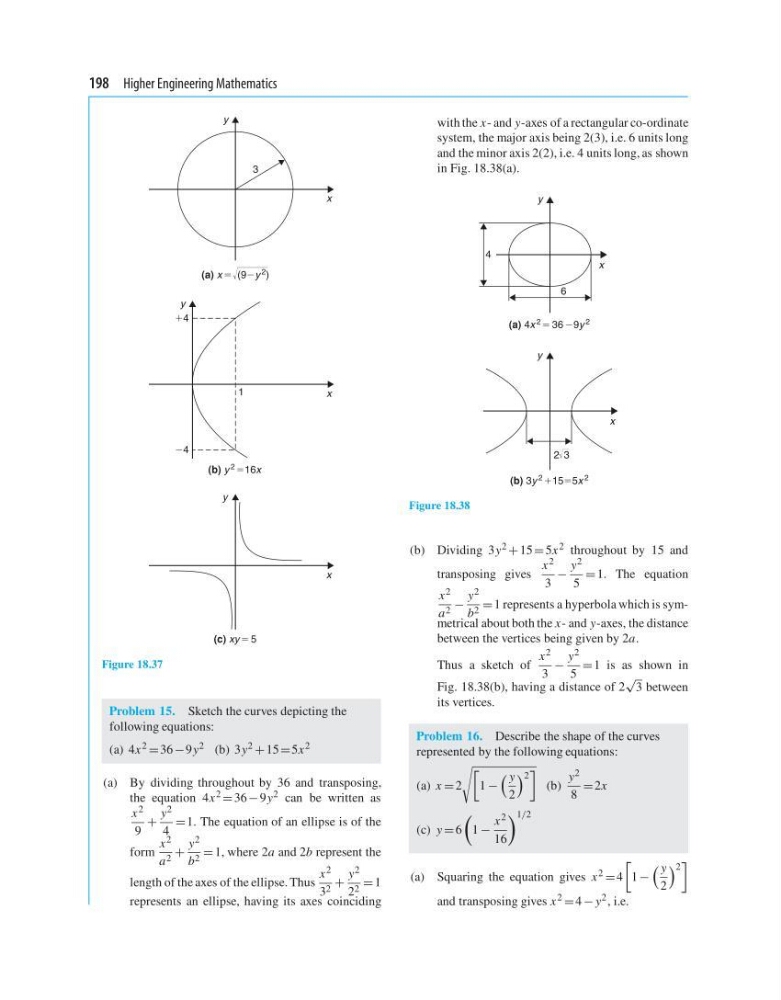
(a) By dividing throughout by 36 and transposing,
the equation 4x 2 = 36 − 9y 2 can be written as
x 2
9
+
y 2
4
= 1. The equation of an ellipse is of the
form
x 2
a 2 +
y 2
b 2 = 1, where 2a and 2b represent the
length of the axes of the ellipse. Thus
x 2
3 2 +
y 2
2 2 = 1
represents an ellipse, having its axes coinciding
with the x- and y-axes of a rectangular co-ordinate
system, the major axis being 2(3), i.e. 6 units long
and the minor axis 2(2), i.e. 4 units long, as shown
in Fig. 18.38(a).
4
6
x
y
x
y
(a) 4x
2 5 36 29y
2
(b) 3y
2 11555x
2
2 3
Œ„
Figure 18.38
(b) Dividing 3y 2 + 15 = 5x 2 throughout by 15 and
transposing gives
x 2
3
−
y 2
5
= 1. The equation
x 2
a 2 −
y 2
b 2 = 1 represents a hyperbola which is symmetrical about both the x- and y-axes, the distance
between the vertices being given by 2a.
Thus a sketch of
x 2
3
−
y 2
5
= 1 is as shown in
Fig. 18.38(b), having a distance of 2
√
3 between
its vertices.
Problem 16. Describe the shape of the curves
represented by the following equations:
(a) x = 2
1 −
y
2
2
(b)
y 2
8
= 2x
(c) y = 6
1 −
x 2
16
1/2
(a) Squaring the equation gives x 2 = 4
1 −
y
2
2
and transposing gives x 2 = 4 − y 2 , i.e.
x
3
y
1
14
24
x
y
x
y
(a) x 5 (92y 2 )
!
(b) y
2 516x
(c) xy 5 5
Figure 18.37
Problem 15. Sketch the curves depicting the
following equations:
(a) 4x 2 = 36 −9y 2 (b) 3y 2 + 15 =5x 2
(a) By dividing throughout by 36 and transposing,
the equation 4x 2 = 36 − 9y 2 can be written as
x 2
9
+
y 2
4
= 1. The equation of an ellipse is of the
form
x 2
a 2 +
y 2
b 2 = 1, where 2a and 2b represent the
length of the axes of the ellipse. Thus
x 2
3 2 +
y 2
2 2 = 1
represents an ellipse, having its axes coinciding
with the x- and y-axes of a rectangular co-ordinate
system, the major axis being 2(3), i.e. 6 units long
and the minor axis 2(2), i.e. 4 units long, as shown
in Fig. 18.38(a).
4
6
x
y
x
y
(a) 4x
2 5 36 29y
2
(b) 3y
2 11555x
2
2 3
Œ„
Figure 18.38
(b) Dividing 3y 2 + 15 = 5x 2 throughout by 15 and
transposing gives
x 2
3
−
y 2
5
= 1. The equation
x 2
a 2 −
y 2
b 2 = 1 represents a hyperbola which is symmetrical about both the x- and y-axes, the distance
between the vertices being given by 2a.
Thus a sketch of
x 2
3
−
y 2
5
= 1 is as shown in
Fig. 18.38(b), having a distance of 2
√
3 between
its vertices.
Problem 16. Describe the shape of the curves
represented by the following equations:
(a) x = 2
1 −
y
2
2
(b)
y 2
8
= 2x
(c) y = 6
1 −
x 2
16
1/2
(a) Squaring the equation gives x 2 = 4
1 −
y
2
2
and transposing gives x 2 = 4 − y 2 , i.e.