

196 Higher Engineering Mathematics
22
22
24
24
26
2
2
4
6
0
4
x
y
y 5
x
2 11
x
y 5
x
2 11
x
y
5
x
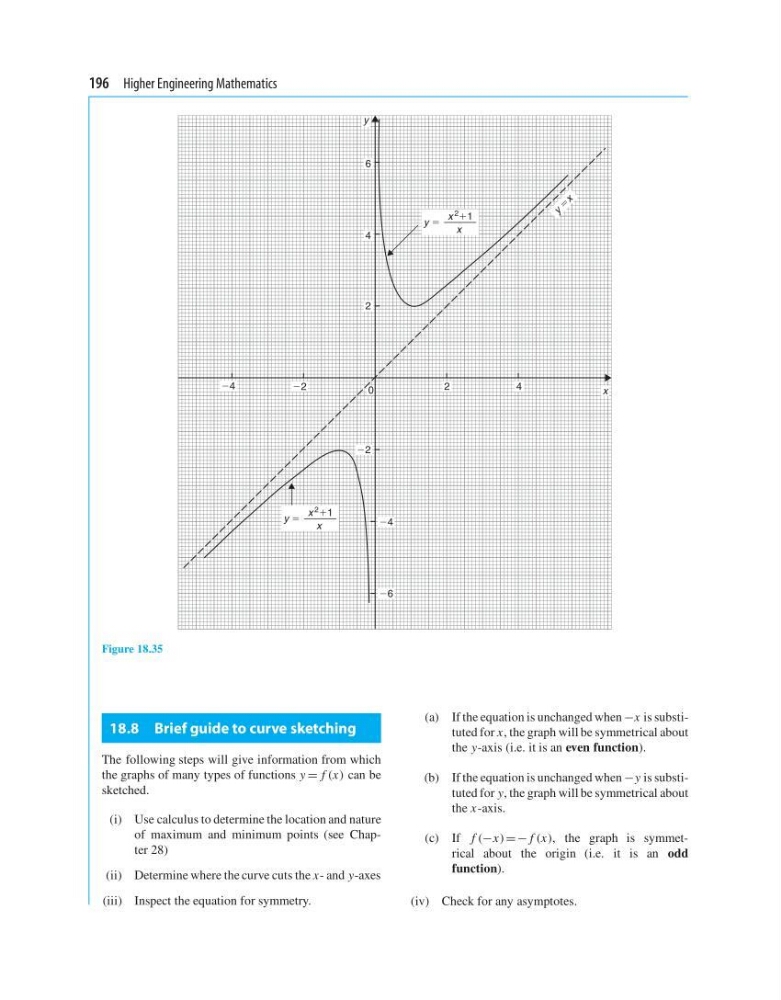
Figure 18.35
18.8 Brief guide to curve sketching
The following steps will give information from which
the graphs of many types of functions y = f (x) can be
sketched.
(i) Use calculus to determine the location and nature
of maximum and minimum points (see Chapter 28)
(ii) Determine where the curve cuts the x- and y-axes
(iii) Inspect the equation for symmetry.
(a) If the equation is unchanged when −x is substituted for x, the graph will be symmetrical about
the y-axis (i.e. it is an even function).
(b) If the equation is unchanged when −y is substituted for y, the graph will be symmetrical about
the x-axis.
(c) If f (−x) = − f (x), the graph is symmetrical about the origin (i.e. it is an odd
function).
(iv) Check for any asymptotes.
22
22
24
24
26
2
2
4
6
0
4
x
y
y 5
x
2 11
x
y 5
x
2 11
x
y
5
x
Figure 18.35
18.8 Brief guide to curve sketching
The following steps will give information from which
the graphs of many types of functions y = f (x) can be
sketched.
(i) Use calculus to determine the location and nature
of maximum and minimum points (see Chapter 28)
(ii) Determine where the curve cuts the x- and y-axes
(iii) Inspect the equation for symmetry.
(a) If the equation is unchanged when −x is substituted for x, the graph will be symmetrical about
the y-axis (i.e. it is an even function).
(b) If the equation is unchanged when −y is substituted for y, the graph will be symmetrical about
the x-axis.
(c) If f (−x) = − f (x), the graph is symmetrical about the origin (i.e. it is an odd
function).
(iv) Check for any asymptotes.