

Compound angles 175
2
0
t (seconds)
v
p
i
p
i
v
1
2
Figure 17.10
p
i
v
v
p
i
0
1
2
2
t (seconds)
Figure 17.11
Substituting ωt = A and (ωt + φ) = B gives:
power, p = V m I m {−
1
2 [cos(ωt + ωt + φ)
− cos(ωt − (ωt + φ))]}
i.e.
p =
1
2 V m I m [cos(−φ) − cos(2ωt + φ)]
However, cos(−φ) = cos φ
Thus p =
1
2 V m I m [cos φ − cos(2ω t + φ)]
The instantaneous power p thus consists of
(i) a sinusoidal term, −
1
2 V m I m cos(2ωt + φ) which
has a mean value over a cycle of zero, and
(ii) a constant term,
1
2 V m I m cos φ (since φ is constant
for a particular circuit).
Thus the average value of power, P =
1
2 V m I m cos φ.
Since V m =
√
2 V and I m =
√
2 I , average power,
P =
1
2 (
√
2 V )(
√
2 I ) cos φ
i.e.
P = V I cos φ
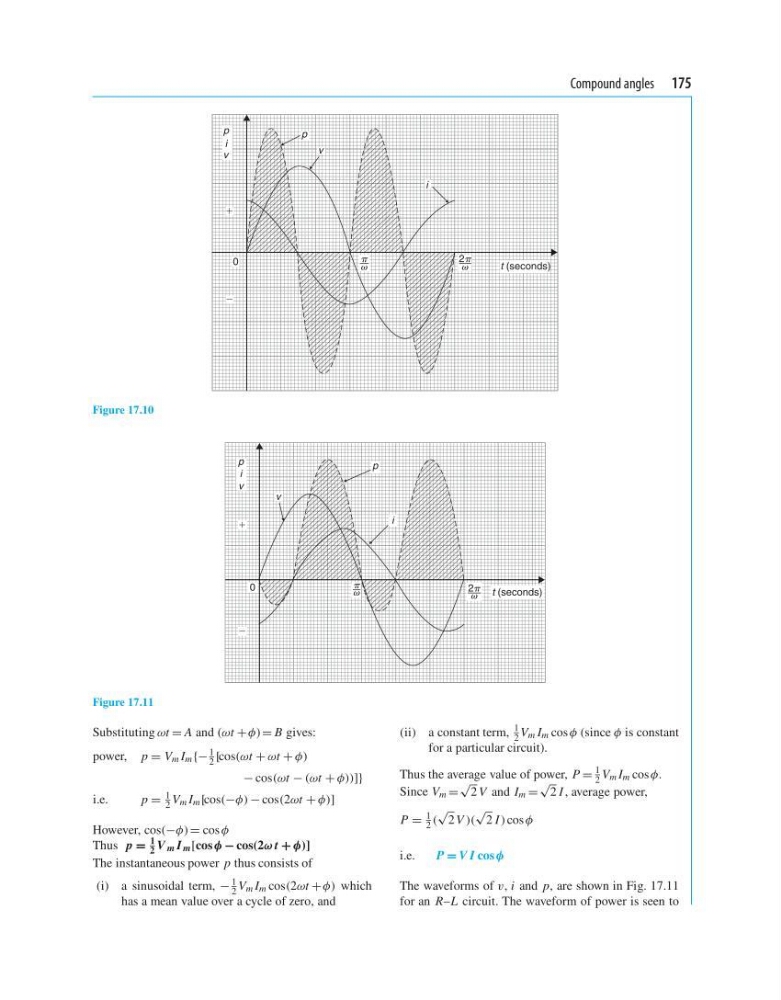
The waveforms of v, i and p, are shown in Fig. 17.11
for an R–L circuit. The waveform of power is seen to
2
0
t (seconds)
v
p
i
p
i
v
1
2
Figure 17.10
p
i
v
v
p
i
0
1
2
2
t (seconds)
Figure 17.11
Substituting ωt = A and (ωt + φ) = B gives:
power, p = V m I m {−
1
2 [cos(ωt + ωt + φ)
− cos(ωt − (ωt + φ))]}
i.e.
p =
1
2 V m I m [cos(−φ) − cos(2ωt + φ)]
However, cos(−φ) = cos φ
Thus p =
1
2 V m I m [cos φ − cos(2ω t + φ)]
The instantaneous power p thus consists of
(i) a sinusoidal term, −
1
2 V m I m cos(2ωt + φ) which
has a mean value over a cycle of zero, and
(ii) a constant term,
1
2 V m I m cos φ (since φ is constant
for a particular circuit).
Thus the average value of power, P =
1
2 V m I m cos φ.
Since V m =
√
2 V and I m =
√
2 I , average power,
P =
1
2 (
√
2 V )(
√
2 I ) cos φ
i.e.
P = V I cos φ
The waveforms of v, i and p, are shown in Fig. 17.11
for an R–L circuit. The waveform of power is seen to