

Revision Test 4
This Revision Test covers the material contained in Chapters 11 to 13. The marks for each question are shown in
brackets at the end of each question.
1. A 2.0 m long ladder is placed against a perpendicular pylon with its foot 52 cm from the pylon.
(a) Find how far up the pylon (correct to the nearest mm) the ladder reaches. (b) If the foot of the
ladder is moved 10 cm towards the pylon how far
does the top of the ladder rise?
(7)
2. Evaluate correct to 4 significant figures:
(a) cos 124
◦ 13
(b) cot 72.68
◦
(4)
3. From a point on horizontal ground a surveyor
measures the angle of elevation of a church spire
as 15 ◦ . He moves 30 m nearer to the church and
measures the angle of elevation as 20 ◦ . Calculate
the height of the spire.
(9)
4. If secant θ = 2.4613 determine the acute
angle θ
(4)
5. Evaluate, correct to 3 significant figures:
3.5 cosec 31 ◦ 17 − cot(−12 ◦ )
3 sec79 ◦ 41
(5)
6. A man leaves a point walking at 6.5 km/h in
a direction E 20 ◦ N (i.e. a bearing of 70 ◦ ). A
cyclist leaves the same point at the same time in a
direction E 40 ◦ S (i.e. a bearing of 130 ◦ ) travelling
at a constant speed. Find the average speed of the
cyclist if the walker and cyclist are 80 km apart
after 5 hours.
(8)
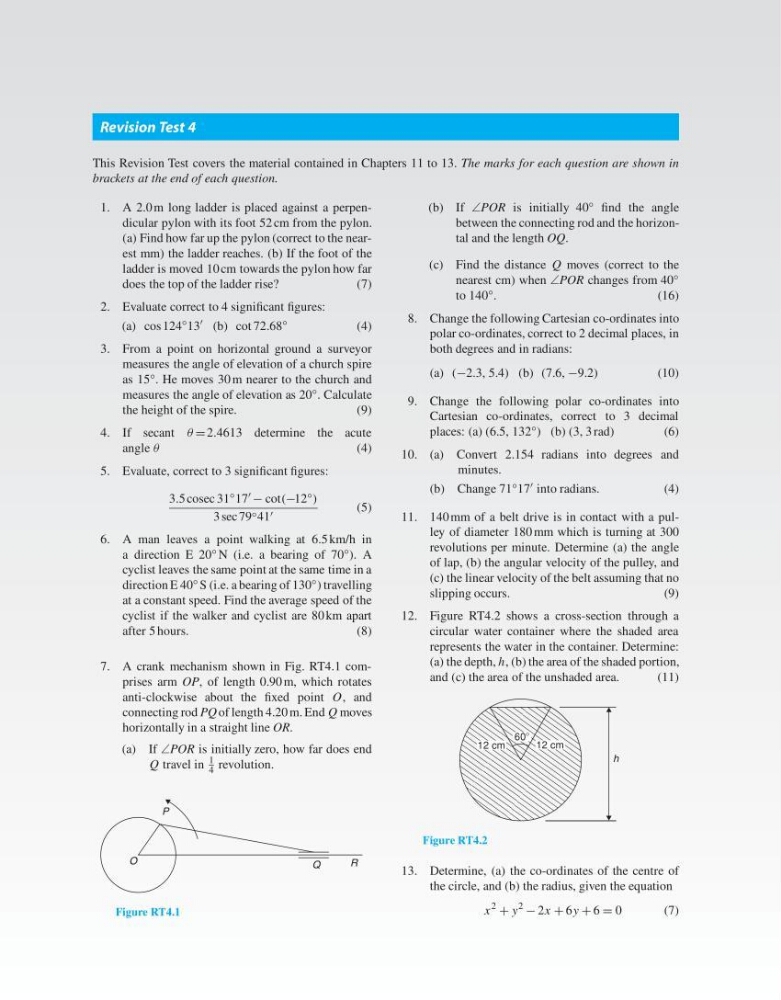
7. A crank mechanism shown in Fig. RT4.1 comprises arm OP, of length 0.90 m, which rotates
anti-clockwise about the fixed point O, and
connecting rod PQ of length 4.20 m. End Q moves
horizontally in a straight line OR.
(a) If ∠POR is initially zero, how far does end
Q travel in
1
4 revolution.
O
Q
P
R
Figure RT4.1
(b) If ∠POR is initially 40 ◦ find the angle
between the connecting rod and the horizontal and the length OQ.
(c) Find the distance Q moves (correct to the
nearest cm) when ∠POR changes from 40 ◦
to 140 ◦ .
(16)
8. Change the following Cartesian co-ordinates into
polar co-ordinates, correct to 2 decimal places, in
both degrees and in radians:
(a) (−2.3, 5.4) (b) (7.6, −9.2)
(10)
9. Change the following polar co-ordinates into
Cartesian co-ordinates, correct to 3 decimal
places: (a) (6.5, 132 ◦ ) (b) (3, 3 rad)
(6)
10. (a) Convert 2.154 radians into degrees and
minutes.
(b) Change 71 ◦ 17 into radians.
(4)
11. 140 mm of a belt drive is in contact with a pulley of diameter 180 mm which is turning at 300
revolutions per minute. Determine (a) the angle
of lap, (b) the angular velocity of the pulley, and
(c) the linear velocity of the belt assuming that no
slipping occurs.
(9)
12. Figure RT4.2 shows a cross-section through a
circular water container where the shaded area
represents the water in the container. Determine:
(a) the depth, h, (b) the area of the shaded portion,
and (c) the area of the unshaded area.
(11)
h
12 cm
608
12 cm
Figure RT4.2
13. Determine, (a) the co-ordinates of the centre of
the circle, and (b) the radius, given the equation
x
2
+ y
2
− 2x + 6y + 6 = 0
( 7 )
This Revision Test covers the material contained in Chapters 11 to 13. The marks for each question are shown in
brackets at the end of each question.
1. A 2.0 m long ladder is placed against a perpendicular pylon with its foot 52 cm from the pylon.
(a) Find how far up the pylon (correct to the nearest mm) the ladder reaches. (b) If the foot of the
ladder is moved 10 cm towards the pylon how far
does the top of the ladder rise?
(7)
2. Evaluate correct to 4 significant figures:
(a) cos 124
◦ 13
(b) cot 72.68
◦
(4)
3. From a point on horizontal ground a surveyor
measures the angle of elevation of a church spire
as 15 ◦ . He moves 30 m nearer to the church and
measures the angle of elevation as 20 ◦ . Calculate
the height of the spire.
(9)
4. If secant θ = 2.4613 determine the acute
angle θ
(4)
5. Evaluate, correct to 3 significant figures:
3.5 cosec 31 ◦ 17 − cot(−12 ◦ )
3 sec79 ◦ 41
(5)
6. A man leaves a point walking at 6.5 km/h in
a direction E 20 ◦ N (i.e. a bearing of 70 ◦ ). A
cyclist leaves the same point at the same time in a
direction E 40 ◦ S (i.e. a bearing of 130 ◦ ) travelling
at a constant speed. Find the average speed of the
cyclist if the walker and cyclist are 80 km apart
after 5 hours.
(8)
7. A crank mechanism shown in Fig. RT4.1 comprises arm OP, of length 0.90 m, which rotates
anti-clockwise about the fixed point O, and
connecting rod PQ of length 4.20 m. End Q moves
horizontally in a straight line OR.
(a) If ∠POR is initially zero, how far does end
Q travel in
1
4 revolution.
O
Q
P
R
Figure RT4.1
(b) If ∠POR is initially 40 ◦ find the angle
between the connecting rod and the horizontal and the length OQ.
(c) Find the distance Q moves (correct to the
nearest cm) when ∠POR changes from 40 ◦
to 140 ◦ .
(16)
8. Change the following Cartesian co-ordinates into
polar co-ordinates, correct to 2 decimal places, in
both degrees and in radians:
(a) (−2.3, 5.4) (b) (7.6, −9.2)
(10)
9. Change the following polar co-ordinates into
Cartesian co-ordinates, correct to 3 decimal
places: (a) (6.5, 132 ◦ ) (b) (3, 3 rad)
(6)
10. (a) Convert 2.154 radians into degrees and
minutes.
(b) Change 71 ◦ 17 into radians.
(4)
11. 140 mm of a belt drive is in contact with a pulley of diameter 180 mm which is turning at 300
revolutions per minute. Determine (a) the angle
of lap, (b) the angular velocity of the pulley, and
(c) the linear velocity of the belt assuming that no
slipping occurs.
(9)
12. Figure RT4.2 shows a cross-section through a
circular water container where the shaded area
represents the water in the container. Determine:
(a) the depth, h, (b) the area of the shaded portion,
and (c) the area of the unshaded area.
(11)
h
12 cm
608
12 cm
Figure RT4.2
13. Determine, (a) the co-ordinates of the centre of
the circle, and (b) the radius, given the equation
x
2
+ y
2
− 2x + 6y + 6 = 0
( 7 )