

112 Higher Engineering Mathematics
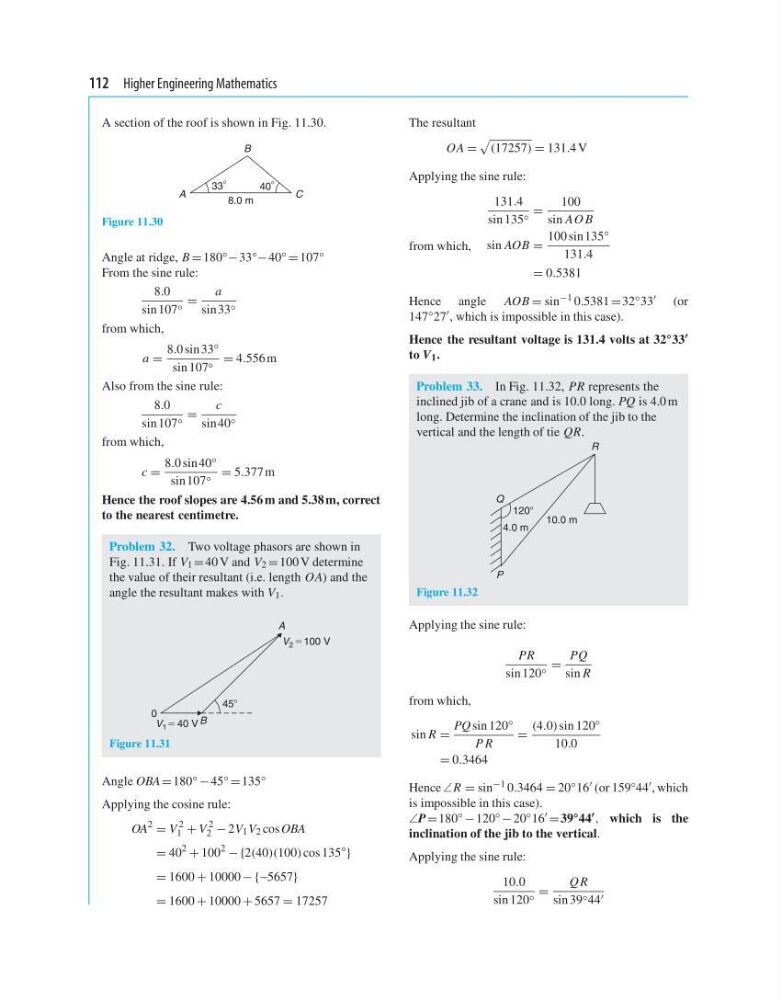
A section of the roof is shown in Fig. 11.30.
B
A
C
8.0 m
33 8
40 8
Figure 11.30
Angle at ridge, B = 180 ◦ − 33 ◦ − 40 ◦ = 107 ◦
From the sine rule:
8.0
sin 107 ◦ =
a
sin 33 ◦
from which,
a =
8.0 sin33 ◦
sin 107 ◦ = 4.556 m
Also from the sine rule:
8.0
sin 107 ◦ =
c
sin 40 ◦
from which,
c =
8.0 sin40 ◦
sin 107 ◦ = 5.377 m
Hence the roof slopes are 4.56 m and 5.38 m, correct
to the nearest centimetre.
Problem 32. Two voltage phasors are shown in
Fig. 11.31. If V 1 = 40 V and V 2 = 100 V determine
the value of their resultant (i.e. length OA) and the
angle the resultant makes with V 1 .
45Њ
0
B
A
V 1 ϭ 40 V
V 2 ϭ100 V
Figure 11.31
Angle OBA = 180 ◦ − 45 ◦ = 135 ◦
Applying the cosine rule:
OA
2
= V
2
1 + V
2
2 − 2V 1 V 2 cos OBA
= 40
2
+ 100
2
− {2(40)(100) cos 135
◦
}
= 1600 + 10000 − {−5657}
= 1600 + 10000 + 5657 = 17257
The resultant
OA =
(17257) = 131.4 V
Applying the sine rule:
131.4
sin 135 ◦ =
100
sin AO B
from which, sin AOB =
100 sin 135 ◦
131.4
= 0.5381
Hence angle AOB = sin −1 0.5381 =32 ◦ 33 (or
147 ◦ 27 , which is impossible in this case).
Hence the resultant voltage is 131.4 volts at 32 ◦ 33
to V 1 .
Problem 33. In Fig. 11.32, PR represents the
inclined jib of a crane and is 10.0 long. PQ is 4.0 m
long. Determine the inclination of the jib to the
vertical and the length of tie QR.
120Њ
4.0 m
10.0 m
R
Q
P
Figure 11.32
Applying the sine rule:
PR
sin 120 ◦ =
PQ
sin R
from which,
sin R =
PQ sin 120 ◦
P R
=
(4.0) sin 120 ◦
10.0
= 0.3464
Hence ∠R = sin −1 0.3464 = 20 ◦ 16 (or 159 ◦ 44 , which
is impossible in this case).
∠P = 180 ◦ − 120 ◦ − 20 ◦ 16 = 39 ◦ 44 , which is the
inclination of the jib to the vertical.
Applying the sine rule:
10.0
sin 120 ◦ =
Q R
sin 39 ◦ 44
A section of the roof is shown in Fig. 11.30.
B
A
C
8.0 m
33 8
40 8
Figure 11.30
Angle at ridge, B = 180 ◦ − 33 ◦ − 40 ◦ = 107 ◦
From the sine rule:
8.0
sin 107 ◦ =
a
sin 33 ◦
from which,
a =
8.0 sin33 ◦
sin 107 ◦ = 4.556 m
Also from the sine rule:
8.0
sin 107 ◦ =
c
sin 40 ◦
from which,
c =
8.0 sin40 ◦
sin 107 ◦ = 5.377 m
Hence the roof slopes are 4.56 m and 5.38 m, correct
to the nearest centimetre.
Problem 32. Two voltage phasors are shown in
Fig. 11.31. If V 1 = 40 V and V 2 = 100 V determine
the value of their resultant (i.e. length OA) and the
angle the resultant makes with V 1 .
45Њ
0
B
A
V 1 ϭ 40 V
V 2 ϭ100 V
Figure 11.31
Angle OBA = 180 ◦ − 45 ◦ = 135 ◦
Applying the cosine rule:
OA
2
= V
2
1 + V
2
2 − 2V 1 V 2 cos OBA
= 40
2
+ 100
2
− {2(40)(100) cos 135
◦
}
= 1600 + 10000 − {−5657}
= 1600 + 10000 + 5657 = 17257
The resultant
OA =
(17257) = 131.4 V
Applying the sine rule:
131.4
sin 135 ◦ =
100
sin AO B
from which, sin AOB =
100 sin 135 ◦
131.4
= 0.5381
Hence angle AOB = sin −1 0.5381 =32 ◦ 33 (or
147 ◦ 27 , which is impossible in this case).
Hence the resultant voltage is 131.4 volts at 32 ◦ 33
to V 1 .
Problem 33. In Fig. 11.32, PR represents the
inclined jib of a crane and is 10.0 long. PQ is 4.0 m
long. Determine the inclination of the jib to the
vertical and the length of tie QR.
120Њ
4.0 m
10.0 m
R
Q
P
Figure 11.32
Applying the sine rule:
PR
sin 120 ◦ =
PQ
sin R
from which,
sin R =
PQ sin 120 ◦
P R
=
(4.0) sin 120 ◦
10.0
= 0.3464
Hence ∠R = sin −1 0.3464 = 20 ◦ 16 (or 159 ◦ 44 , which
is impossible in this case).
∠P = 180 ◦ − 120 ◦ − 20 ◦ 16 = 39 ◦ 44 , which is the
inclination of the jib to the vertical.
Applying the sine rule:
10.0
sin 120 ◦ =
Q R
sin 39 ◦ 44