

Introduction to trigonometry 111
F = 136
◦ 56
is not possible in this case since
136 ◦ 56 + 64 ◦ is greater than 180 ◦ . Thus only
F = 43 ◦ 4 is valid
∠D = 180
◦
− 64
◦
− 43
◦ 4
= 72
◦ 56
Area of triangle DE F =
1
2 d f sin E
=
1
2 (35.0)(25.0) sin 64 ◦ = 393.2 mm 2 .
Problem 30. A triangle ABC has sides a =
9.0 cm, b = 7.5 cm and c = 6.5 cm. Determine its
three angles and its area.
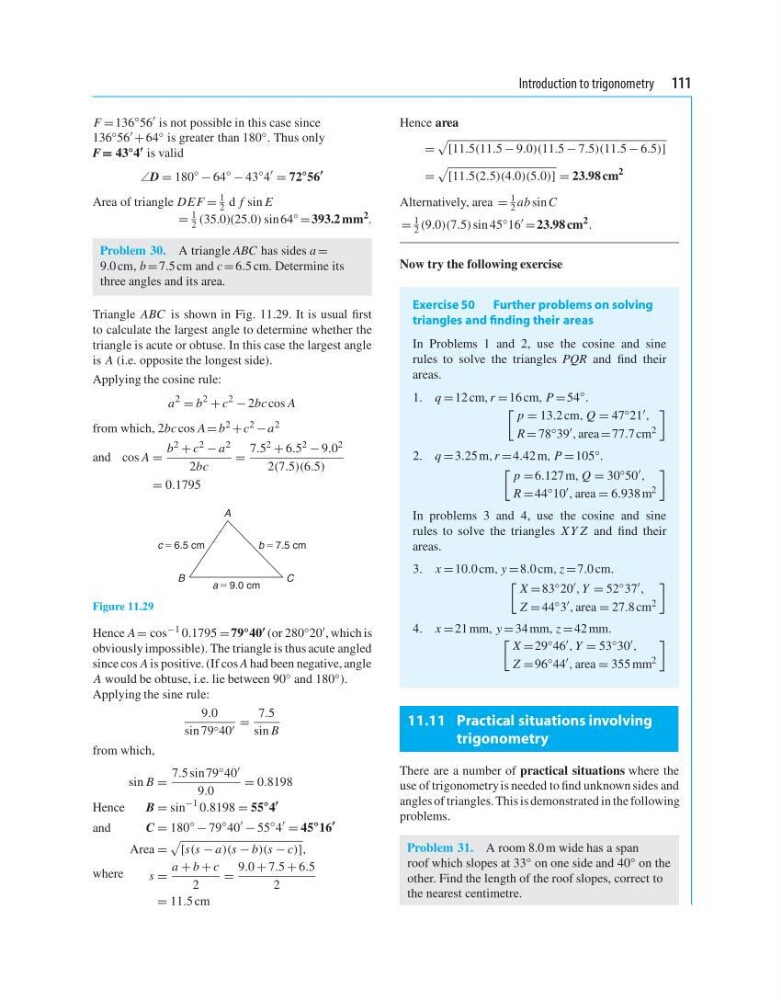
Triangle ABC is shown in Fig. 11.29. It is usual first
to calculate the largest angle to determine whether the
triangle is acute or obtuse. In this case the largest angle
is A (i.e. opposite the longest side).
Applying the cosine rule:
a
2
= b
2
+ c
2
− 2bc cos A
from which, 2bc cos A = b 2 + c 2 − a 2
and cos A =
b 2 + c 2 − a 2
2bc
=
7.5 2 + 6.5 2 − 9.0 2
2(7.5)(6.5)
= 0.1795
A
B
C
a 5 9.0 cm
c 5 6.5 cm
b 5 7.5 cm
Figure 11.29
Hence A = cos −1 0.1795 = 79 ◦ 40 (or 280 ◦ 20 , which is
obviously impossible). The triangle is thus acute angled
since cos A is positive. (If cos A had been negative, angle
A would be obtuse, i.e. lie between 90 ◦ and 180 ◦ ).
Applying the sine rule:
9.0
sin 79 ◦ 40 =
7.5
sin B
from which,
sin B =
7.5 sin79 ◦ 40
9.0
= 0.8198
Hence
B = sin
−1 0.8198 = 55
◦ 4
and
C = 180
◦
− 79
◦ 40
− 55
◦ 4
= 45
◦ 16
Area =
[s(s − a)(s − b)(s − c)],
where
s =
a + b + c
2
=
9.0 + 7.5 + 6.5
2
= 11.5 cm
Hence area
=
[11.5(11.5 − 9.0)(11.5 − 7.5)(11.5 − 6.5)]
=
[11.5(2.5)(4.0)(5.0)] = 23.98 cm
2
Alternatively, area =
1
2 ab sin C
=
1
2 (9.0)(7.5) sin 45 ◦ 16 = 23.98 cm
2 .
Now try the following exercise
Exercise 50 Further problems on solving
triangles and finding their areas
In Problems 1 and 2, use the cosine and sine
rules to solve the triangles PQR and find their
areas.
1. q = 12 cm, r = 16 cm, P = 54
◦ .
p = 13.2 cm, Q = 47 ◦ 21 ,
R = 78 ◦ 39 , area = 77.7 cm 2
2. q = 3.25 m, r = 4.42 m, P = 105 ◦ .
p = 6.127 m, Q = 30 ◦ 50 ,
R = 44 ◦ 10 , area = 6.938 m 2
In problems 3 and 4, use the cosine and sine
rules to solve the triangles X Y Z and find their
areas.
3. x = 10.0 cm, y = 8.0 cm, z =7.0 cm.
X = 83 ◦ 20 , Y = 52 ◦ 37 ,
Z = 44 ◦ 3 , area = 27.8 cm 2
4. x = 21 mm, y = 34 mm, z = 42 mm.
X = 29 ◦ 46 , Y = 53 ◦ 30 ,
Z = 96 ◦ 44 , area = 355 mm 2
11.11 Practical situations involving
trigonometry
There are a number of practical situations where the
use of trigonometry is needed to find unknown sides and
angles of triangles. This is demonstrated in the following
problems.
Problem 31. A room 8.0 m wide has a span
roof which slopes at 33 ◦ on one side and 40 ◦ on the
other. Find the length of the roof slopes, correct to
the nearest centimetre.
F = 136
◦ 56
is not possible in this case since
136 ◦ 56 + 64 ◦ is greater than 180 ◦ . Thus only
F = 43 ◦ 4 is valid
∠D = 180
◦
− 64
◦
− 43
◦ 4
= 72
◦ 56
Area of triangle DE F =
1
2 d f sin E
=
1
2 (35.0)(25.0) sin 64 ◦ = 393.2 mm 2 .
Problem 30. A triangle ABC has sides a =
9.0 cm, b = 7.5 cm and c = 6.5 cm. Determine its
three angles and its area.
Triangle ABC is shown in Fig. 11.29. It is usual first
to calculate the largest angle to determine whether the
triangle is acute or obtuse. In this case the largest angle
is A (i.e. opposite the longest side).
Applying the cosine rule:
a
2
= b
2
+ c
2
− 2bc cos A
from which, 2bc cos A = b 2 + c 2 − a 2
and cos A =
b 2 + c 2 − a 2
2bc
=
7.5 2 + 6.5 2 − 9.0 2
2(7.5)(6.5)
= 0.1795
A
B
C
a 5 9.0 cm
c 5 6.5 cm
b 5 7.5 cm
Figure 11.29
Hence A = cos −1 0.1795 = 79 ◦ 40 (or 280 ◦ 20 , which is
obviously impossible). The triangle is thus acute angled
since cos A is positive. (If cos A had been negative, angle
A would be obtuse, i.e. lie between 90 ◦ and 180 ◦ ).
Applying the sine rule:
9.0
sin 79 ◦ 40 =
7.5
sin B
from which,
sin B =
7.5 sin79 ◦ 40
9.0
= 0.8198
Hence
B = sin
−1 0.8198 = 55
◦ 4
and
C = 180
◦
− 79
◦ 40
− 55
◦ 4
= 45
◦ 16
Area =
[s(s − a)(s − b)(s − c)],
where
s =
a + b + c
2
=
9.0 + 7.5 + 6.5
2
= 11.5 cm
Hence area
=
[11.5(11.5 − 9.0)(11.5 − 7.5)(11.5 − 6.5)]
=
[11.5(2.5)(4.0)(5.0)] = 23.98 cm
2
Alternatively, area =
1
2 ab sin C
=
1
2 (9.0)(7.5) sin 45 ◦ 16 = 23.98 cm
2 .
Now try the following exercise
Exercise 50 Further problems on solving
triangles and finding their areas
In Problems 1 and 2, use the cosine and sine
rules to solve the triangles PQR and find their
areas.
1. q = 12 cm, r = 16 cm, P = 54
◦ .
p = 13.2 cm, Q = 47 ◦ 21 ,
R = 78 ◦ 39 , area = 77.7 cm 2
2. q = 3.25 m, r = 4.42 m, P = 105 ◦ .
p = 6.127 m, Q = 30 ◦ 50 ,
R = 44 ◦ 10 , area = 6.938 m 2
In problems 3 and 4, use the cosine and sine
rules to solve the triangles X Y Z and find their
areas.
3. x = 10.0 cm, y = 8.0 cm, z =7.0 cm.
X = 83 ◦ 20 , Y = 52 ◦ 37 ,
Z = 44 ◦ 3 , area = 27.8 cm 2
4. x = 21 mm, y = 34 mm, z = 42 mm.
X = 29 ◦ 46 , Y = 53 ◦ 30 ,
Z = 96 ◦ 44 , area = 355 mm 2
11.11 Practical situations involving
trigonometry
There are a number of practical situations where the
use of trigonometry is needed to find unknown sides and
angles of triangles. This is demonstrated in the following
problems.
Problem 31. A room 8.0 m wide has a span
roof which slopes at 33 ◦ on one side and 40 ◦ on the
other. Find the length of the roof slopes, correct to
the nearest centimetre.