

106 Higher Engineering Mathematics
Area of triangle XYZ
=
1
2 (base) (perpendicular height)
=
1
2 (X Y )(X Z) =
1
2 (18.37)(7.906)
= 72.62 mm
2
Now try the following exercise
Exercise 47 Further problems on the
solution of right-angled triangles
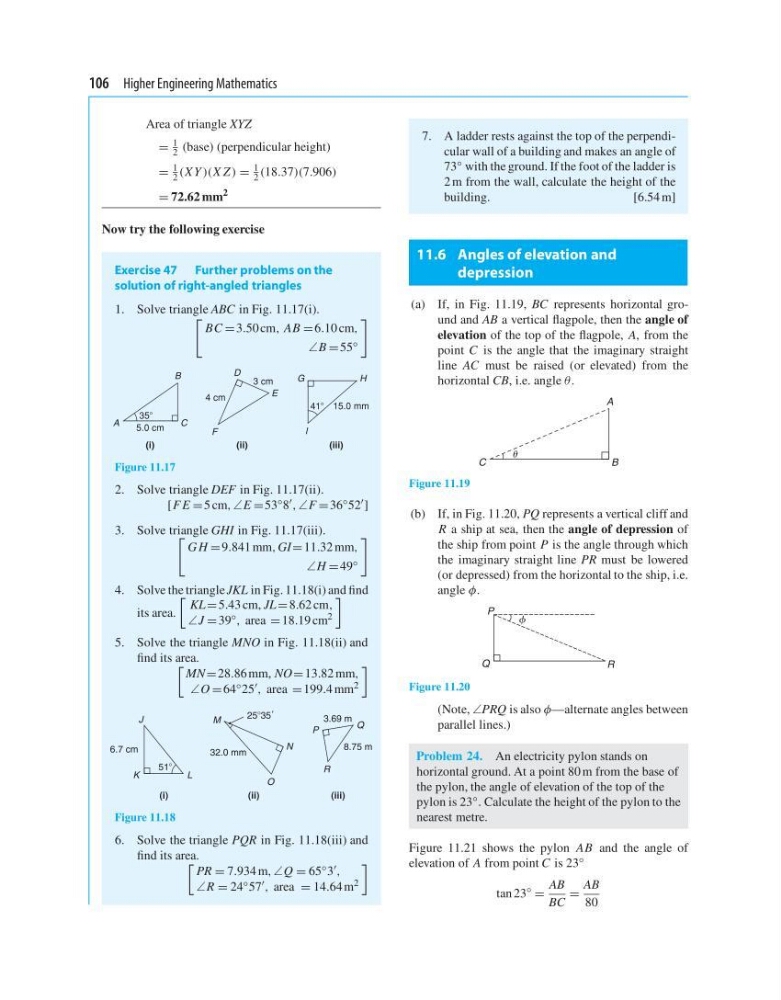
1. Solve triangle ABC in Fig. 11.17(i).
BC = 3.50 cm, AB = 6.10 cm,
∠B = 55 ◦
(i)
B
A
C
5.0 cm
358
(iii)
418
G
l
H
15.0 mm
(ii)
F
E
D
3 cm
4 cm
Figure 11.17
2. Solve triangle DEF in Fig. 11.17(ii).
[F E = 5 cm, ∠E =53 ◦ 8 , ∠F = 36 ◦ 52 ]
3. Solve triangle GHI in Fig. 11.17(iii).
G H = 9.841 mm, GI = 11.32 mm,
∠H = 49 ◦
4. Solve the triangle JKL in Fig. 11.18(i) and find
its area.
KL = 5.43 cm, JL = 8.62 cm,
∠J = 39
◦
, area = 18.19 cm
2
5. Solve the triangle MNO in Fig. 11.18(ii) and
find its area.
MN = 28.86 mm, NO= 13.82 mm,
∠O = 64 ◦ 25 , area = 199.4 mm 2
(i)
518
J
K
L
6.7 cm
(ii)
M
N
O
32.0 mm
258359
(iii)
P
8.75 m
3.69 m Q
R
Figure 11.18
6. Solve the triangle PQR in Fig. 11.18(iii) and
find its area.
PR = 7.934 m, ∠Q = 65 ◦ 3 ,
∠R = 24 ◦ 57 , area = 14.64 m 2
7. A ladder rests against the top of the perpendicular wall of a building and makes an angle of
73 ◦ with the ground. If the foot of the ladder is
2 m from the wall, calculate the height of the
building.
[6.54 m]
11.6 Angles of elevation and
depression
(a) If, in Fig. 11.19, BC represents horizontal ground and AB a vertical flagpole, then the angle of
elevation of the top of the flagpole, A, from the
point C is the angle that the imaginary straight
line AC must be raised (or elevated) from the
horizontal CB, i.e. angle θ.
A
B
C
Figure 11.19
(b) If, in Fig. 11.20, PQ represents a vertical cliff and
R a ship at sea, then the angle of depression of
the ship from point P is the angle through which
the imaginary straight line PR must be lowered
(or depressed) from the horizontal to the ship, i.e.
angle φ.
P
Q
R
Figure 11.20
(Note, ∠PRQ is also φ—alternate angles between
parallel lines.)
Problem 24. An electricity pylon stands on
horizontal ground. At a point 80 m from the base of
the pylon, the angle of elevation of the top of the
pylon is 23 ◦ . Calculate the height of the pylon to the
nearest metre.
Figure 11.21 shows the pylon AB and the angle of
elevation of A from point C is 23 ◦
tan 23
◦
=
AB
BC
=
AB
80
Area of triangle XYZ
=
1
2 (base) (perpendicular height)
=
1
2 (X Y )(X Z) =
1
2 (18.37)(7.906)
= 72.62 mm
2
Now try the following exercise
Exercise 47 Further problems on the
solution of right-angled triangles
1. Solve triangle ABC in Fig. 11.17(i).
BC = 3.50 cm, AB = 6.10 cm,
∠B = 55 ◦
(i)
B
A
C
5.0 cm
358
(iii)
418
G
l
H
15.0 mm
(ii)
F
E
D
3 cm
4 cm
Figure 11.17
2. Solve triangle DEF in Fig. 11.17(ii).
[F E = 5 cm, ∠E =53 ◦ 8 , ∠F = 36 ◦ 52 ]
3. Solve triangle GHI in Fig. 11.17(iii).
G H = 9.841 mm, GI = 11.32 mm,
∠H = 49 ◦
4. Solve the triangle JKL in Fig. 11.18(i) and find
its area.
KL = 5.43 cm, JL = 8.62 cm,
∠J = 39
◦
, area = 18.19 cm
2
5. Solve the triangle MNO in Fig. 11.18(ii) and
find its area.
MN = 28.86 mm, NO= 13.82 mm,
∠O = 64 ◦ 25 , area = 199.4 mm 2
(i)
518
J
K
L
6.7 cm
(ii)
M
N
O
32.0 mm
258359
(iii)
P
8.75 m
3.69 m Q
R
Figure 11.18
6. Solve the triangle PQR in Fig. 11.18(iii) and
find its area.
PR = 7.934 m, ∠Q = 65 ◦ 3 ,
∠R = 24 ◦ 57 , area = 14.64 m 2
7. A ladder rests against the top of the perpendicular wall of a building and makes an angle of
73 ◦ with the ground. If the foot of the ladder is
2 m from the wall, calculate the height of the
building.
[6.54 m]
11.6 Angles of elevation and
depression
(a) If, in Fig. 11.19, BC represents horizontal ground and AB a vertical flagpole, then the angle of
elevation of the top of the flagpole, A, from the
point C is the angle that the imaginary straight
line AC must be raised (or elevated) from the
horizontal CB, i.e. angle θ.
A
B
C
Figure 11.19
(b) If, in Fig. 11.20, PQ represents a vertical cliff and
R a ship at sea, then the angle of depression of
the ship from point P is the angle through which
the imaginary straight line PR must be lowered
(or depressed) from the horizontal to the ship, i.e.
angle φ.
P
Q
R
Figure 11.20
(Note, ∠PRQ is also φ—alternate angles between
parallel lines.)
Problem 24. An electricity pylon stands on
horizontal ground. At a point 80 m from the base of
the pylon, the angle of elevation of the top of the
pylon is 23 ◦ . Calculate the height of the pylon to the
nearest metre.
Figure 11.21 shows the pylon AB and the angle of
elevation of A from point C is 23 ◦
tan 23
◦
=
AB
BC
=
AB
80