

Introduction to trigonometry 105
27. Evaluate correct to 5 significant figures:
(a) cosec (−143 ◦ ) (b) cot(−252 ◦ )
(c) sec(−67 ◦ 22 )
(a) −1.6616 (b) −0.32492
(c) 2.5985
11.5 Solution of right-angled
triangles
To ‘solve a right-angled triangle’ means ‘to find the
unknown sides and angles’. This is achieved by using
(i) the theorem of Pythagoras, and/or (ii) trigonometric
ratios. This is demonstrated in the following problems.
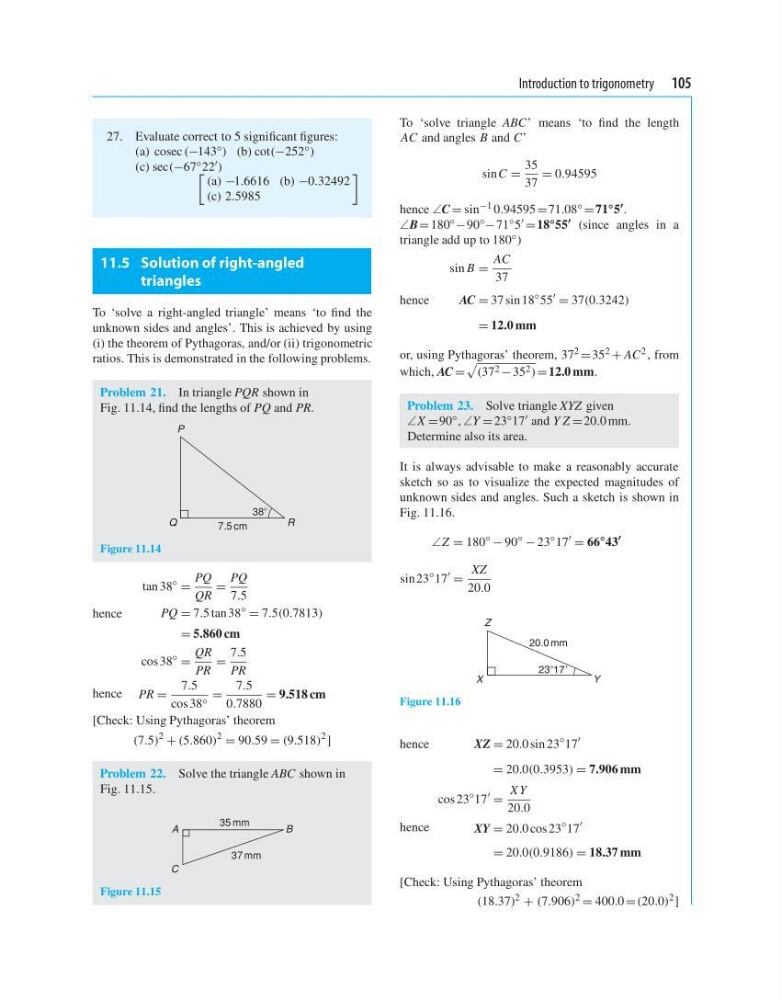
Problem 21. In triangle PQR shown in
Fig. 11.14, find the lengths of PQ and PR.
Q
R
P
7.5 cm
388
Figure 11.14
tan 38
◦
=
PQ
QR
=
PQ
7.5
hence
PQ = 7.5 tan 38
◦
= 7.5(0.7813)
= 5.860 cm
cos 38
◦
=
QR
PR
=
7.5
PR
hence PR =
7.5
cos 38 ◦ =
7.5
0.7880
= 9.518 cm
[Check: Using Pythagoras’ theorem
(7.5)
2
+ (5.860)
2
= 90.59 = (9.518)
2 ]
Problem 22. Solve the triangle ABC shown in
Fig. 11.15.
A
C
B
37 mm
35 mm
Figure 11.15
To ‘solve triangle ABC’ means ‘to find the length
AC and angles B and C’
sin C =
35
37
= 0.94595
hence ∠C = sin −1 0.94595 =71.08 ◦ = 71 ◦ 5 .
∠B = 180 ◦ − 90 ◦ − 71 ◦ 5 = 18 ◦ 55 (since angles in a
triangle add up to 180 ◦ )
sin B =
AC
37
hence
AC = 37 sin 18
◦ 55
= 37(0.3242)
= 12.0 mm
or, using Pythagoras’ theorem, 37 2 = 35 2 + AC 2 , from
which, AC =
(37 2 − 35 2 ) = 12.0 mm.
Problem 23. Solve triangle XYZ given
∠X =90 ◦ , ∠Y = 23 ◦ 17 and Y Z = 20.0 mm.
Determine also its area.
It is always advisable to make a reasonably accurate
sketch so as to visualize the expected magnitudes of
unknown sides and angles. Such a sketch is shown in
Fig. 11.16.
∠Z = 180
◦
− 90
◦
− 23
◦ 17
= 66
◦ 43
sin 23
◦ 17
=
XZ
20.0
X
Y
Z
20.0 mm
238179
Figure 11.16
hence
XZ = 20.0 sin 23
◦ 17
= 20.0(0.3953) = 7.906 mm
cos 23
◦ 17
=
X Y
20.0
hence
XY = 20.0 cos 23
◦ 17
= 20.0(0.9186) = 18.37 mm
[Check: Using Pythagoras’ theorem
(18.37) 2 + (7.906) 2 = 400.0 = (20.0) 2 ]
27. Evaluate correct to 5 significant figures:
(a) cosec (−143 ◦ ) (b) cot(−252 ◦ )
(c) sec(−67 ◦ 22 )
(a) −1.6616 (b) −0.32492
(c) 2.5985
11.5 Solution of right-angled
triangles
To ‘solve a right-angled triangle’ means ‘to find the
unknown sides and angles’. This is achieved by using
(i) the theorem of Pythagoras, and/or (ii) trigonometric
ratios. This is demonstrated in the following problems.
Problem 21. In triangle PQR shown in
Fig. 11.14, find the lengths of PQ and PR.
Q
R
P
7.5 cm
388
Figure 11.14
tan 38
◦
=
PQ
QR
=
PQ
7.5
hence
PQ = 7.5 tan 38
◦
= 7.5(0.7813)
= 5.860 cm
cos 38
◦
=
QR
PR
=
7.5
PR
hence PR =
7.5
cos 38 ◦ =
7.5
0.7880
= 9.518 cm
[Check: Using Pythagoras’ theorem
(7.5)
2
+ (5.860)
2
= 90.59 = (9.518)
2 ]
Problem 22. Solve the triangle ABC shown in
Fig. 11.15.
A
C
B
37 mm
35 mm
Figure 11.15
To ‘solve triangle ABC’ means ‘to find the length
AC and angles B and C’
sin C =
35
37
= 0.94595
hence ∠C = sin −1 0.94595 =71.08 ◦ = 71 ◦ 5 .
∠B = 180 ◦ − 90 ◦ − 71 ◦ 5 = 18 ◦ 55 (since angles in a
triangle add up to 180 ◦ )
sin B =
AC
37
hence
AC = 37 sin 18
◦ 55
= 37(0.3242)
= 12.0 mm
or, using Pythagoras’ theorem, 37 2 = 35 2 + AC 2 , from
which, AC =
(37 2 − 35 2 ) = 12.0 mm.
Problem 23. Solve triangle XYZ given
∠X =90 ◦ , ∠Y = 23 ◦ 17 and Y Z = 20.0 mm.
Determine also its area.
It is always advisable to make a reasonably accurate
sketch so as to visualize the expected magnitudes of
unknown sides and angles. Such a sketch is shown in
Fig. 11.16.
∠Z = 180
◦
− 90
◦
− 23
◦ 17
= 66
◦ 43
sin 23
◦ 17
=
XZ
20.0
X
Y
Z
20.0 mm
238179
Figure 11.16
hence
XZ = 20.0 sin 23
◦ 17
= 20.0(0.3953) = 7.906 mm
cos 23
◦ 17
=
X Y
20.0
hence
XY = 20.0 cos 23
◦ 17
= 20.0(0.9186) = 18.37 mm
[Check: Using Pythagoras’ theorem
(18.37) 2 + (7.906) 2 = 400.0 = (20.0) 2 ]