

100 Higher Engineering Mathematics
B
A
2
0
4
(a)
(b)
6
8
8
f(x)
7
6
4
3
2
B
C
A
2
0
4
6
8
8
f (x)
6
4
2
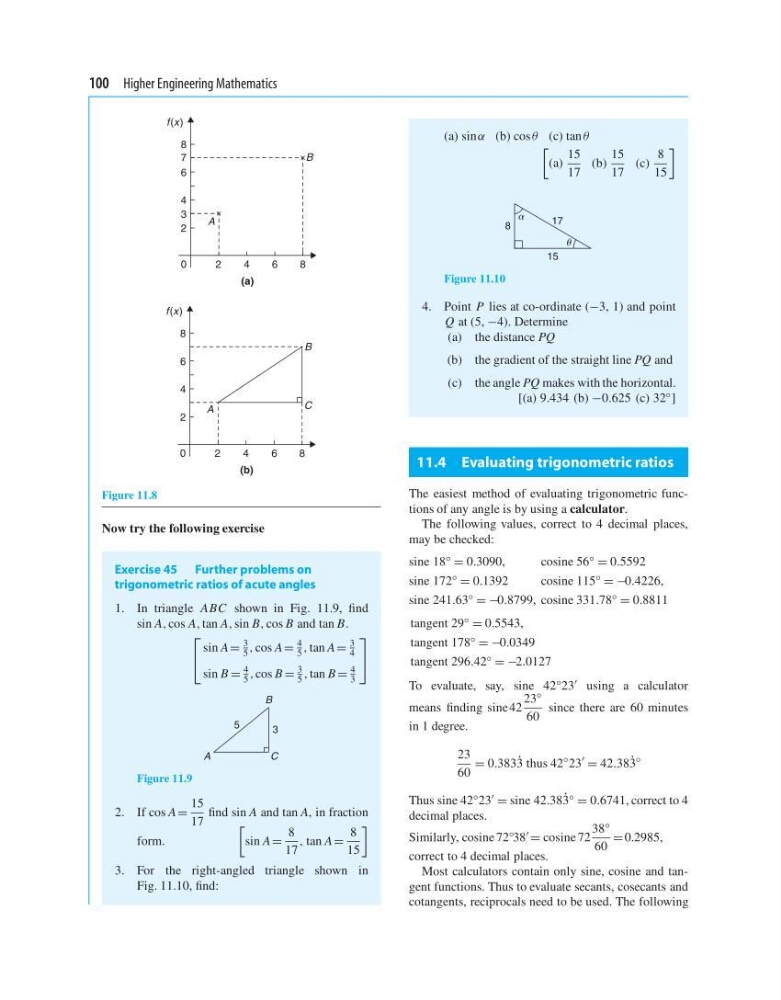
Figure 11.8
Now try the following exercise
Exercise 45 Further problems on
trigonometric ratios of acute angles
1. In triangle ABC shown in Fig. 11.9, find
sin A, cos A, tan A, sin B, cos B and tan B.
⎡
⎣
sin A =
3
5 , cos A =
4
5 , tan A =
3
4
sin B =
4
5 , cos B =
3
5 , tan B =
4
3
⎤
⎦
B
C
3
5
A
Figure 11.9
2. If cos A =
15
17
find sin A and tan A, in fraction
form.
sin A =
8
17
, tan A =
8
15
3. For the right-angled triangle shown in
Fig. 11.10, find:
(a) sin α (b) cos θ (c) tan θ
(a)
15
17
(b)
15
17
(c)
8
15
␣
17
8
15
Figure 11.10
4. Point P lies at co-ordinate (−3, 1) and point
Q at (5, −4). Determine
(a) the distance PQ
(b) the gradient of the straight line PQ and
(c) the angle PQ makes with the horizontal.
[(a) 9.434 (b) −0.625 (c) 32 ◦ ]
11.4 Evaluating trigonometric ratios
The easiest method of evaluating trigonometric functions of any angle is by using a calculator.
The following values, correct to 4 decimal places,
may be checked:
sine 18 ◦ = 0.3090,
cosine 56 ◦ = 0.5592
sine 172
◦
= 0.1392
cosine 115
◦
= −0.4226,
sine 241.63 ◦ = −0.8799, cosine 331.78 ◦ = 0.8811
tangent 29 ◦ = 0.5543,
tangent 178 ◦ = −0.0349
tangent 296.42 ◦ = −2.0127
To evaluate, say, sine 42 ◦ 23 using a calculator
means finding sine 42
23
◦
60
since there are 60 minutes
in 1 degree.
23
60
= 0.383 ˙
3 thus 42
◦ 23
= 42.38 ˙
3
◦
Thus sine 42 ◦ 23 = sine 42.38 ˙
3 ◦ = 0.6741, correct to 4
decimal places.
Similarly, cosine 72 ◦ 38 = cosine 72
38 ◦
60
= 0.2985,
correct to 4 decimal places.
Most calculators contain only sine, cosine and tangent functions. Thus to evaluate secants, cosecants and
cotangents, reciprocals need to be used. The following
B
A
2
0
4
(a)
(b)
6
8
8
f(x)
7
6
4
3
2
B
C
A
2
0
4
6
8
8
f (x)
6
4
2
Figure 11.8
Now try the following exercise
Exercise 45 Further problems on
trigonometric ratios of acute angles
1. In triangle ABC shown in Fig. 11.9, find
sin A, cos A, tan A, sin B, cos B and tan B.
⎡
⎣
sin A =
3
5 , cos A =
4
5 , tan A =
3
4
sin B =
4
5 , cos B =
3
5 , tan B =
4
3
⎤
⎦
B
C
3
5
A
Figure 11.9
2. If cos A =
15
17
find sin A and tan A, in fraction
form.
sin A =
8
17
, tan A =
8
15
3. For the right-angled triangle shown in
Fig. 11.10, find:
(a) sin α (b) cos θ (c) tan θ
(a)
15
17
(b)
15
17
(c)
8
15
␣
17
8
15
Figure 11.10
4. Point P lies at co-ordinate (−3, 1) and point
Q at (5, −4). Determine
(a) the distance PQ
(b) the gradient of the straight line PQ and
(c) the angle PQ makes with the horizontal.
[(a) 9.434 (b) −0.625 (c) 32 ◦ ]
11.4 Evaluating trigonometric ratios
The easiest method of evaluating trigonometric functions of any angle is by using a calculator.
The following values, correct to 4 decimal places,
may be checked:
sine 18 ◦ = 0.3090,
cosine 56 ◦ = 0.5592
sine 172
◦
= 0.1392
cosine 115
◦
= −0.4226,
sine 241.63 ◦ = −0.8799, cosine 331.78 ◦ = 0.8811
tangent 29 ◦ = 0.5543,
tangent 178 ◦ = −0.0349
tangent 296.42 ◦ = −2.0127
To evaluate, say, sine 42 ◦ 23 using a calculator
means finding sine 42
23
◦
60
since there are 60 minutes
in 1 degree.
23
60
= 0.383 ˙
3 thus 42
◦ 23
= 42.38 ˙
3
◦
Thus sine 42 ◦ 23 = sine 42.38 ˙
3 ◦ = 0.6741, correct to 4
decimal places.
Similarly, cosine 72 ◦ 38 = cosine 72
38 ◦
60
= 0.2985,
correct to 4 decimal places.
Most calculators contain only sine, cosine and tangent functions. Thus to evaluate secants, cosecants and
cotangents, reciprocals need to be used. The following