

Introduction to trigonometry 99
(vi)
cotangent θ =
adjacent side
opposite side
i.e.
cot θ =
a
b
c
b
a
Figure 11.6
(b) From above,
(i)
sin θ
cos θ
=
b
c
a
c
=
b
a
= tan θ,
i.e. tan θ =
sin θ
cos θ
(ii)
cos θ
sin θ
=
a
c
b
c
=
a
b
= cot θ,
i.e. cot θ =
cos θ
sin θ
(iii)
sec θ =
1
cos θ
(iv)
cosec θ =
1
sin θ
(Note ‘s’ and ‘c’ go together)
(v)
cot θ =
1
tan θ
Secants, cosecants and cotangents are called the
reciprocal ratios.
Problem 3. If cos X =
9
41
determine the value of
the other five trigonometry ratios.
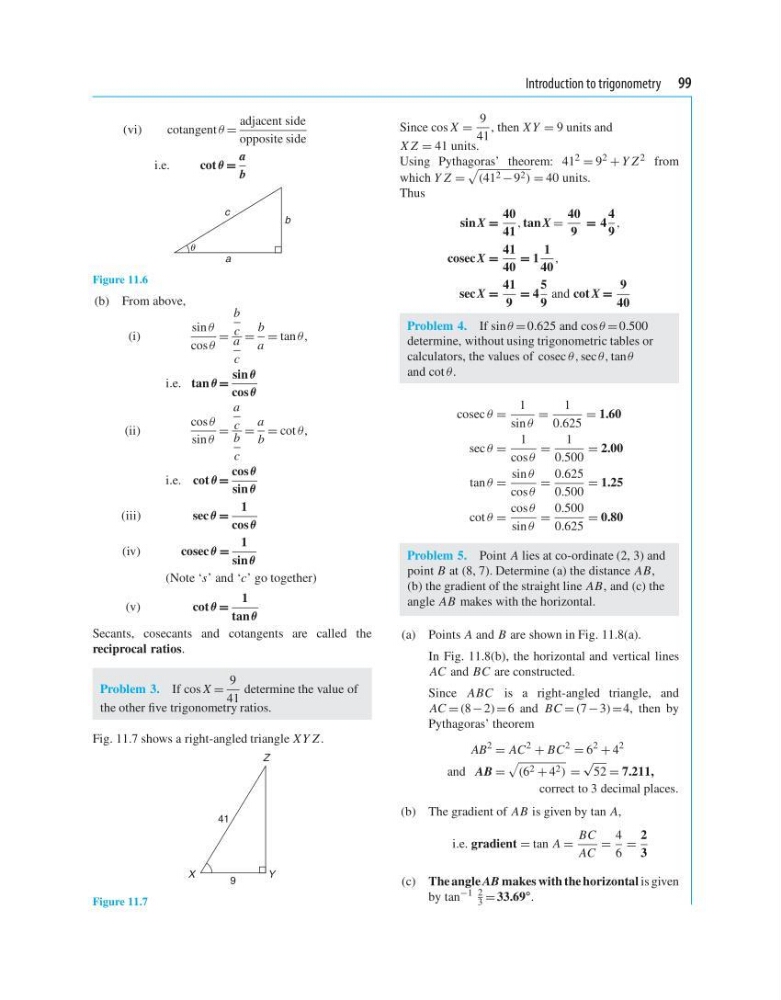
Fig. 11.7 shows a right-angled triangle X Y Z .
Y
Z
X
9
41
Figure 11.7
Since cos X =
9
41
, then X Y = 9 units and
X Z = 41 units.
Using Pythagoras’ theorem: 41 2 = 9 2 + Y Z 2 from
which Y Z =
(41 2 − 9 2 ) = 40 units.
Thus
sin X =
40
41
, tan X =
40
9
= 4
4
9
,
cosec X =
41
40
= 1
1
40
,
sec X =
41
9
= 4
5
9
and cot X =
9
40
Problem 4. If sin θ = 0.625 and cos θ = 0.500
determine, without using trigonometric tables or
calculators, the values of cosec θ, sec θ, tan θ
and cot θ.
cosec θ =
1
sin θ
=
1
0.625
= 1.60
sec θ =
1
cos θ
=
1
0.500
= 2.00
tan θ =
sin θ
cos θ
=
0.625
0.500
= 1.25
cot θ =
cos θ
sin θ
=
0.500
0.625
= 0.80
Problem 5. Point A lies at co-ordinate (2, 3) and
point B at (8, 7). Determine (a) the distance AB,
(b) the gradient of the straight line AB, and (c) the
angle AB makes with the horizontal.
(a) Points A and B are shown in Fig. 11.8(a).
In Fig. 11.8(b), the horizontal and vertical lines
AC and BC are constructed.
Since ABC is a right-angled triangle, and
AC = (8 − 2) = 6 and BC = (7 − 3) =4, then by
Pythagoras’ theorem
AB
2
= AC
2
+ BC
2
= 6
2
+ 4
2
and AB =
(6 2 + 4 2 ) =
√
52 = 7.211,
correct to 3 decimal places.
(b) The gradient of AB is given by tan A,
i.e. gradient = tan A =
BC
AC
=
4
6
=
2
3
(c) The angle AB makes with the horizontal is given
by tan
−1 2
3 = 33.69
◦ .
(vi)
cotangent θ =
adjacent side
opposite side
i.e.
cot θ =
a
b
c
b
a
Figure 11.6
(b) From above,
(i)
sin θ
cos θ
=
b
c
a
c
=
b
a
= tan θ,
i.e. tan θ =
sin θ
cos θ
(ii)
cos θ
sin θ
=
a
c
b
c
=
a
b
= cot θ,
i.e. cot θ =
cos θ
sin θ
(iii)
sec θ =
1
cos θ
(iv)
cosec θ =
1
sin θ
(Note ‘s’ and ‘c’ go together)
(v)
cot θ =
1
tan θ
Secants, cosecants and cotangents are called the
reciprocal ratios.
Problem 3. If cos X =
9
41
determine the value of
the other five trigonometry ratios.
Fig. 11.7 shows a right-angled triangle X Y Z .
Y
Z
X
9
41
Figure 11.7
Since cos X =
9
41
, then X Y = 9 units and
X Z = 41 units.
Using Pythagoras’ theorem: 41 2 = 9 2 + Y Z 2 from
which Y Z =
(41 2 − 9 2 ) = 40 units.
Thus
sin X =
40
41
, tan X =
40
9
= 4
4
9
,
cosec X =
41
40
= 1
1
40
,
sec X =
41
9
= 4
5
9
and cot X =
9
40
Problem 4. If sin θ = 0.625 and cos θ = 0.500
determine, without using trigonometric tables or
calculators, the values of cosec θ, sec θ, tan θ
and cot θ.
cosec θ =
1
sin θ
=
1
0.625
= 1.60
sec θ =
1
cos θ
=
1
0.500
= 2.00
tan θ =
sin θ
cos θ
=
0.625
0.500
= 1.25
cot θ =
cos θ
sin θ
=
0.500
0.625
= 0.80
Problem 5. Point A lies at co-ordinate (2, 3) and
point B at (8, 7). Determine (a) the distance AB,
(b) the gradient of the straight line AB, and (c) the
angle AB makes with the horizontal.
(a) Points A and B are shown in Fig. 11.8(a).
In Fig. 11.8(b), the horizontal and vertical lines
AC and BC are constructed.
Since ABC is a right-angled triangle, and
AC = (8 − 2) = 6 and BC = (7 − 3) =4, then by
Pythagoras’ theorem
AB
2
= AC
2
+ BC
2
= 6
2
+ 4
2
and AB =
(6 2 + 4 2 ) =
√
52 = 7.211,
correct to 3 decimal places.
(b) The gradient of AB is given by tan A,
i.e. gradient = tan A =
BC
AC
=
4
6
=
2
3
(c) The angle AB makes with the horizontal is given
by tan
−1 2
3 = 33.69
◦ .