

benefits,” and “cultural benefits,” which are different from the four categories
identified by the MA (Ibid.).
Behavioral intentions of the respondents were then measured by the questionnaire
using statements such as “I would accept a tax increase for marine conservation” or
“I would volunteer for marine conservation.” The same five-point Likert-type scale
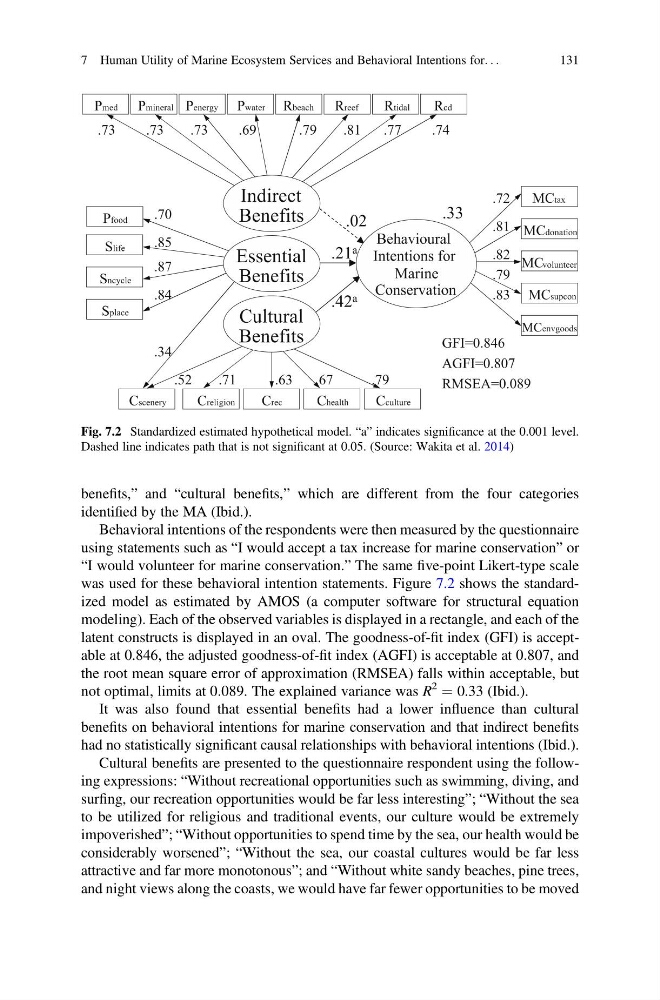
was used for these behavioral intention statements. Figure 7.2 shows the standardized model as estimated by AMOS (a computer software for structural equation
modeling). Each of the observed variables is displayed in a rectangle, and each of the
latent constructs is displayed in an oval. The goodness-of-fit index (GFI) is acceptable at 0.846, the adjusted goodness-of-fit index (AGFI) is acceptable at 0.807, and
the root mean square error of approximation (RMSEA) falls within acceptable, but
not optimal, limits at 0.089. The explained variance was R
2
¼ 0.33 (Ibid.).
It was also found that essential benefits had a lower influence than cultural
benefits on behavioral intentions for marine conservation and that indirect benefits
had no statistically significant causal relationships with behavioral intentions (Ibid.).
Cultural benefits are presented to the questionnaire respondent using the following expressions: “Without recreational opportunities such as swimming, diving, and
surfing, our recreation opportunities would be far less interesting”; “Without the sea
to be utilized for religious and traditional events, our culture would be extremely
impoverished”; “Without opportunities to spend time by the sea, our health would be
considerably worsened”; “Without the sea, our coastal cultures would be far less
attractive and far more monotonous”; and “Without white sandy beaches, pine trees,
and night views along the coasts, we would have far fewer opportunities to be moved
Fig. 7.2 Standardized estimated hypothetical model. “a” indicates significance at the 0.001 level.
Dashed line indicates path that is not significant at 0.05. (Source: Wakita et al. 2014)
7 Human Utility of Marine Ecosystem Services and Behavioral Intentions for. . .
131
identified by the MA (Ibid.).
Behavioral intentions of the respondents were then measured by the questionnaire
using statements such as “I would accept a tax increase for marine conservation” or
“I would volunteer for marine conservation.” The same five-point Likert-type scale
was used for these behavioral intention statements. Figure 7.2 shows the standardized model as estimated by AMOS (a computer software for structural equation
modeling). Each of the observed variables is displayed in a rectangle, and each of the
latent constructs is displayed in an oval. The goodness-of-fit index (GFI) is acceptable at 0.846, the adjusted goodness-of-fit index (AGFI) is acceptable at 0.807, and
the root mean square error of approximation (RMSEA) falls within acceptable, but
not optimal, limits at 0.089. The explained variance was R
2
¼ 0.33 (Ibid.).
It was also found that essential benefits had a lower influence than cultural
benefits on behavioral intentions for marine conservation and that indirect benefits
had no statistically significant causal relationships with behavioral intentions (Ibid.).
Cultural benefits are presented to the questionnaire respondent using the following expressions: “Without recreational opportunities such as swimming, diving, and
surfing, our recreation opportunities would be far less interesting”; “Without the sea
to be utilized for religious and traditional events, our culture would be extremely
impoverished”; “Without opportunities to spend time by the sea, our health would be
considerably worsened”; “Without the sea, our coastal cultures would be far less
attractive and far more monotonous”; and “Without white sandy beaches, pine trees,
and night views along the coasts, we would have far fewer opportunities to be moved
Fig. 7.2 Standardized estimated hypothetical model. “a” indicates significance at the 0.001 level.
Dashed line indicates path that is not significant at 0.05. (Source: Wakita et al. 2014)
7 Human Utility of Marine Ecosystem Services and Behavioral Intentions for. . .
131