

Relational Databases: An Introduction
205
Relational databases have standard operations that act on relations. A request to extract
data from the database is called a query. Queries use standard operations to create their
output. The standard set of operations used is called the relational algebra. Three of the
operations of the relational algebra are described in the examples that follow.
First Operation: Selection
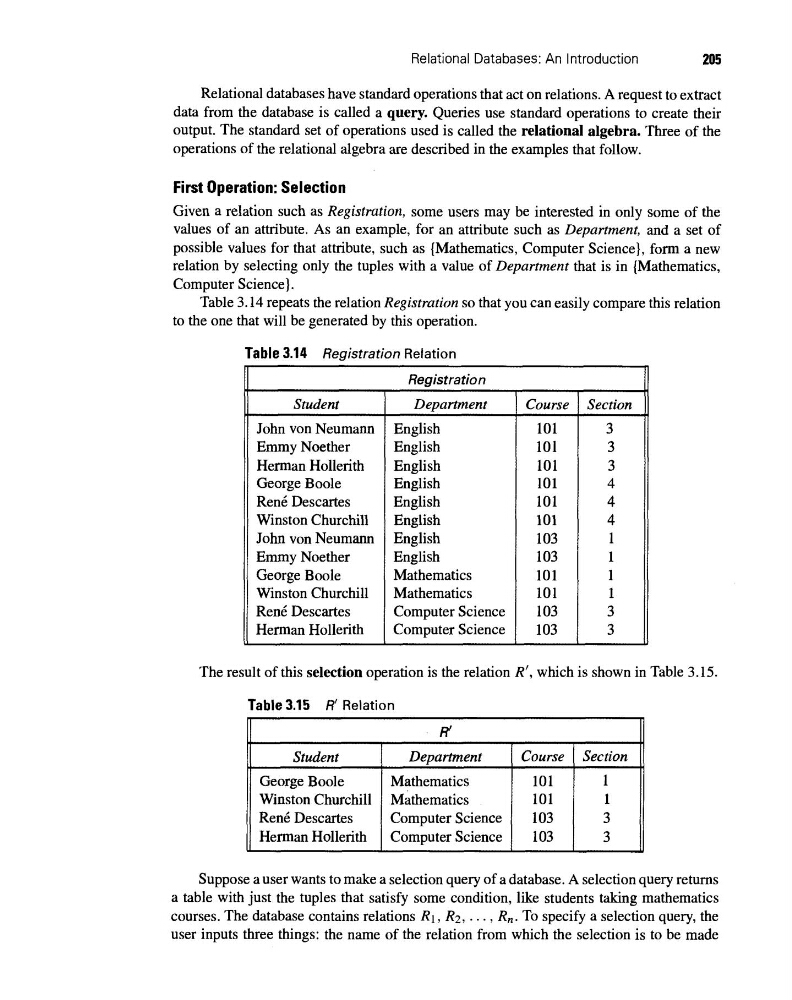
Given a relation such as Registration, some users may be interested in only some of the
values of an attribute. As an example, for an attribute such as Department, and a set of
possible values for that attribute, such as {Mathematics, Computer Science}, form a new
relation by selecting only the tuples with a value of Department that is in {Mathematics,
Computer Science).
Table 3.14 repeats the relation Registration so that you can easily compare this relation
to the one that will be generated by this operation.
Table 3.14 Registration Relation
Registration
Student
Department
Course Section
John von Neumann English
101
3
Emmy Noether
English
101
3
Herman Hollerith
English
101
3
George Boole
English
101
4
Ren6 Descartes
English
101
4
Winston Churchill
English
101
4
John von Neumann English
103
1
Emmy Noether
English
103
1
George Boole
Mathematics
101
1
Winston Churchill
Mathematics
101
1
Ren6 Descartes
Computer Science
103
3
Herman Hollerith
Computer Science
103
3
The result of this selection operation is the relation R', which is shown in Table 3.15.
Table 3.15 R' Relation
Student
Department
Course Section
George Boole
Mathematics
101
1
Winston Churchill Mathematics
101
1
Rend Descartes
Computer Science
103
3
Herman Hollerith
Computer Science
103
3
Suppose a user wants to make a selection query of a database. A selection query returns
a table with just the tuples that satisfy some condition, like students taking mathematics
courses. The database contains relations R 1 , R 2 .. . .. R, To specify a selection query, the
user inputs three things: the name of the relation from which the selection is to be made
205
Relational databases have standard operations that act on relations. A request to extract
data from the database is called a query. Queries use standard operations to create their
output. The standard set of operations used is called the relational algebra. Three of the
operations of the relational algebra are described in the examples that follow.
First Operation: Selection
Given a relation such as Registration, some users may be interested in only some of the
values of an attribute. As an example, for an attribute such as Department, and a set of
possible values for that attribute, such as {Mathematics, Computer Science}, form a new
relation by selecting only the tuples with a value of Department that is in {Mathematics,
Computer Science).
Table 3.14 repeats the relation Registration so that you can easily compare this relation
to the one that will be generated by this operation.
Table 3.14 Registration Relation
Registration
Student
Department
Course Section
John von Neumann English
101
3
Emmy Noether
English
101
3
Herman Hollerith
English
101
3
George Boole
English
101
4
Ren6 Descartes
English
101
4
Winston Churchill
English
101
4
John von Neumann English
103
1
Emmy Noether
English
103
1
George Boole
Mathematics
101
1
Winston Churchill
Mathematics
101
1
Ren6 Descartes
Computer Science
103
3
Herman Hollerith
Computer Science
103
3
The result of this selection operation is the relation R', which is shown in Table 3.15.
Table 3.15 R' Relation
Student
Department
Course Section
George Boole
Mathematics
101
1
Winston Churchill Mathematics
101
1
Rend Descartes
Computer Science
103
3
Herman Hollerith
Computer Science
103
3
Suppose a user wants to make a selection query of a database. A selection query returns
a table with just the tuples that satisfy some condition, like students taking mathematics
courses. The database contains relations R 1 , R 2 .. . .. R, To specify a selection query, the
user inputs three things: the name of the relation from which the selection is to be made