

204
CHAPTER 3 Relations
is teaching a course is often used for purposes independent of determining who is registered for the course. It therefore is better to store the new information in a separate table.
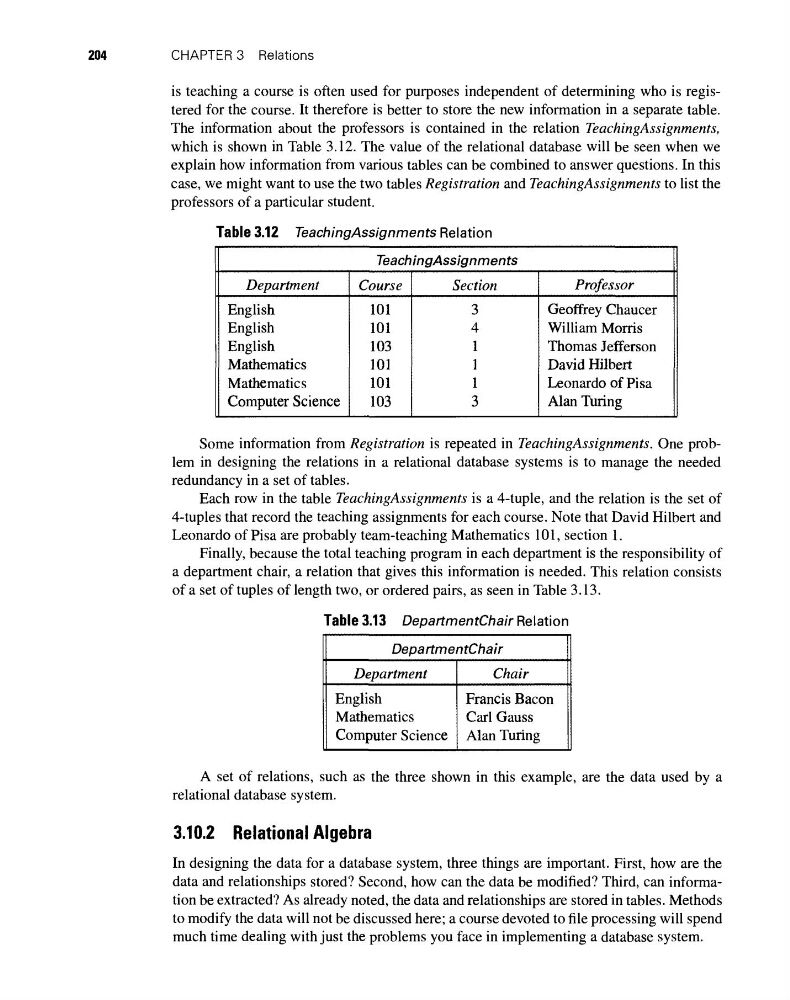
The information about the professors is contained in the relation TeachingAssignments,
which is shown in Table 3.12. The value of the relational database will be seen when we
explain how information from various tables can be combined to answer questions. In this
case, we might want to use the two tables Registration and TeachingAssignments to list the
professors of a particular student.
Table 3.12 TeachingAssignments Relation
TeachingAssignments
Department
Course
Section
Professor
English
101
3
Geoffrey Chaucer
English
101
4
William Morris
English
103
1
Thomas Jefferson
Mathematics
101
1
David Hilbert
Mathematics
101
1
Leonardo of Pisa
Computer Science
103
3
Alan Turing
Some information from Registration is repeated in TeachingAssignments. One problem in designing the relations in a relational database systems is to manage the needed
redundancy in a set of tables.
Each row in the table TeachingAssignments is a 4-tuple, and the relation is the set of
4-tuples that record the teaching assignments for each course. Note that David Hilbert and
Leonardo of Pisa are probably team-teaching Mathematics 101, section 1.
Finally, because the total teaching program in each department is the responsibility of
a department chair, a relation that gives this information is needed. This relation consists
of a set of tuples of length two, or ordered pairs, as seen in Table 3.13.
Table3.13 DepartmentChair Relation
DepartmentChair
Department
Chair
English
Francis Bacon
Mathematics
Carl Gauss
Computer Science Alan Turing
A set of relations, such as the three shown in this example, are the data used by a
relational database system.
3.10.2 Relational Algebra
In designing the data for a database system, three things are important. First, how are the
data and relationships stored? Second, how can the data be modified? Third, can information be extracted? As already noted, the data and relationships are stored in tables. Methods
to modify the data will not be discussed here; a course devoted to file processing will spend
much time dealing with just the problems you face in implementing a database system.
CHAPTER 3 Relations
is teaching a course is often used for purposes independent of determining who is registered for the course. It therefore is better to store the new information in a separate table.
The information about the professors is contained in the relation TeachingAssignments,
which is shown in Table 3.12. The value of the relational database will be seen when we
explain how information from various tables can be combined to answer questions. In this
case, we might want to use the two tables Registration and TeachingAssignments to list the
professors of a particular student.
Table 3.12 TeachingAssignments Relation
TeachingAssignments
Department
Course
Section
Professor
English
101
3
Geoffrey Chaucer
English
101
4
William Morris
English
103
1
Thomas Jefferson
Mathematics
101
1
David Hilbert
Mathematics
101
1
Leonardo of Pisa
Computer Science
103
3
Alan Turing
Some information from Registration is repeated in TeachingAssignments. One problem in designing the relations in a relational database systems is to manage the needed
redundancy in a set of tables.
Each row in the table TeachingAssignments is a 4-tuple, and the relation is the set of
4-tuples that record the teaching assignments for each course. Note that David Hilbert and
Leonardo of Pisa are probably team-teaching Mathematics 101, section 1.
Finally, because the total teaching program in each department is the responsibility of
a department chair, a relation that gives this information is needed. This relation consists
of a set of tuples of length two, or ordered pairs, as seen in Table 3.13.
Table3.13 DepartmentChair Relation
DepartmentChair
Department
Chair
English
Francis Bacon
Mathematics
Carl Gauss
Computer Science Alan Turing
A set of relations, such as the three shown in this example, are the data used by a
relational database system.
3.10.2 Relational Algebra
In designing the data for a database system, three things are important. First, how are the
data and relationships stored? Second, how can the data be modified? Third, can information be extracted? As already noted, the data and relationships are stored in tables. Methods
to modify the data will not be discussed here; a course devoted to file processing will spend
much time dealing with just the problems you face in implementing a database system.