

67
4.3.2 End of Life and Early Obsolescence
So-called boneyards were massive sites where out-of-service war time material was
collected, inventoried, stored, stripped down, and recycled. This would be where all
the budgeted equipment would go in the last phase after the “phase out” was complete. The informal but popular moniker given to these facilities subtly elevates the
sites from mere scrap facilities to the final resting places for the remains of once
vital beings. The name casually given to these sites in the mid-1940s foreshadows
Novick’s metaphorical transference that, a decade later, would blur the distinction
between living beings belonging squarely to the ecosphere with the inanimate ones
of the technosphere.
Stockpiles of leftover materials were no longer needed to feed the fight. Instead,
they were used, for pennies on the dollar, to jumpstart a new consumer economy.
Besides the general-purpose vehicle (GP) or jeep, few products successfully made
the direct transition from the war theater to the consumer market, so a lot of scrap
metal had to go somewhere or sit and rust. Steel and aluminum, two of the most
malleable and easily recycled materials available, can be melted down and reformed,
repeatedly, without losing any of the performative properties that make them useful.
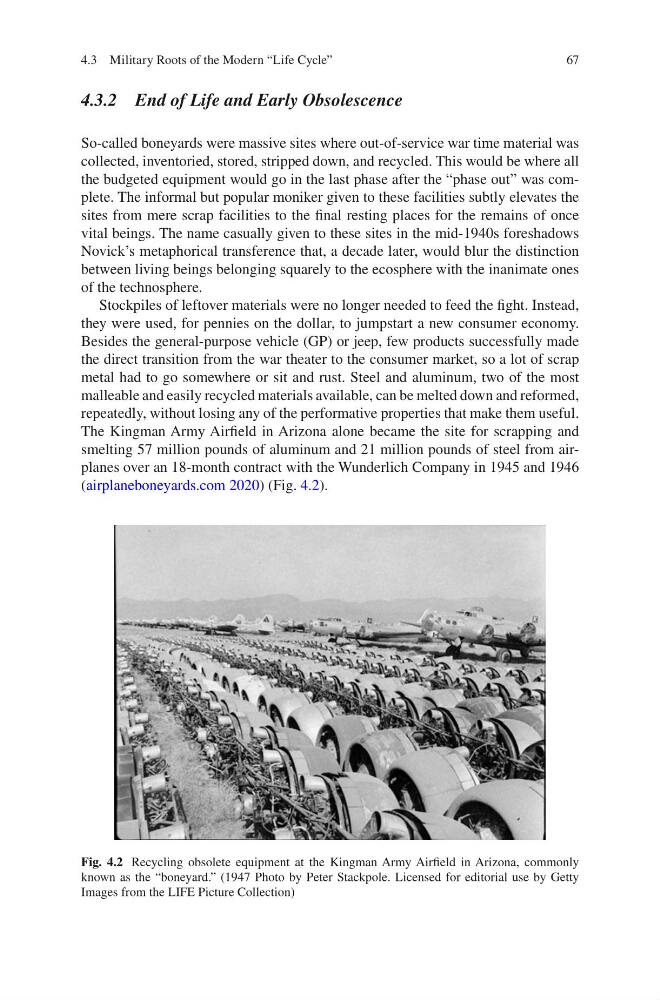
The Kingman Army Airfield in Arizona alone became the site for scrapping and
smelting 57 million pounds of aluminum and 21 million pounds of steel from airplanes over an 18-month contract with the Wunderlich Company in 1945 and 1946
(airplaneboneyards.com 2020) (Fig. 4.2).
Fig. 4.2 Recycling obsolete equipment at the Kingman Army Airfield in Arizona, commonly
known as the “boneyard.” (1947 Photo by Peter Stackpole. Licensed for editorial use by Getty
Images from the LIFE Picture Collection)
4.3 Military Roots of the Modern “Life Cycle”
4.3.2 End of Life and Early Obsolescence
So-called boneyards were massive sites where out-of-service war time material was
collected, inventoried, stored, stripped down, and recycled. This would be where all
the budgeted equipment would go in the last phase after the “phase out” was complete. The informal but popular moniker given to these facilities subtly elevates the
sites from mere scrap facilities to the final resting places for the remains of once
vital beings. The name casually given to these sites in the mid-1940s foreshadows
Novick’s metaphorical transference that, a decade later, would blur the distinction
between living beings belonging squarely to the ecosphere with the inanimate ones
of the technosphere.
Stockpiles of leftover materials were no longer needed to feed the fight. Instead,
they were used, for pennies on the dollar, to jumpstart a new consumer economy.
Besides the general-purpose vehicle (GP) or jeep, few products successfully made
the direct transition from the war theater to the consumer market, so a lot of scrap
metal had to go somewhere or sit and rust. Steel and aluminum, two of the most
malleable and easily recycled materials available, can be melted down and reformed,
repeatedly, without losing any of the performative properties that make them useful.
The Kingman Army Airfield in Arizona alone became the site for scrapping and
smelting 57 million pounds of aluminum and 21 million pounds of steel from airplanes over an 18-month contract with the Wunderlich Company in 1945 and 1946
(airplaneboneyards.com 2020) (Fig. 4.2).
Fig. 4.2 Recycling obsolete equipment at the Kingman Army Airfield in Arizona, commonly
known as the “boneyard.” (1947 Photo by Peter Stackpole. Licensed for editorial use by Getty
Images from the LIFE Picture Collection)
4.3 Military Roots of the Modern “Life Cycle”