

193
applications of the results. The results of a WBLCA study stop at just one building.
However, any study at the scale of a product has the potential to have widespread
impacts across many buildings. SolidWorks Sustainability is a very powerful tool to
analyze an individual product or assembly in extreme detail. Due to the focused
scale of a SolidWorks model, every single element of one building component can
be modeled, as it would exist in the real world. Just like a BIM model, a SolidWorks
model only contains as much information as a designer adds to it. A study at the
scale of a discrete building component can be used to either compare existing, comparable products (i.e., wood window, aluminum window, clad window) or to optimize the design of a single product by changing the design (i.e., geometry, materials,
finishes) while still meeting the same criteria (i.e., wind loads, water resistance,
thermal performance) required of the product (Mirabella et al. 2014).
Taking the example of different window frame materials into SolidWorks
Sustainability, it is possible to compare results across impact categories to find the
best option. In this study, windows with a wood frame, aluminum frame, and wood
frame clad in aluminum are compared. The FU of the study is one 2′ × 4′ fixed window with double pane glazing. The study assumes a 40-year service life and is
inclusive of the material, manufacturing, transportation, and end-of-life cycle stages.
The wood window consistently had the lowest environmental impacts, followed
closely by the aluminum clad wood window across the impact categories (Fig. 9.12).
The results for water eutrophication are the closest for all three options, but these
numbers are so small that the margins of error are higher and the results are less
reliable. When looking at the differences between the three types of windows, it is
important to remember that these are the impacts of just one 8sf window. However,
the example of Building 197 has 14,765sf of windows across the project, and any
savings get multiplied up to the scale of the building and beyond. There are
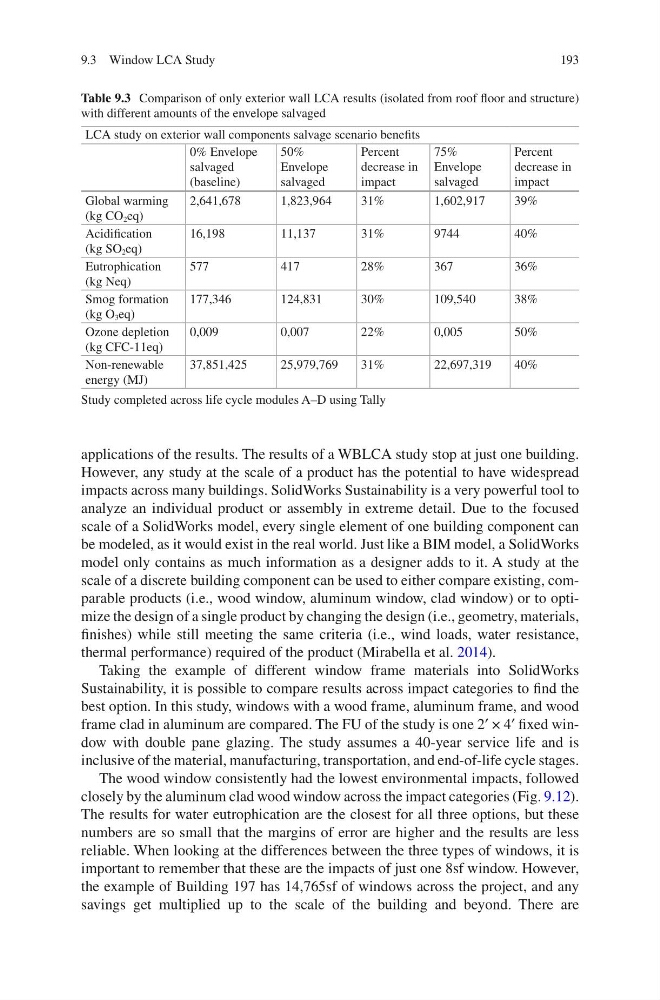
Table 9.3 Comparison of only exterior wall LCA results (isolated from roof floor and structure)
with different amounts of the envelope salvaged
LCA study on exterior wall components salvage scenario benefits
0% Envelope
salvaged
(baseline)
50%
Envelope
salvaged
Percent
decrease in
impact
75%
Envelope
salvaged
Percent
decrease in
impact
Global warming
(kg CO 2 eq)
2,641,678
1,823,964
31%
1,602,917
39%
Acidification
(kg SO 2 eq)
16,198
11,137
31%
9744
40%
Eutrophication
(kg Neq)
577
417
28%
367
36%
Smog formation
(kg O 3 eq)
177,346
124,831
30%
109,540
38%
Ozone depletion
(kg CFC-11eq)
0,009
0,007
22%
0,005
50%
Non-renewable
energy (MJ)
37,851,425
25,979,769
31%
22,697,319
40%
Study completed across life cycle modules A–D using Tally
9.3 Window LCA Study
applications of the results. The results of a WBLCA study stop at just one building.
However, any study at the scale of a product has the potential to have widespread
impacts across many buildings. SolidWorks Sustainability is a very powerful tool to
analyze an individual product or assembly in extreme detail. Due to the focused
scale of a SolidWorks model, every single element of one building component can
be modeled, as it would exist in the real world. Just like a BIM model, a SolidWorks
model only contains as much information as a designer adds to it. A study at the
scale of a discrete building component can be used to either compare existing, comparable products (i.e., wood window, aluminum window, clad window) or to optimize the design of a single product by changing the design (i.e., geometry, materials,
finishes) while still meeting the same criteria (i.e., wind loads, water resistance,
thermal performance) required of the product (Mirabella et al. 2014).
Taking the example of different window frame materials into SolidWorks
Sustainability, it is possible to compare results across impact categories to find the
best option. In this study, windows with a wood frame, aluminum frame, and wood
frame clad in aluminum are compared. The FU of the study is one 2′ × 4′ fixed window with double pane glazing. The study assumes a 40-year service life and is
inclusive of the material, manufacturing, transportation, and end-of-life cycle stages.
The wood window consistently had the lowest environmental impacts, followed
closely by the aluminum clad wood window across the impact categories (Fig. 9.12).
The results for water eutrophication are the closest for all three options, but these
numbers are so small that the margins of error are higher and the results are less
reliable. When looking at the differences between the three types of windows, it is
important to remember that these are the impacts of just one 8sf window. However,
the example of Building 197 has 14,765sf of windows across the project, and any
savings get multiplied up to the scale of the building and beyond. There are
Table 9.3 Comparison of only exterior wall LCA results (isolated from roof floor and structure)
with different amounts of the envelope salvaged
LCA study on exterior wall components salvage scenario benefits
0% Envelope
salvaged
(baseline)
50%
Envelope
salvaged
Percent
decrease in
impact
75%
Envelope
salvaged
Percent
decrease in
impact
Global warming
(kg CO 2 eq)
2,641,678
1,823,964
31%
1,602,917
39%
Acidification
(kg SO 2 eq)
16,198
11,137
31%
9744
40%
Eutrophication
(kg Neq)
577
417
28%
367
36%
Smog formation
(kg O 3 eq)
177,346
124,831
30%
109,540
38%
Ozone depletion
(kg CFC-11eq)
0,009
0,007
22%
0,005
50%
Non-renewable
energy (MJ)
37,851,425
25,979,769
31%
22,697,319
40%
Study completed across life cycle modules A–D using Tally
9.3 Window LCA Study