

180
the initial value for acidification was an order of magnitude larger than any values
for the other wall assemblies or tools. This initial data point was manufacturer specific, but no specific product for this project was chosen. Changing the LCI dataset
used from this to a generic dataset, from NREL, brings the acidification levels much
closer to the anticipated level based on the other tools and materials studied.
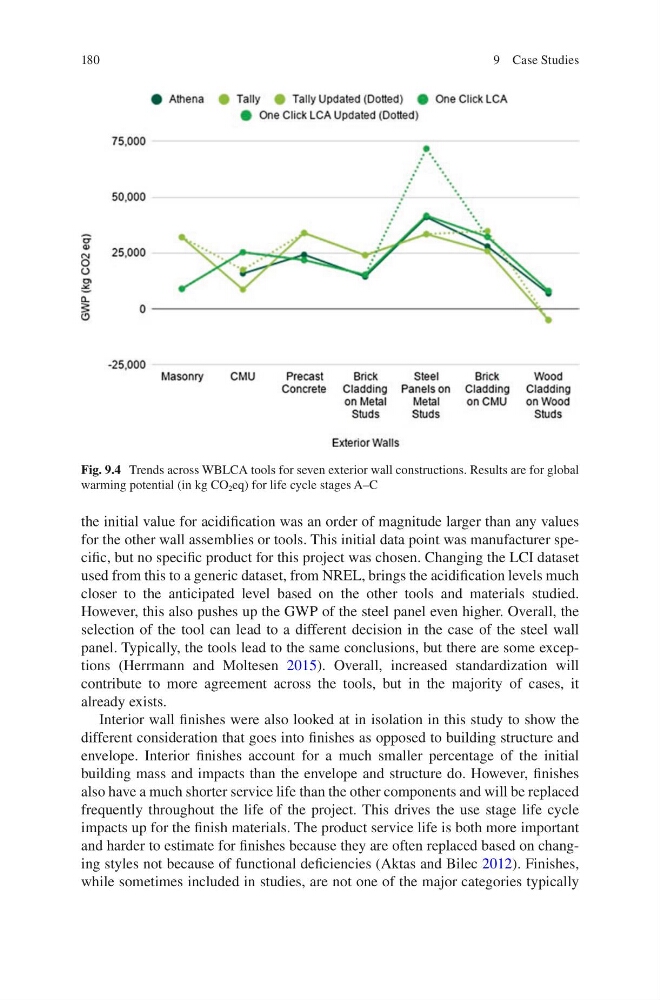
However, this also pushes up the GWP of the steel panel even higher. Overall, the
selection of the tool can lead to a different decision in the case of the steel wall
panel. Typically, the tools lead to the same conclusions, but there are some exceptions (Herrmann and Moltesen 2015). Overall, increased standardization will
contribute to more agreement across the tools, but in the majority of cases, it
already exists.
Interior wall finishes were also looked at in isolation in this study to show the
different consideration that goes into finishes as opposed to building structure and
envelope. Interior finishes account for a much smaller percentage of the initial
building mass and impacts than the envelope and structure do. However, finishes
also have a much shorter service life than the other components and will be replaced
frequently throughout the life of the project. This drives the use stage life cycle
impacts up for the finish materials. The product service life is both more important
and harder to estimate for finishes because they are often replaced based on changing styles not because of functional deficiencies (Aktas and Bilec 2012). Finishes,
while sometimes included in studies, are not one of the major categories typically
Fig. 9.4 Trends across WBLCA tools for seven exterior wall constructions. Results are for global
warming potential (in kg CO 2 eq) for life cycle stages A–C
9 Case Studies
the initial value for acidification was an order of magnitude larger than any values
for the other wall assemblies or tools. This initial data point was manufacturer specific, but no specific product for this project was chosen. Changing the LCI dataset
used from this to a generic dataset, from NREL, brings the acidification levels much
closer to the anticipated level based on the other tools and materials studied.
However, this also pushes up the GWP of the steel panel even higher. Overall, the
selection of the tool can lead to a different decision in the case of the steel wall
panel. Typically, the tools lead to the same conclusions, but there are some exceptions (Herrmann and Moltesen 2015). Overall, increased standardization will
contribute to more agreement across the tools, but in the majority of cases, it
already exists.
Interior wall finishes were also looked at in isolation in this study to show the
different consideration that goes into finishes as opposed to building structure and
envelope. Interior finishes account for a much smaller percentage of the initial
building mass and impacts than the envelope and structure do. However, finishes
also have a much shorter service life than the other components and will be replaced
frequently throughout the life of the project. This drives the use stage life cycle
impacts up for the finish materials. The product service life is both more important
and harder to estimate for finishes because they are often replaced based on changing styles not because of functional deficiencies (Aktas and Bilec 2012). Finishes,
while sometimes included in studies, are not one of the major categories typically
Fig. 9.4 Trends across WBLCA tools for seven exterior wall constructions. Results are for global
warming potential (in kg CO 2 eq) for life cycle stages A–C
9 Case Studies