

810
The Logarithm Function
A related function (in fact, the inverse function) is the logarithm function,
defined by
y = log b x
meaning
b
y
= x
Therefore log 2 16 = 4, for example, because 2
4
= 16. These two equations are
the logarithmic form and exponential form of the same fact. Similarly, log 2 8 = 3
and log 2 2 = 1.
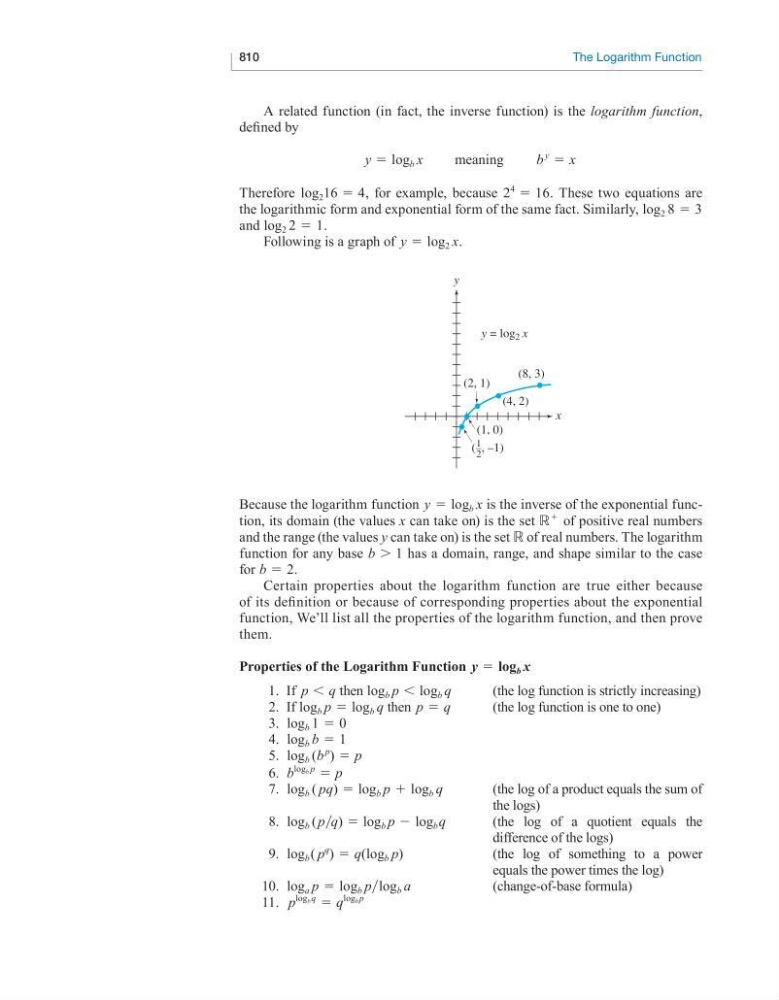
Following is a graph of y = log 2 x.
y = log 2 x
(1, 0)
(4, 2)
(2, 1)
(8, 3)
y
x
( , –1)
1 _
2
Because the logarithm function y = log b x is the inverse of the exponential function, its domain (the values x can take on) is the set R
+
of positive real numbers
and the range (the values y can take on) is the set R of real numbers. The logarithm
function for any base b > 1 has a domain, range, and shape similar to the case
for b = 2.
Certain properties about the logarithm function are true either because
of its definition or because of corresponding properties about the exponential
function, We’ll list all the properties of the logarithm function, and then prove
them.
Properties of the Logarithm Function y = log b x
1. If p < q then log b p < log b q
(the log function is strictly increasing)
2. If log b p = log b q then p = q
(the log function is one to one)
3. log b 1 = 0
4. log b b = 1
5. log b (b
p
) = p
6. b
log b p
= p
7. log b ( pq) = log b p + log b q
(the log of a product equals the sum of
the logs)
8. log b ( p͞q) = log b p − log b q
(the log of a quotient equals the
difference of the logs)
9. log b ( p
q
) = q(log b p)
(the log of something to a power
equals the power times the log)
10. log a p = log b p͞ log b a
(change-of-base formula)
11. p
log b q
= q
log b p