

The logarithm function is closely related to the exponential function
y = b
x
where b, the base, is a constant greater than 1. (Actually b can be any positive
number, but the only interesting cases occur when b > 1.) Recall the following
rules of exponents:
1. b
n
b
m
= b
n+m
(when you multiply, you add exponents)
2. b
n
͞b
m
= b
n−m
(when you divide, you subtract exponents)
3. (b
n
)
m
= b
nm
(when you raise a power to a power, you multiply
exponents)
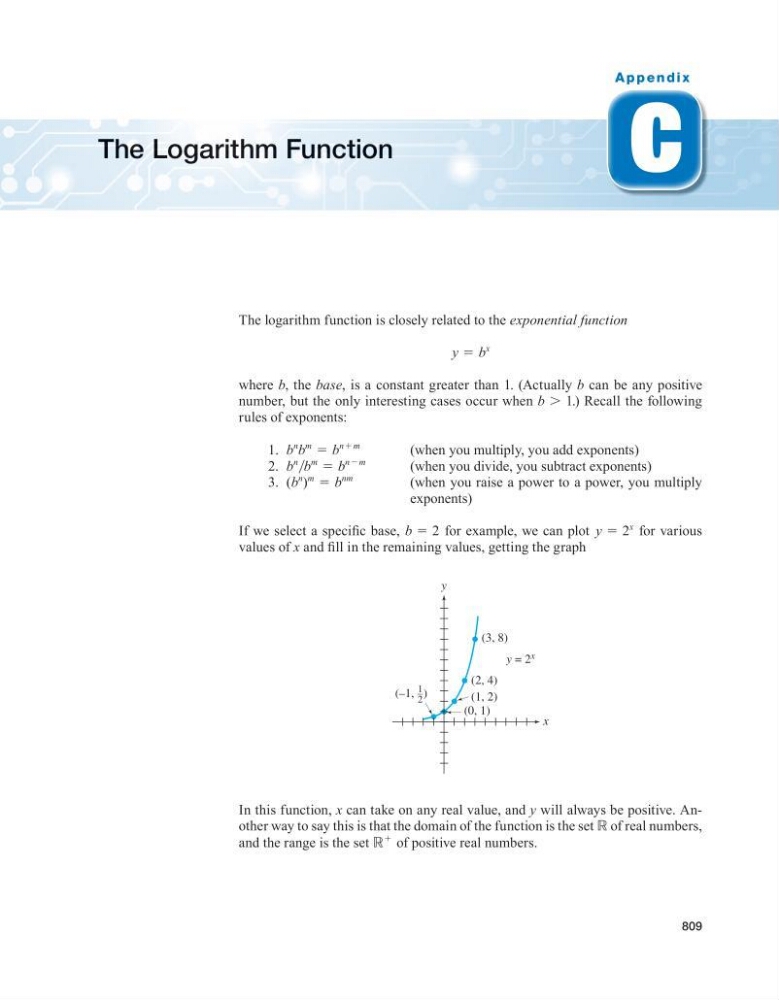
If we select a specific base, b = 2 for example, we can plot y = 2
x
for various
values of x and fill in the remaining values, getting the graph
y = 2 x
(3, 8)
(2, 4)
(1, 2)
(0, 1)
(–1, )
y
x
1 _
2
In this function, x can take on any real value, and y will always be positive. Another way to say this is that the domain of the function is the set R of real numbers,
and the range is the set R
+
of positive real numbers.
The Logarithm Function
C C
A p p e n d i x
809