

746
Modeling Arithmetic, Computation, and Languages
…
…
…
Output
Input
Combinational
network
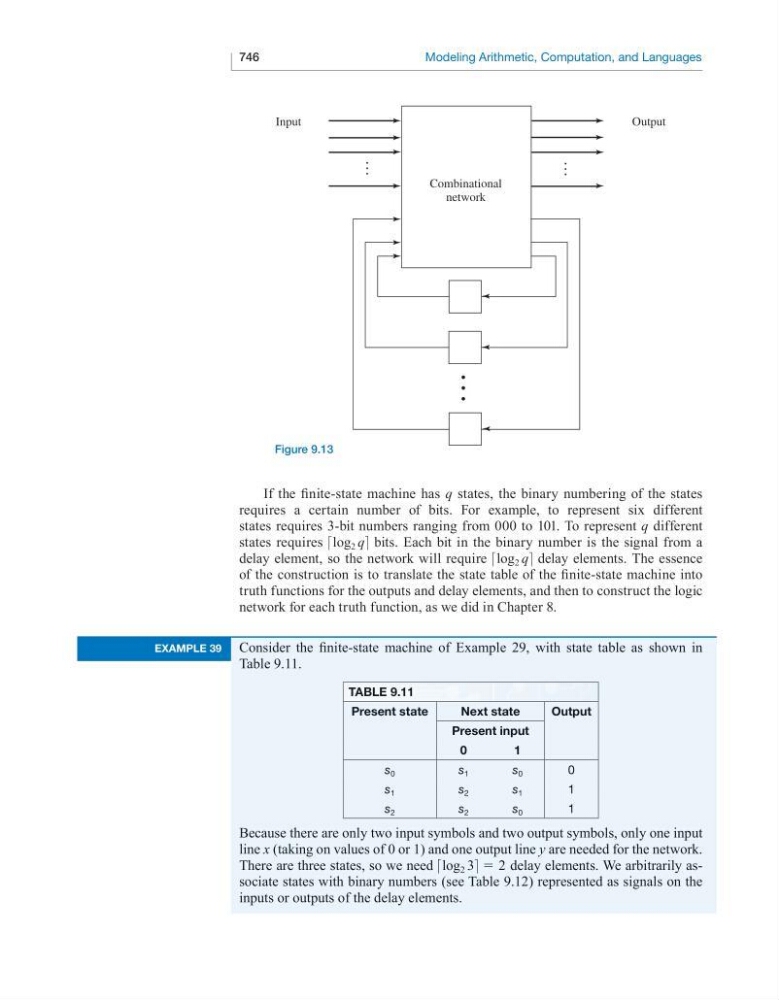
If the finite-state machine has q states, the binary numbering of the states
requires a certain number of bits. For example, to represent six different
states requires 3-bit numbers ranging from 000 to 101. To represent q different
states requires
truth functions for the outputs and delay elements, and then to construct the logic
network for each truth function, as we did in Chapter 8.
figure 9.13
example 39
Consider the finite-state machine of Example 29, with state table as shown in
Table 9.11.
table 9.11
present state
next state
output
present input
0
1
s 0
s 1
s 0
0
s 1
s 2
s 1
1
s 2
s 2
s 0
1
Because there are only two input symbols and two output symbols, only one input
line x (taking on values of 0 or 1) and one output line y are needed for the network.
There are three states, so we need