

Section 9.1 Algebraic Structures
705
This table contains exactly the same data that were in the original T table; the rows
and columns have just been shuffled. Written in this form, it’s clear that the T table
is just a relabeling (using f ) of the S table, so f is indeed an isomorphism. Note that
inverses map to inverses:
f (2
−1
) = f (9) = 4 and −f (2) = −1 = 4
f (9
−1
) = f (2) = 1 and −f (9) = −4 = 1
And we can simulate the computation 9 # 2 = 5 in S by mapping to T, applying
the + operation, and mapping back to S:
f (9) = 4, f (2) = 1
4 + 1 = 0
f
−1
(0) = 5, which is 9 # 2
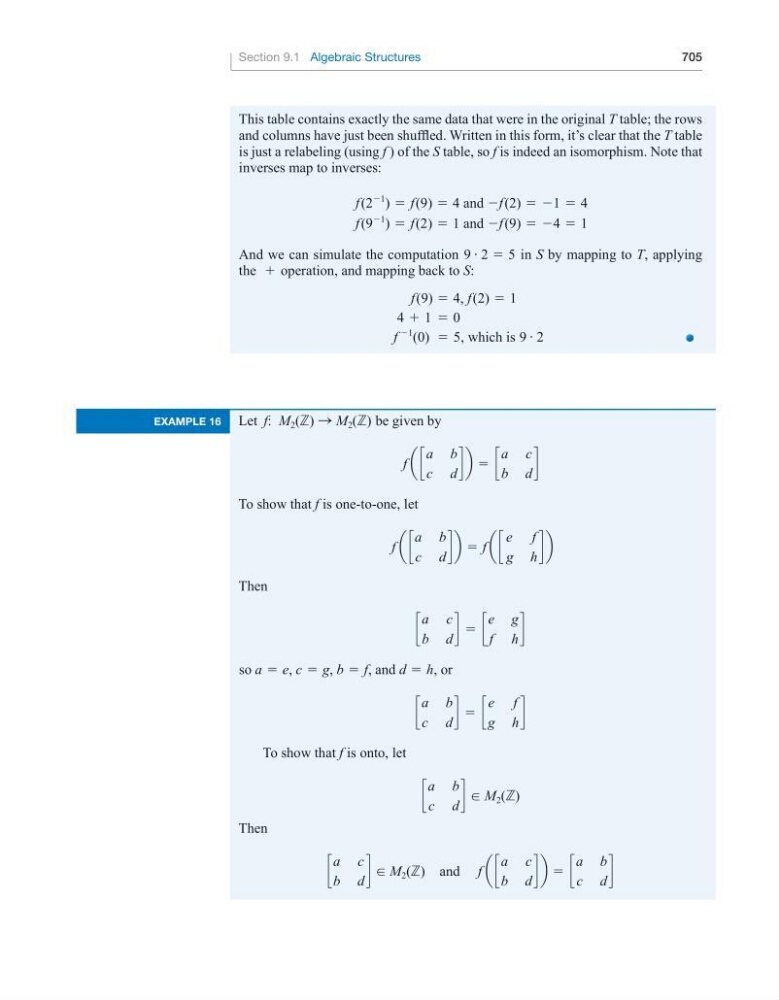
example 16
Let f: M 2 (Z) S M 2 (Z) be given by
f a c
a b
c d
d b = c
a c
b d
d
To show that f is one-to-one, let
f a c
a b
c d
d b = f a c
e f
g h
d b
Then
c
a c
b d
d = c
e g
f h
d
so a = e, c = g, b = f, and d = h, or
c
a b
c d
d = c
e f
g h
d
To show that f is onto, let
c
a b
c d
d [ M 2 (Z)
Then
c
a c
b d
d [ M 2 (Z) and f a c
a c
b d
d b = c
a b
c d
d