

704
Modeling Arithmetic, Computation, and Languages
Also note that
log b (1∙x) = log b 1 − log b x = 0 − log b x = −log b x = −f (x)
so f maps the inverse of x in 3R
+
, # 4 to the inverse of f (x) in 3R, + 4. Finally, both
groups are commutative.
Because the two groups in Example 14 are isomorphic, each is the mirror
image of the other, and each can be used to simulate a computation in the other.
Suppose, for example, that b = 2. Then 3R, + 4 can be used to simulate the computation 64 # 512 in 3R
+
, # 4. First, map from R
+
to R:
f (64) = log 2 64 = 6
f (512) = log 2 512 = 9
Now in 3R, + 4 perform the computation
6 + 9 = 15
Finally, use f
−1
to map back to R
+
:
f
−1
(15) = 2
15
= 32,768
(In the age bc—before calculators and computers—large numbers were multiplied by using tables of common logarithms, where b = 10, to convert a multiplication problem to an addition problem, as addition is less prone to human error.)
Either of two isomorphic groups can always simulate computations in the other,
just as in Example 14.
example 15
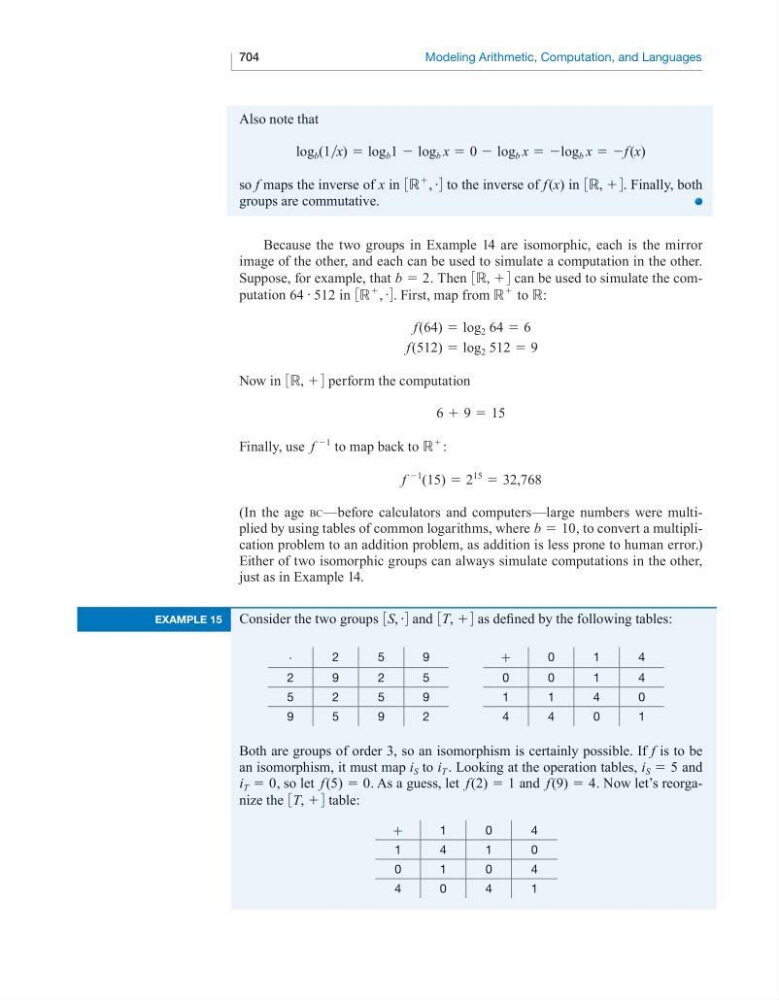
Consider the two groups 3S, # 4 and 3T, + 4 as defined by the following tables:
#
2
5
9
2
9
2
5
5
2
5
9
9
5
9
2
+
0
1
4
0
0
1
4
1
1
4
0
4
4
0
1
+
1
0
4
1
4
1
0
0
1
0
4
4
0
4
1
Both are groups of order 3, so an isomorphism is certainly possible. If f is to be
an isomorphism, it must map i S to i T . Looking at the operation tables, i S = 5 and
i T = 0, so let f (5) = 0. As a guess, let f (2) = 1 and f (9) = 4. Now let’s reorganize the 3T, + 4 table: