

676
Boolean Algebra and Computer Logic
number of 1s
x 1
x 2
x 3
x 4
Two
0
1
1
–
One
–
0
1
0
1
0
–
0
0
–
1
0
In situations where there is more than one minimal sum-of-products form, the
comparison table will have nonessential, nonredundant reduced terms. A selection must be made from these reduced terms to cover all columns not covered by
essential terms.
table 8.19
0111 1010 0110 0010 1000
011–
✓
✓
–010
✓
✓
10–0
✓
✓
0–10
✓
✓
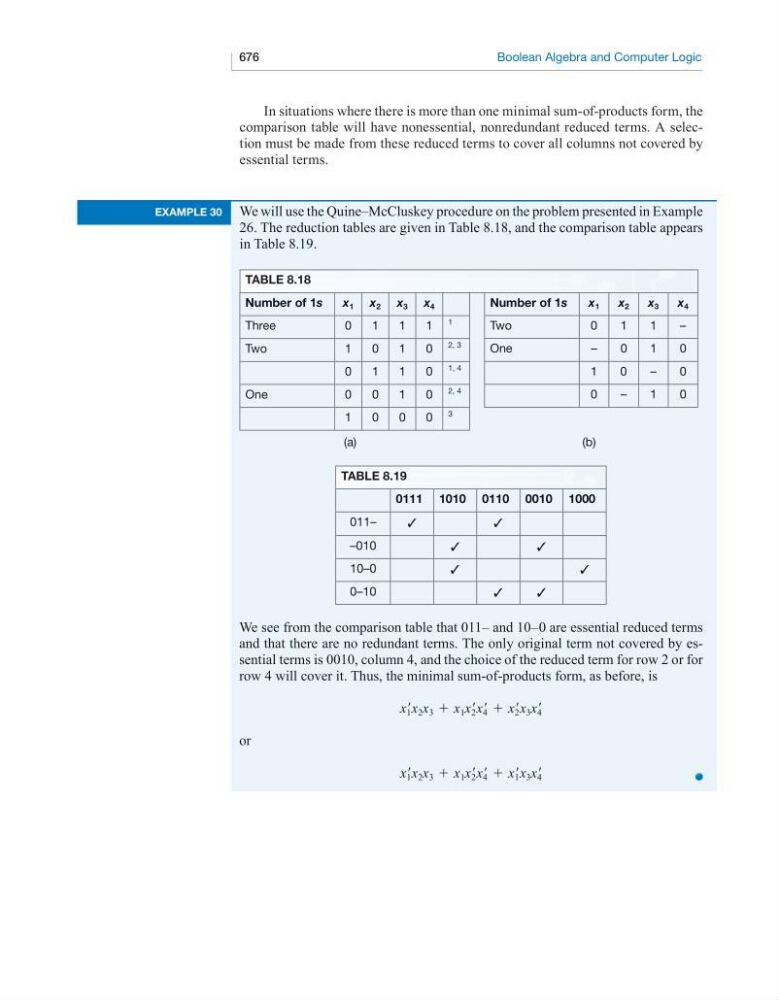
We see from the comparison table that 011– and 10–0 are essential reduced terms
and that there are no redundant terms. The only original term not covered by essential terms is 0010, column 4, and the choice of the reduced term for row 2 or for
row 4 will cover it. Thus, the minimal sum-of-products form, as before, is
x 1 ′x 2 x 3 + x 1 x 2 ′x 4 ′ + x 2 ′x 3 x 4 ′
or
x 1 ′x 2 x 3 + x 1 x 2 ′x 4 ′ + x 1 ′x 3 x 4 ′
(a)
(b)
example 30
We will use the Quine–McCluskey procedure on the problem presented in Example
26. The reduction tables are given in Table 8.18, and the comparison table appears
in Table 8.19.
table 8.18
number of 1s
x 1 x 2 x 3 x 4
Three
0
1
1
1
1
Two
1
0
1
0
2, 3
0
1
1
0
1, 4
One
0
0
1
0
2, 4
1
0
0
0
3