

ic
Section 8.3 Minimization
675
number of 1s x 1 x 2 x 3 x 4
Two
– 0 1 1
One
0 – 1 0
0 – 0 1
0 0 1 –
1
0 0 – 1
1
None
– 0 0 0
0 0 – 0
1
0 0 0 –
1
number of 1s x 1
x 2
x 3
x 4
None
0
0
–
–
(a)
(b)
(c)
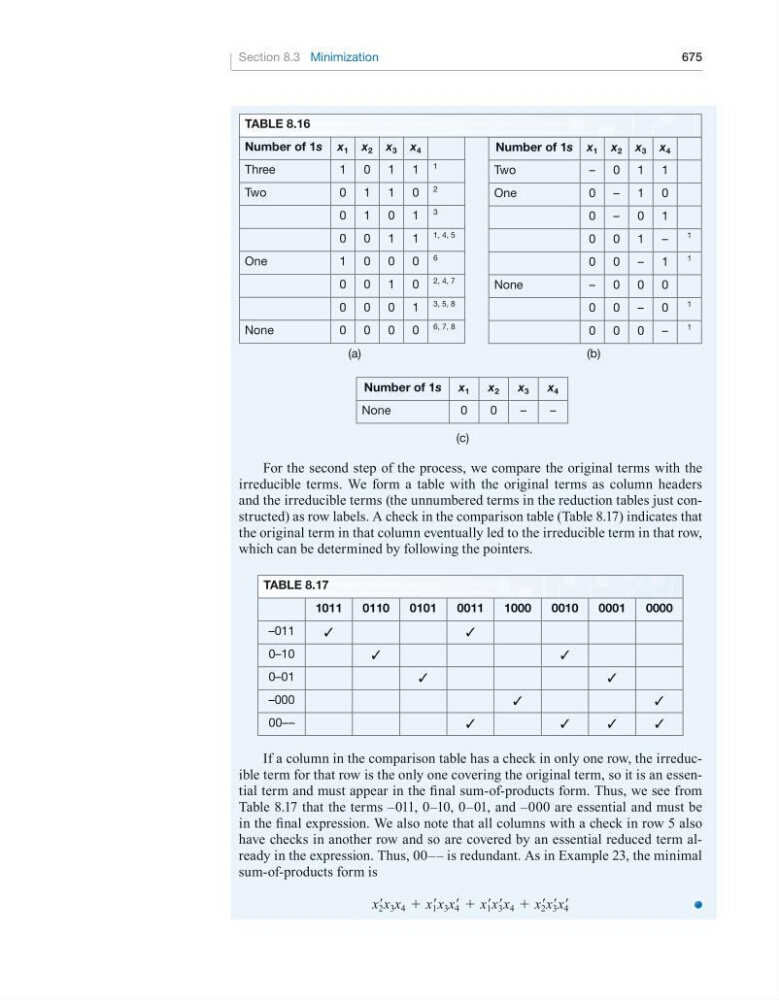
For the second step of the process, we compare the original terms with the
irreducible terms. We form a table with the original terms as column headers
and the irreducible terms (the unnumbered terms in the reduction tables just constructed) as row labels. A check in the comparison table (Table 8.17) indicates that
the original term in that column eventually led to the irreducible term in that row,
which can be determined by following the pointers.
table 8.17
1011
0110
0101
0011
1000
0010
0001
0000
–011
✓
✓
0–10
✓
✓
0–01
✓
✓
–000
✓
✓
00– –
✓
✓
✓
✓
If a column in the comparison table has a check in only one row, the irreducible term for that row is the only one covering the original term, so it is an essential term and must appear in the final sum-of-products form. Thus, we see from
Table 8.17 that the terms –011, 0–10, 0–01, and –000 are essential and must be
in the final expression. We also note that all columns with a check in row 5 also
have checks in another row and so are covered by an essential reduced term already in the expression. Thus, 00– – is redundant. As in Example 23, the minimal
sum-of-products form is
x 2 ′x 3 x 4 + x 1 ′x 3 x 4 ′ + x 1 ′x 3 ′x 4 + x 2 ′x 3 ′x 4 ′
table 8.16
number of 1s x 1 x 2 x 3 x 4
Three
1 0 1 1
1
Two
0 1 1 0
2
0 1 0 1
3
0 0 1 1
1, 4, 5
One
1 0 0 0
6
0 0 1 0
2, 4, 7
0 0 0 1
3, 5, 8
None
0 0 0 0
6, 7, 8