

388
Relations, Functions, and Matrices
properties of Functions
Onto Functions
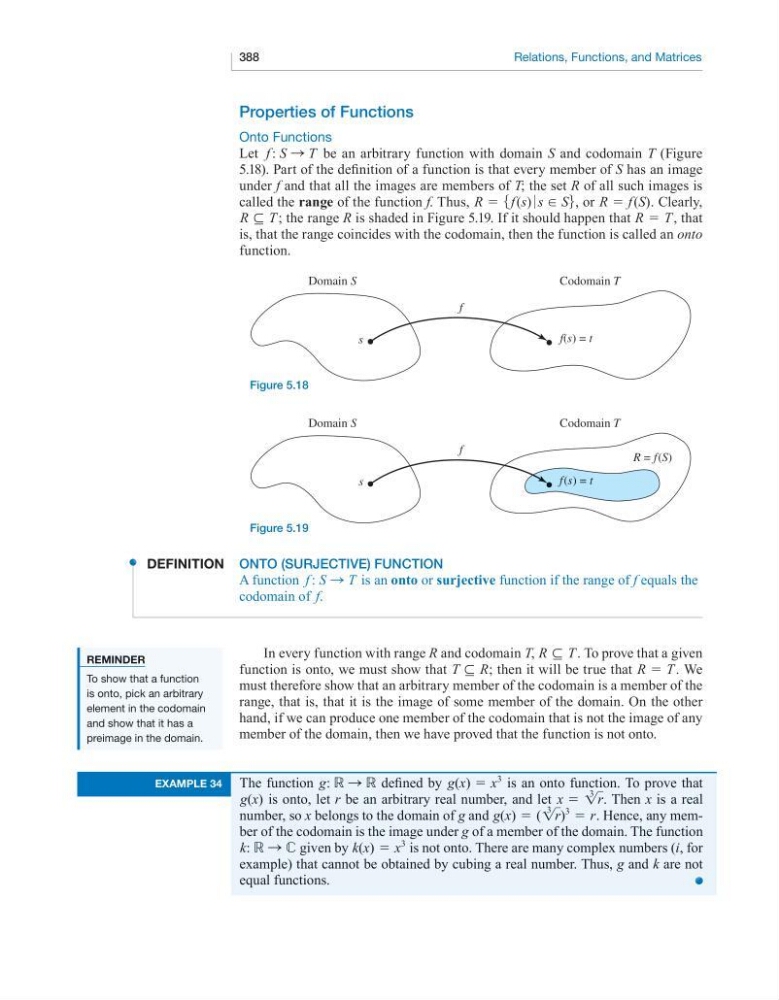
Let f : S S T be an arbitrary function with domain S and codomain T (Figure
5.18). Part of the definition of a function is that every member of S has an image
under f and that all the images are members of T; the set R of all such images is
called the range of the function f. Thus, R = 5 f (s) 0 s [ S6, or R = f (S). Clearly,
R # T ; the range R is shaded in Figure 5.19. If it should happen that R = T , that
is, that the range coincides with the codomain, then the function is called an onto
function.
Domain S
Codomain T
f(s) = t
f
s
Domain S
Codomain T
f(s) = t
R = f(S)
f
s
Figure 5.18
Figure 5.19
DefInItIon onto (SuRjective) Function
A function f : S S T is an onto or surjective function if the range of f equals the
codomain of f.
In every function with range R and codomain T, R # T . To prove that a given
function is onto, we must show that T # R; then it will be true that R = T . We
must therefore show that an arbitrary member of the codomain is a member of the
range, that is, that it is the image of some member of the domain. On the other
hand, if we can produce one member of the codomain that is not the image of any
member of the domain, then we have proved that the function is not onto.
RemInDeR
To show that a function
is onto, pick an arbitrary
element in the codomain
and show that it has a
preimage in the domain.
example 34
The function g: R S R defined by g(x) = x
3
is an onto function. To prove that
g(x) is onto, let r be an arbitrary real number, and let x = !
3
r. Then x is a real
number, so x belongs to the domain of g and g(x) = ( !
3
r)
3
= r. Hence, any member of the codomain is the image under g of a member of the domain. The function
k: R S C given by k(x) = x
3
is not onto. There are many complex numbers (i, for
example) that cannot be obtained by cubing a real number. Thus, g and k are not
equal functions.
Relations, Functions, and Matrices
properties of Functions
Onto Functions
Let f : S S T be an arbitrary function with domain S and codomain T (Figure
5.18). Part of the definition of a function is that every member of S has an image
under f and that all the images are members of T; the set R of all such images is
called the range of the function f. Thus, R = 5 f (s) 0 s [ S6, or R = f (S). Clearly,
R # T ; the range R is shaded in Figure 5.19. If it should happen that R = T , that
is, that the range coincides with the codomain, then the function is called an onto
function.
Domain S
Codomain T
f(s) = t
f
s
Domain S
Codomain T
f(s) = t
R = f(S)
f
s
Figure 5.18
Figure 5.19
DefInItIon onto (SuRjective) Function
A function f : S S T is an onto or surjective function if the range of f equals the
codomain of f.
In every function with range R and codomain T, R # T . To prove that a given
function is onto, we must show that T # R; then it will be true that R = T . We
must therefore show that an arbitrary member of the codomain is a member of the
range, that is, that it is the image of some member of the domain. On the other
hand, if we can produce one member of the codomain that is not the image of any
member of the domain, then we have proved that the function is not onto.
RemInDeR
To show that a function
is onto, pick an arbitrary
element in the codomain
and show that it has a
preimage in the domain.
example 34
The function g: R S R defined by g(x) = x
3
is an onto function. To prove that
g(x) is onto, let r be an arbitrary real number, and let x = !
3
r. Then x is a real
number, so x belongs to the domain of g and g(x) = ( !
3
r)
3
= r. Hence, any member of the codomain is the image under g of a member of the domain. The function
k: R S C given by k(x) = x
3
is not onto. There are many complex numbers (i, for
example) that cannot be obtained by cubing a real number. Thus, g and k are not
equal functions.