

s
Section 5.4 Functions
387
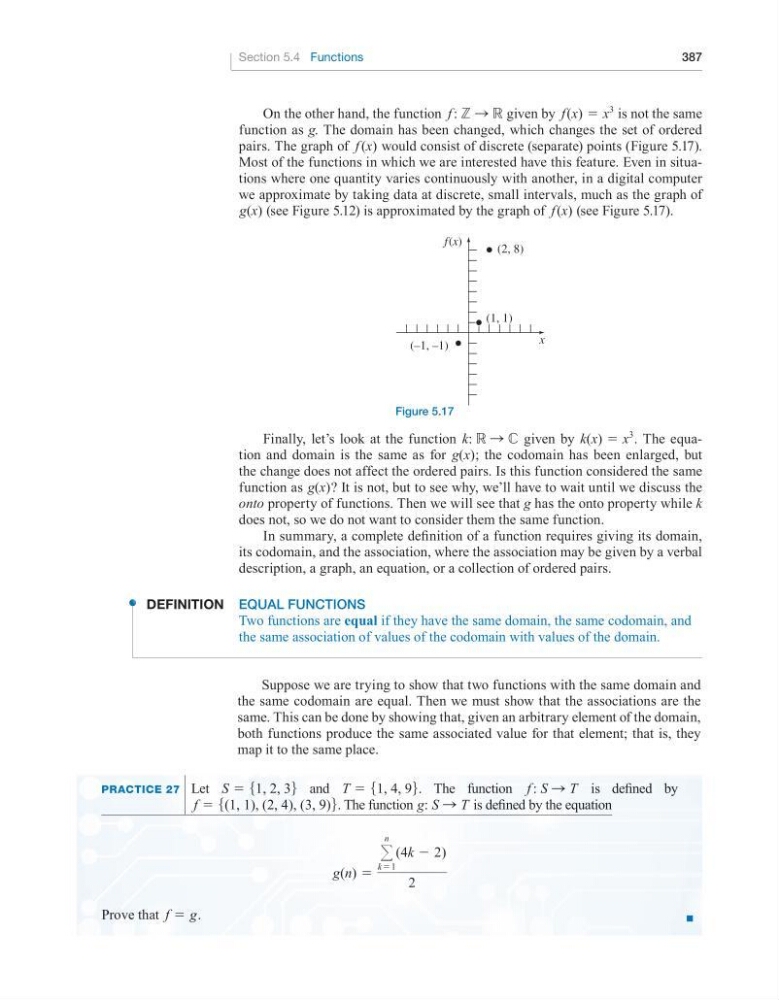
On the other hand, the function f : Z S R given by f (x) = x
3
is not the same
function as g. The domain has been changed, which changes the set of ordered
pairs. The graph of f (x) would consist of discrete (separate) points (Figure 5.17).
Most of the functions in which we are interested have this feature. Even in situations where one quantity varies continuously with another, in a digital computer
we approximate by taking data at discrete, small intervals, much as the graph of
g(x) (see Figure 5.12) is approximated by the graph of f (x) (see Figure 5.17).
(–1, –1)
(1, 1)
(2, 8)
f(x)
x
Finally, let’s look at the function k: R S C given by k(x) = x
3
. The equation and domain is the same as for g(x); the codomain has been enlarged, but
the change does not affect the ordered pairs. Is this function considered the same
function as g(x)? It is not, but to see why, we’ll have to wait until we discuss the
onto property of functions. Then we will see that g has the onto property while k
does not, so we do not want to consider them the same function.
In summary, a complete definition of a function requires giving its domain,
its codomain, and the association, where the association may be given by a verbal
description, a graph, an equation, or a collection of ordered pairs.
Figure 5.17
DefInItIon equal FunctionS
Two functions are equal if they have the same domain, the same codomain, and
the same association of values of the codomain with values of the domain.
Suppose we are trying to show that two functions with the same domain and
the same codomain are equal. Then we must show that the associations are the
same. This can be done by showing that, given an arbitrary element of the domain,
both functions produce the same associated value for that element; that is, they
map it to the same place.
PRaCtiCe 27 Let S = 51, 2, 36 and T = 51, 4, 96. The function f : S S T is defined by
f = 5(1, 1), (2, 4), (3, 9)6. The function g: S S T is defined by the equation
g(n) =
∙
n
k=1
(4k − 2)
2
Prove that f = g.
■
Section 5.4 Functions
387
On the other hand, the function f : Z S R given by f (x) = x
3
is not the same
function as g. The domain has been changed, which changes the set of ordered
pairs. The graph of f (x) would consist of discrete (separate) points (Figure 5.17).
Most of the functions in which we are interested have this feature. Even in situations where one quantity varies continuously with another, in a digital computer
we approximate by taking data at discrete, small intervals, much as the graph of
g(x) (see Figure 5.12) is approximated by the graph of f (x) (see Figure 5.17).
(–1, –1)
(1, 1)
(2, 8)
f(x)
x
Finally, let’s look at the function k: R S C given by k(x) = x
3
. The equation and domain is the same as for g(x); the codomain has been enlarged, but
the change does not affect the ordered pairs. Is this function considered the same
function as g(x)? It is not, but to see why, we’ll have to wait until we discuss the
onto property of functions. Then we will see that g has the onto property while k
does not, so we do not want to consider them the same function.
In summary, a complete definition of a function requires giving its domain,
its codomain, and the association, where the association may be given by a verbal
description, a graph, an equation, or a collection of ordered pairs.
Figure 5.17
DefInItIon equal FunctionS
Two functions are equal if they have the same domain, the same codomain, and
the same association of values of the codomain with values of the domain.
Suppose we are trying to show that two functions with the same domain and
the same codomain are equal. Then we must show that the associations are the
same. This can be done by showing that, given an arbitrary element of the domain,
both functions produce the same associated value for that element; that is, they
map it to the same place.
PRaCtiCe 27 Let S = 51, 2, 36 and T = 51, 4, 96. The function f : S S T is defined by
f = 5(1, 1), (2, 4), (3, 9)6. The function g: S S T is defined by the equation
g(n) =
∙
n
k=1
(4k − 2)
2
Prove that f = g.
■