

156
D. L. N. Rao et al.
Approach 3: STCR-IPNS based fertilizer and manure prescription equations have
been developed to derive doses of NPK fertilizers and organic manures to different
crops using nutrient availability coefficients of organic manures, nutrient requirement
of crops and use efficiency of soil and fertilizer nutrients. If a farmer knows the soil
test values of his field, target yield and amount of FYM available on his farm, he can
obtain an optimum dose of NPK and organic manures from the fertilizer prescription
equations. Approaches 2 and 3 were found most economical as compared to the
Approach 1 in several field trials conducted at various STCR centres [2]. These
approaches need to be popularized among farmers through extension agencies.
4.1 INM Under Irrigated Agriculture
Long-term studies being carried out under various long-term projects of ICAR in
India [39] have shown that it is possible to substitute a part of fertilizer N needs of
both summer and winter crops by farm yard manure (FYM) without any adverse
effect on the total productivity of the system in major cropping systems such as ricerice, rice-wheat, maize-wheat, sorghum-wheat, pearl millet-wheat, maize-wheat and
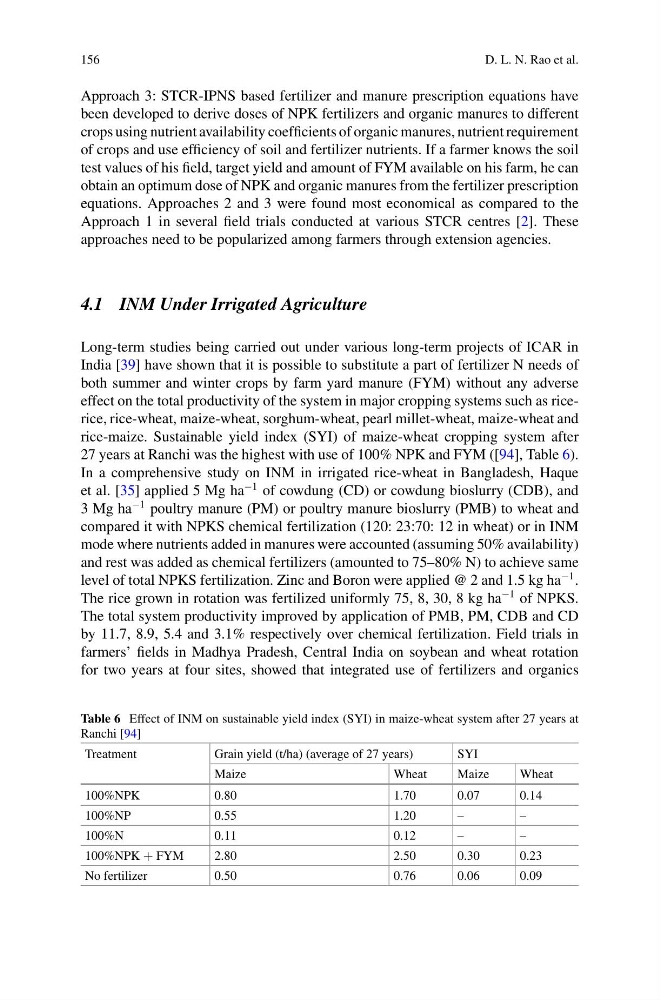
rice-maize. Sustainable yield index (SYI) of maize-wheat cropping system after
27 years at Ranchi was the highest with use of 100% NPK and FYM ([94], Table 6).
In a comprehensive study on INM in irrigated rice-wheat in Bangladesh, Haque
et al. [35] applied 5 Mg ha
−1 of cowdung (CD) or cowdung bioslurry (CDB), and
3 Mg ha
−1 poultry manure (PM) or poultry manure bioslurry (PMB) to wheat and
compared it with NPKS chemical fertilization (120: 23:70: 12 in wheat) or in INM
mode where nutrients added in manures were accounted (assuming 50% availability)
and rest was added as chemical fertilizers (amounted to 75–80% N) to achieve same
level of total NPKS fertilization. Zinc and Boron were applied @ 2 and 1.5 kg ha
−1 .
The rice grown in rotation was fertilized uniformly 75, 8, 30, 8 kg ha
−1 of NPKS.
The total system productivity improved by application of PMB, PM, CDB and CD
by 11.7, 8.9, 5.4 and 3.1% respectively over chemical fertilization. Field trials in
farmers’ fields in Madhya Pradesh, Central India on soybean and wheat rotation
for two years at four sites, showed that integrated use of fertilizers and organics
Table 6 Effect of INM on sustainable yield index (SYI) in maize-wheat system after 27 years at
Ranchi [94]
Treatment
Grain yield (t/ha) (average of 27 years)
SYI
Maize
Wheat
Maize
Wheat
100%NPK
0.80
1.70
0.07
0.14
100%NP
0.55
1.20
–
–
100%N
0.11
0.12
–
–
100%NPK + FYM
2.80
2.50
0.30
0.23
No fertilizer
0.50
0.76
0.06
0.09
D. L. N. Rao et al.
Approach 3: STCR-IPNS based fertilizer and manure prescription equations have
been developed to derive doses of NPK fertilizers and organic manures to different
crops using nutrient availability coefficients of organic manures, nutrient requirement
of crops and use efficiency of soil and fertilizer nutrients. If a farmer knows the soil
test values of his field, target yield and amount of FYM available on his farm, he can
obtain an optimum dose of NPK and organic manures from the fertilizer prescription
equations. Approaches 2 and 3 were found most economical as compared to the
Approach 1 in several field trials conducted at various STCR centres [2]. These
approaches need to be popularized among farmers through extension agencies.
4.1 INM Under Irrigated Agriculture
Long-term studies being carried out under various long-term projects of ICAR in
India [39] have shown that it is possible to substitute a part of fertilizer N needs of
both summer and winter crops by farm yard manure (FYM) without any adverse
effect on the total productivity of the system in major cropping systems such as ricerice, rice-wheat, maize-wheat, sorghum-wheat, pearl millet-wheat, maize-wheat and
rice-maize. Sustainable yield index (SYI) of maize-wheat cropping system after
27 years at Ranchi was the highest with use of 100% NPK and FYM ([94], Table 6).
In a comprehensive study on INM in irrigated rice-wheat in Bangladesh, Haque
et al. [35] applied 5 Mg ha
−1 of cowdung (CD) or cowdung bioslurry (CDB), and
3 Mg ha
−1 poultry manure (PM) or poultry manure bioslurry (PMB) to wheat and
compared it with NPKS chemical fertilization (120: 23:70: 12 in wheat) or in INM
mode where nutrients added in manures were accounted (assuming 50% availability)
and rest was added as chemical fertilizers (amounted to 75–80% N) to achieve same
level of total NPKS fertilization. Zinc and Boron were applied @ 2 and 1.5 kg ha
−1 .
The rice grown in rotation was fertilized uniformly 75, 8, 30, 8 kg ha
−1 of NPKS.
The total system productivity improved by application of PMB, PM, CDB and CD
by 11.7, 8.9, 5.4 and 3.1% respectively over chemical fertilization. Field trials in
farmers’ fields in Madhya Pradesh, Central India on soybean and wheat rotation
for two years at four sites, showed that integrated use of fertilizers and organics
Table 6 Effect of INM on sustainable yield index (SYI) in maize-wheat system after 27 years at
Ranchi [94]
Treatment
Grain yield (t/ha) (average of 27 years)
SYI
Maize
Wheat
Maize
Wheat
100%NPK
0.80
1.70
0.07
0.14
100%NP
0.55
1.20
–
–
100%N
0.11
0.12
–
–
100%NPK + FYM
2.80
2.50
0.30
0.23
No fertilizer
0.50
0.76
0.06
0.09