

100
E. Vavoulidou et al.
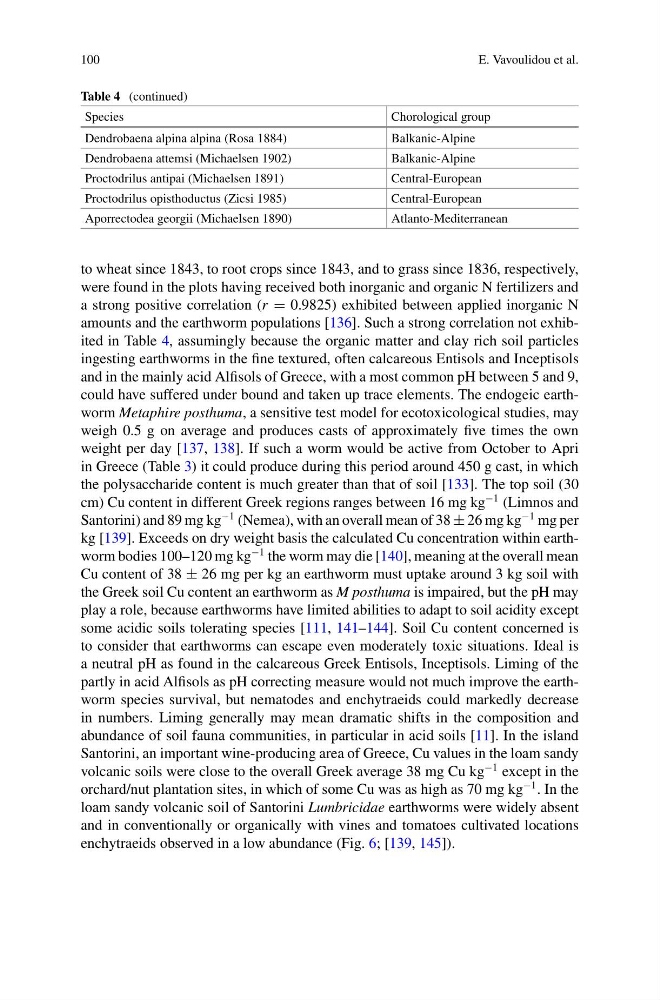
Table 4 (continued)
Species
Chorological group
Dendrobaena alpina alpina (Rosa 1884)
Balkanic-Alpine
Dendrobaena attemsi (Michaelsen 1902)
Balkanic-Alpine
Proctodrilus antipai (Michaelsen 1891)
Central-European
Proctodrilus opisthoductus (Zicsi 1985)
Central-European
Aporrectodea georgii (Michaelsen 1890)
Atlanto-Mediterranean
to wheat since 1843, to root crops since 1843, and to grass since 1836, respectively,
were found in the plots having received both inorganic and organic N fertilizers and
a strong positive correlation (r = 0.9825) exhibited between applied inorganic N
amounts and the earthworm populations [136]. Such a strong correlation not exhibited in Table 4, assumingly because the organic matter and clay rich soil particles
ingesting earthworms in the fine textured, often calcareous Entisols and Inceptisols
and in the mainly acid Alfisols of Greece, with a most common pH between 5 and 9,
could have suffered under bound and taken up trace elements. The endogeic earthworm Metaphire posthuma, a sensitive test model for ecotoxicological studies, may
weigh 0.5 g on average and produces casts of approximately five times the own
weight per day [137, 138]. If such a worm would be active from October to Apri
in Greece (Table 3) it could produce during this period around 450 g cast, in which
the polysaccharide content is much greater than that of soil [133]. The top soil (30
cm) Cu content in different Greek regions ranges between 16 mg kg
−1 (Limnos and
Santorini) and 89 mg kg
−1 (Nemea), with an overall mean of 38 ± 26 mg kg
−1 mg per
kg [139]. Exceeds on dry weight basis the calculated Cu concentration within earthworm bodies 100–120 mg kg
−1 the worm may die [140], meaning at the overall mean
Cu content of 38 ± 26 mg per kg an earthworm must uptake around 3 kg soil with
the Greek soil Cu content an earthworm as M posthuma is impaired, but the pH may
play a role, because earthworms have limited abilities to adapt to soil acidity except
some acidic soils tolerating species [111, 141–144]. Soil Cu content concerned is
to consider that earthworms can escape even moderately toxic situations. Ideal is
a neutral pH as found in the calcareous Greek Entisols, Inceptisols. Liming of the
partly in acid Alfisols as pH correcting measure would not much improve the earthworm species survival, but nematodes and enchytraeids could markedly decrease
in numbers. Liming generally may mean dramatic shifts in the composition and
abundance of soil fauna communities, in particular in acid soils [11]. In the island
Santorini, an important wine-producing area of Greece, Cu values in the loam sandy
volcanic soils were close to the overall Greek average 38 mg Cu kg
−1 except in the
orchard/nut plantation sites, in which of some Cu was as high as 70 mg kg
−1 . In the
loam sandy volcanic soil of Santorini Lumbricidae earthworms were widely absent
and in conventionally or organically with vines and tomatoes cultivated locations
enchytraeids observed in a low abundance (Fig. 6; [139, 145]).
E. Vavoulidou et al.
Table 4 (continued)
Species
Chorological group
Dendrobaena alpina alpina (Rosa 1884)
Balkanic-Alpine
Dendrobaena attemsi (Michaelsen 1902)
Balkanic-Alpine
Proctodrilus antipai (Michaelsen 1891)
Central-European
Proctodrilus opisthoductus (Zicsi 1985)
Central-European
Aporrectodea georgii (Michaelsen 1890)
Atlanto-Mediterranean
to wheat since 1843, to root crops since 1843, and to grass since 1836, respectively,
were found in the plots having received both inorganic and organic N fertilizers and
a strong positive correlation (r = 0.9825) exhibited between applied inorganic N
amounts and the earthworm populations [136]. Such a strong correlation not exhibited in Table 4, assumingly because the organic matter and clay rich soil particles
ingesting earthworms in the fine textured, often calcareous Entisols and Inceptisols
and in the mainly acid Alfisols of Greece, with a most common pH between 5 and 9,
could have suffered under bound and taken up trace elements. The endogeic earthworm Metaphire posthuma, a sensitive test model for ecotoxicological studies, may
weigh 0.5 g on average and produces casts of approximately five times the own
weight per day [137, 138]. If such a worm would be active from October to Apri
in Greece (Table 3) it could produce during this period around 450 g cast, in which
the polysaccharide content is much greater than that of soil [133]. The top soil (30
cm) Cu content in different Greek regions ranges between 16 mg kg
−1 (Limnos and
Santorini) and 89 mg kg
−1 (Nemea), with an overall mean of 38 ± 26 mg kg
−1 mg per
kg [139]. Exceeds on dry weight basis the calculated Cu concentration within earthworm bodies 100–120 mg kg
−1 the worm may die [140], meaning at the overall mean
Cu content of 38 ± 26 mg per kg an earthworm must uptake around 3 kg soil with
the Greek soil Cu content an earthworm as M posthuma is impaired, but the pH may
play a role, because earthworms have limited abilities to adapt to soil acidity except
some acidic soils tolerating species [111, 141–144]. Soil Cu content concerned is
to consider that earthworms can escape even moderately toxic situations. Ideal is
a neutral pH as found in the calcareous Greek Entisols, Inceptisols. Liming of the
partly in acid Alfisols as pH correcting measure would not much improve the earthworm species survival, but nematodes and enchytraeids could markedly decrease
in numbers. Liming generally may mean dramatic shifts in the composition and
abundance of soil fauna communities, in particular in acid soils [11]. In the island
Santorini, an important wine-producing area of Greece, Cu values in the loam sandy
volcanic soils were close to the overall Greek average 38 mg Cu kg
−1 except in the
orchard/nut plantation sites, in which of some Cu was as high as 70 mg kg
−1 . In the
loam sandy volcanic soil of Santorini Lumbricidae earthworms were widely absent
and in conventionally or organically with vines and tomatoes cultivated locations
enchytraeids observed in a low abundance (Fig. 6; [139, 145]).