

66
Internet of Things (IoT)
4.3 Security
Every device involved in IoT represents a risk, and it is a major threat to an organization
about the confidentiality of the data collected and the integrity of the dataset. Connecting
low-cost IoT devices with minimal security mechanism will face ever-increasing potential security threats. IoT applications pose a variety of security challenges. For instance,
in factory floor automation, the deeply embedded programmable logic controllers (PLCs)
which operate robotic systems are typically integrated with the enterprise IT infrastructure. How can those PLCs be shielded from human interference at the same time protecting
the investment in the IT infrastructure and leveraging the available security controls [8].
4.3.1 IoT Security Requirements
IoT involves sharing of data among users and objects or among objects themselves. In this
environment, certain security requirements should be implemented. Basic IoT framework
is shown in Figure 4.5 and the security at each layer is mandatory.
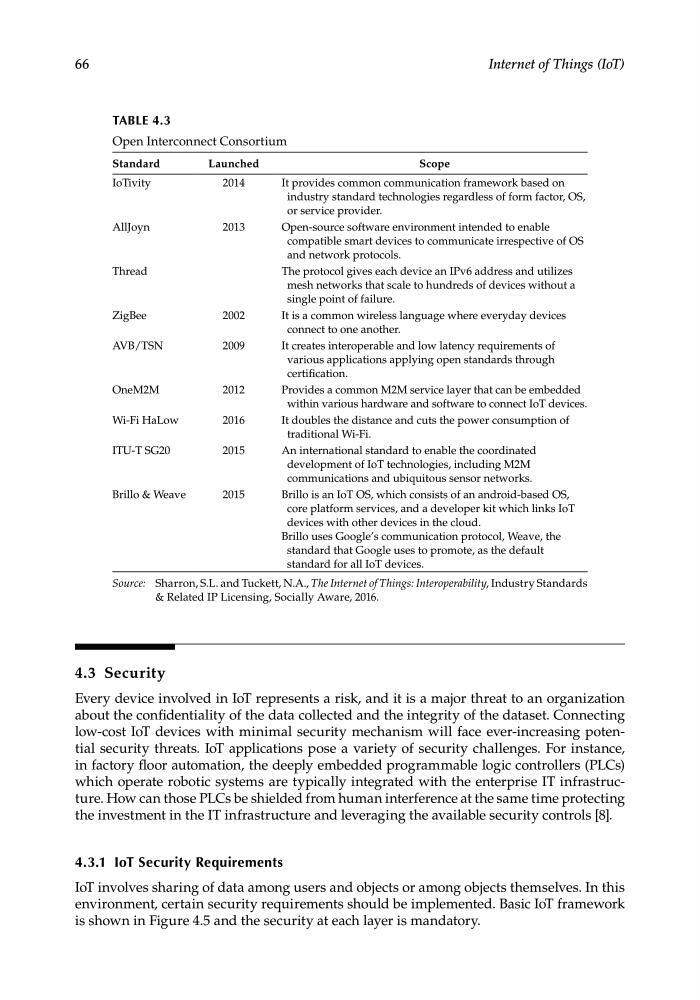
TABLE 4.3
Open Interconnect Consortium
Standard
Launched
Scope
IoTivity
2014
It provides common communication framework based on
industry standard technologies regardless of form factor, OS,
or service provider.
AllJoyn
2013
Open-source software environment intended to enable
compatible smart devices to communicate irrespective of OS
and network protocols.
Thread
The protocol gives each device an IPv6 address and utilizes
mesh networks that scale to hundreds of devices without a
single point of failure.
ZigBee
2002
It is a common wireless language where everyday devices
connect to one another.
AVB/TSN
2009
It creates interoperable and low latency requirements of
various applications applying open standards through
certification.
OneM2M
2012
Provides a common M2M service layer that can be embedded
within various hardware and software to connect IoT devices.
Wi-Fi HaLow
2016
It doubles the distance and cuts the power consumption of
traditional Wi-Fi.
ITU-T SG20
2015
An international standard to enable the coordinated
development of IoT technologies, including M2M
communications and ubiquitous sensor networks.
Brillo & Weave
2015
Brillo is an IoT OS, which consists of an android-based OS,
core platform services, and a developer kit which links IoT
devices with other devices in the cloud.
Brillo uses Google’s communication protocol, Weave, the
standard that Google uses to promote, as the default
standard for all IoT devices.
Source: Sharron, S.L. and Tuckett, N.A., The Internet of Things: Interoperability, Industry Standards
& Related IP Licensing, Socially Aware, 2016.
Internet of Things (IoT)
4.3 Security
Every device involved in IoT represents a risk, and it is a major threat to an organization
about the confidentiality of the data collected and the integrity of the dataset. Connecting
low-cost IoT devices with minimal security mechanism will face ever-increasing potential security threats. IoT applications pose a variety of security challenges. For instance,
in factory floor automation, the deeply embedded programmable logic controllers (PLCs)
which operate robotic systems are typically integrated with the enterprise IT infrastructure. How can those PLCs be shielded from human interference at the same time protecting
the investment in the IT infrastructure and leveraging the available security controls [8].
4.3.1 IoT Security Requirements
IoT involves sharing of data among users and objects or among objects themselves. In this
environment, certain security requirements should be implemented. Basic IoT framework
is shown in Figure 4.5 and the security at each layer is mandatory.
TABLE 4.3
Open Interconnect Consortium
Standard
Launched
Scope
IoTivity
2014
It provides common communication framework based on
industry standard technologies regardless of form factor, OS,
or service provider.
AllJoyn
2013
Open-source software environment intended to enable
compatible smart devices to communicate irrespective of OS
and network protocols.
Thread
The protocol gives each device an IPv6 address and utilizes
mesh networks that scale to hundreds of devices without a
single point of failure.
ZigBee
2002
It is a common wireless language where everyday devices
connect to one another.
AVB/TSN
2009
It creates interoperable and low latency requirements of
various applications applying open standards through
certification.
OneM2M
2012
Provides a common M2M service layer that can be embedded
within various hardware and software to connect IoT devices.
Wi-Fi HaLow
2016
It doubles the distance and cuts the power consumption of
traditional Wi-Fi.
ITU-T SG20
2015
An international standard to enable the coordinated
development of IoT technologies, including M2M
communications and ubiquitous sensor networks.
Brillo & Weave
2015
Brillo is an IoT OS, which consists of an android-based OS,
core platform services, and a developer kit which links IoT
devices with other devices in the cloud.
Brillo uses Google’s communication protocol, Weave, the
standard that Google uses to promote, as the default
standard for all IoT devices.
Source: Sharron, S.L. and Tuckett, N.A., The Internet of Things: Interoperability, Industry Standards
& Related IP Licensing, Socially Aware, 2016.