

25
Identification from Wearable Device Brain Signals
K-means algorithm. The major difference is that we use medoids instead of centroids of
the clusters.
Let us assume that the clusters are represented by K-medoids:
c c
ck
, ,...,
1
2
. For each
object vector,
v, let
d v c j
( )
,
be the distance between itself and the medoid of cluster
c j
Let
d v c
dv c
i
i j k
j
( )
( )
=
≤ ≤
,
min
,
. The ratios
d v c
d v c
i
j
( ) ( )
,
,
, 1 ≤ i, j ≤ k, are used to determine
the membership of
v . Let
T
j
d v c
d v c
threshold
i j
i
j
( ) ( )
=
≤
≠
:
,
,
and
.
1. If T ≠ ϕ,
v A c i
( )
∈
and
v A c j
( )
∈
, j T
∀ ∈ . Furthermore, ~v is not part of any lower
bound. The above criterion guarantees that property (P3) is satisfied.
2. Otherwise, if T ≠ ϕ,
v A c i
( )
∈
. In addition, by property (P2)
v A c i
( )
∈
It should be emphasized that the approximation space A is not defined based on any
predefined relation on the set of objects. The lower and upper bounds are constructed
based on the criteria described above.
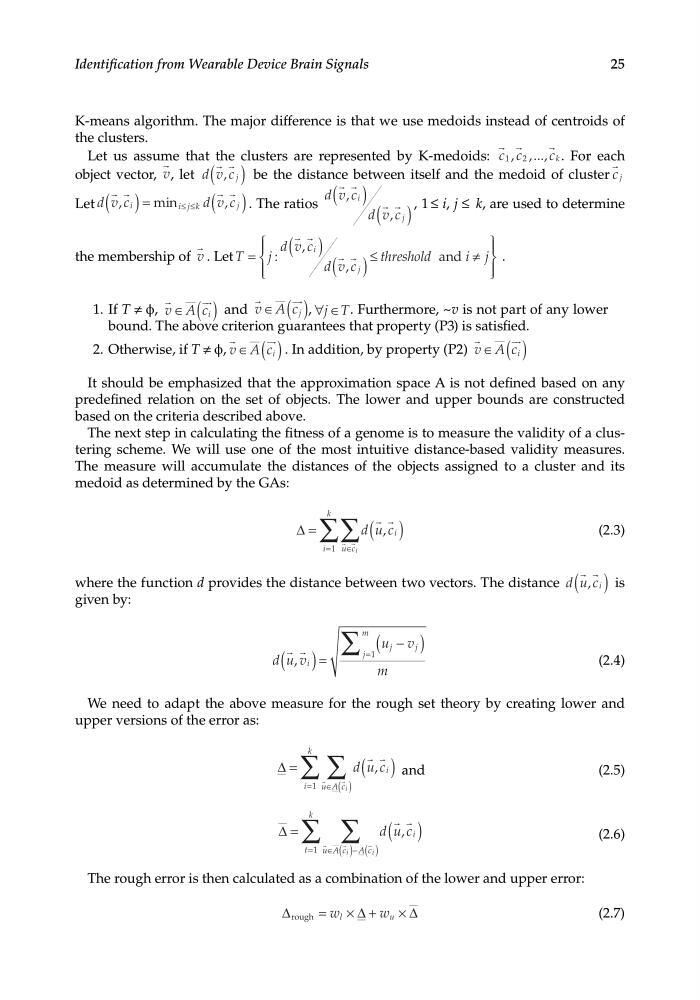
The next step in calculating the fitness of a genome is to measure the validity of a clustering scheme. We will use one of the most intuitive distance-based validity measures.
The measure will accumulate the distances of the objects assigned to a cluster and its
medoid as determined by the GAs:
d u ci
u c
i
k
i
,
1
∑
∑ ( )
∆ =
∈
=
(2.3)
where the function d provides the distance between two vectors. The distance
d u ci
( )
,
is
given by:
d u v
u v
m
i
j
j
j
m
,
1
∑
( )
(
)
=
−
=
(2.4)
We need to adapt the above measure for the rough set theory by creating lower and
upper versions of the error as:
d u ci
u A c
i
k
i
,
1
∑
∑ ( )
∆ =
( )
∈
=
and
(2.5)
d u ci
u A c A c
t
k
i
i
,
1
∑
∑
( )
∆ =
( ) ( )
∈
−
=
(2.6)
The rough error is then calculated as a combination of the lower and upper error:
w
w
l
u
rough
∆
= × ∆ +
×∆
(2.7)
Identification from Wearable Device Brain Signals
K-means algorithm. The major difference is that we use medoids instead of centroids of
the clusters.
Let us assume that the clusters are represented by K-medoids:
c c
ck
, ,...,
1
2
. For each
object vector,
v, let
d v c j
( )
,
be the distance between itself and the medoid of cluster
c j
Let
d v c
dv c
i
i j k
j
( )
( )
=
≤ ≤
,
min
,
. The ratios
d v c
d v c
i
j
( ) ( )
,
,
, 1 ≤ i, j ≤ k, are used to determine
the membership of
v . Let
T
j
d v c
d v c
threshold
i j
i
j
( ) ( )
=
≤
≠
:
,
,
and
.
1. If T ≠ ϕ,
v A c i
( )
∈
and
v A c j
( )
∈
, j T
∀ ∈ . Furthermore, ~v is not part of any lower
bound. The above criterion guarantees that property (P3) is satisfied.
2. Otherwise, if T ≠ ϕ,
v A c i
( )
∈
. In addition, by property (P2)
v A c i
( )
∈
It should be emphasized that the approximation space A is not defined based on any
predefined relation on the set of objects. The lower and upper bounds are constructed
based on the criteria described above.
The next step in calculating the fitness of a genome is to measure the validity of a clustering scheme. We will use one of the most intuitive distance-based validity measures.
The measure will accumulate the distances of the objects assigned to a cluster and its
medoid as determined by the GAs:
d u ci
u c
i
k
i
,
1
∑
∑ ( )
∆ =
∈
=
(2.3)
where the function d provides the distance between two vectors. The distance
d u ci
( )
,
is
given by:
d u v
u v
m
i
j
j
j
m
,
1
∑
( )
(
)
=
−
=
(2.4)
We need to adapt the above measure for the rough set theory by creating lower and
upper versions of the error as:
d u ci
u A c
i
k
i
,
1
∑
∑ ( )
∆ =
( )
∈
=
and
(2.5)
d u ci
u A c A c
t
k
i
i
,
1
∑
∑
( )
∆ =
( ) ( )
∈
−
=
(2.6)
The rough error is then calculated as a combination of the lower and upper error:
w
w
l
u
rough
∆
= × ∆ +
×∆
(2.7)