

302
Internet of Things (IoT)
14.1.3.3 High Technology
A number of studies show that information technology provides support for training and
therapy for autistic children. It not only provides support to increase the learning ability
but also extensively reduces the disturbing behaviors of the autistic children and expands
consistency with directions of learning (Moore et al. 2000; Pleinis and Romanczyk 1985).
Different software and tools have been developed to expand perusing and general and
social relational abilities of children with autism. According to Cheng et al. (2003), computer technology in a teaching environment for autistic children helps increase focused
attention, generalization of skills, changing of behavior, etc., whereas in the traditional
approaches of learning to autism the child fails in some aspects.
14.1.4 Current Developments and Applications of IoT Technologies
This section discusses a few ultramodern and new applications of IoT technology for
providing guidance and help to children suffering from ASDs. Several studies have
identified that caution is necessary when taking into consideration the application
of IoT made by the large amount of modern research improvements, as indicated in
Figure 14.3. Low-tech technology became helpful for autistic children to establish their
daily schedule and it would be easy for children to modify the schedule themselves.
High-tech technology could support in training additional complicated processing. A
noticeable changes has been guaranteed in the study of autism by using the progressive
technology. However, most research (Michel 2004) results have not been used to wider
testing. The right assures can only be exposed over time, as systematic, restricted scientific testings are approved. This present changing situation, following IoT devices, is
coordinated to the particulars of the required theme. It helps the dual target of empowering socialization and encouraging collaboration among children with ASD.
14.1.5 Wearable Devices
As explained by Fletcher et al. (2010), wearable sensors are successfully implanted for a
long-term constant physiological monitoring, which is vital for the cure and supervision
of many neurological disorders, mental disorder issues, and chronic illnesses. Wearable
sensors also have integrated into fashion accessories, garments, wristbands, hats, shoes,
socks, headphones, eyeglasses, etc. These gadgets sometimes include the accelerometers
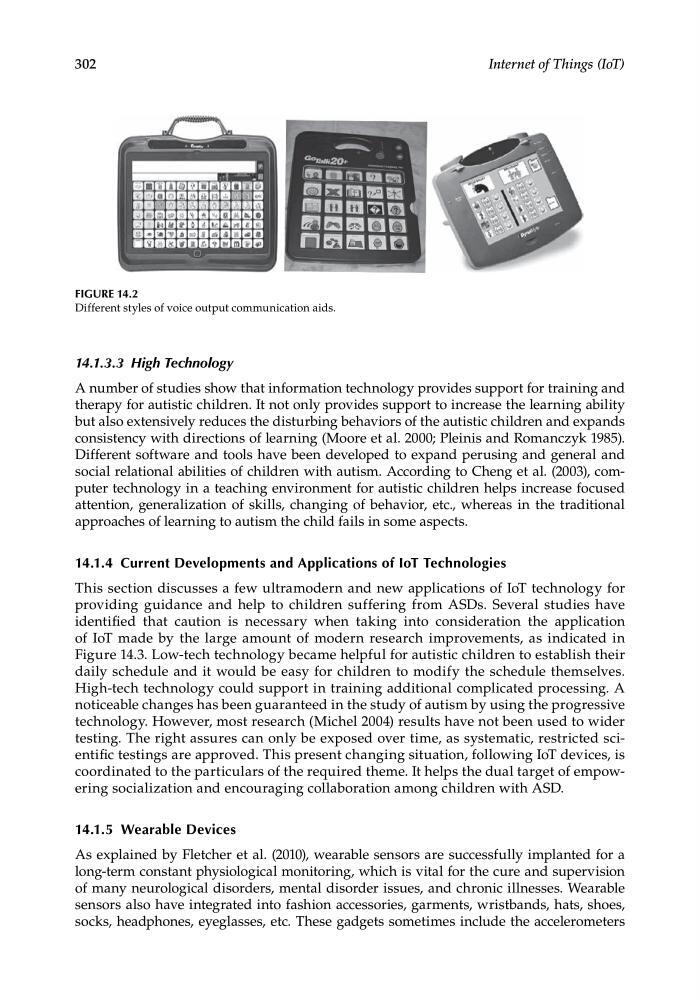
FIGURE 14.2
Different styles of voice output communication aids.
Internet of Things (IoT)
14.1.3.3 High Technology
A number of studies show that information technology provides support for training and
therapy for autistic children. It not only provides support to increase the learning ability
but also extensively reduces the disturbing behaviors of the autistic children and expands
consistency with directions of learning (Moore et al. 2000; Pleinis and Romanczyk 1985).
Different software and tools have been developed to expand perusing and general and
social relational abilities of children with autism. According to Cheng et al. (2003), computer technology in a teaching environment for autistic children helps increase focused
attention, generalization of skills, changing of behavior, etc., whereas in the traditional
approaches of learning to autism the child fails in some aspects.
14.1.4 Current Developments and Applications of IoT Technologies
This section discusses a few ultramodern and new applications of IoT technology for
providing guidance and help to children suffering from ASDs. Several studies have
identified that caution is necessary when taking into consideration the application
of IoT made by the large amount of modern research improvements, as indicated in
Figure 14.3. Low-tech technology became helpful for autistic children to establish their
daily schedule and it would be easy for children to modify the schedule themselves.
High-tech technology could support in training additional complicated processing. A
noticeable changes has been guaranteed in the study of autism by using the progressive
technology. However, most research (Michel 2004) results have not been used to wider
testing. The right assures can only be exposed over time, as systematic, restricted scientific testings are approved. This present changing situation, following IoT devices, is
coordinated to the particulars of the required theme. It helps the dual target of empowering socialization and encouraging collaboration among children with ASD.
14.1.5 Wearable Devices
As explained by Fletcher et al. (2010), wearable sensors are successfully implanted for a
long-term constant physiological monitoring, which is vital for the cure and supervision
of many neurological disorders, mental disorder issues, and chronic illnesses. Wearable
sensors also have integrated into fashion accessories, garments, wristbands, hats, shoes,
socks, headphones, eyeglasses, etc. These gadgets sometimes include the accelerometers
FIGURE 14.2
Different styles of voice output communication aids.