

268
Internet of Things (IoT)
properties or predicates describe relations between resources. For example: “hasLocation,” “hasType,” “hasID,” “deviceID.” The relationship from subject to object is expressed
in a directional way. Properties in RDF are also identified by URIs. Say, for example,
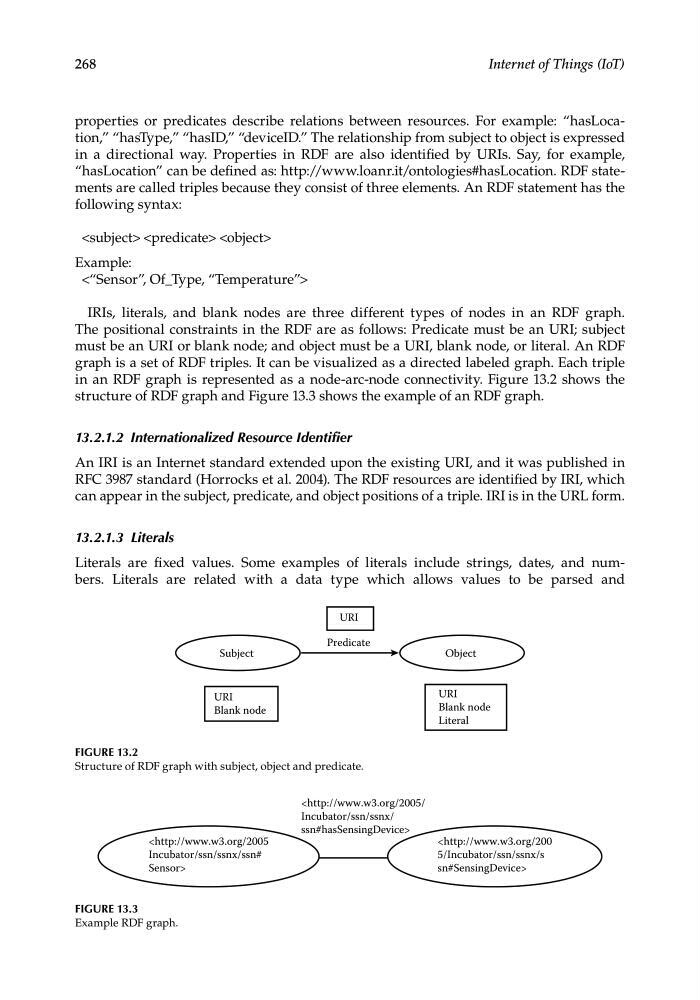
“ hasLocation” can be defined as: http://www.loanr.it/ontologies#hasLocation. RDF statements are called triples because they consist of three elements. An RDF statement has the
following syntax:
Internet of Things (IoT)
properties or predicates describe relations between resources. For example: “hasLocation,” “hasType,” “hasID,” “deviceID.” The relationship from subject to object is expressed
in a directional way. Properties in RDF are also identified by URIs. Say, for example,
“ hasLocation” can be defined as: http://www.loanr.it/ontologies#hasLocation. RDF statements are called triples because they consist of three elements. An RDF statement has the
following syntax: