

267
Semantic Technologies for IoT
high-level abstractions from sensor data. Fourth, context-awareness could be implemented
using semantic reasoning. Finally, in theory, semantics eases the knowledge sharing and
reuse of domain knowledge expertise which should avoid the reinvention of the wheel.
Indeed, each time a new domain-specific vocabulary is defined.
13.2 Semantic Technology
13.2.1 Resource Description Framework
The resource description framework (RDF) (Klyne and Carroll 2004) is a framework for
graph-based information representation about resources and was intended for representing metadata about WWW resources. RDF gives interoperability between various applications that exchange information, which can be inferred by machine on the web. Various
uses of RDF are given below:
• Providing standards for exchanging data between databases.
• By connecting RDF descriptions of people across multiple websites, distributed
social networks can be built.
• Cross-dataset can be executed with the help of Simple Protocol and RDF Query
Language (SPARQL) query if the datasets are interconnected in an organization.
13.2.1.1 RDF Data Model
An RDF is a graph-based data model, and subject–predicate–object expression is its basic
structure. We can make a statement about resources using RDF. Each resource is associated with universal resource identifier (URI). An URI is structured like an URL (Uniform
Resource Locator) or some other type of identifier. Special kinds of resource called
Services and applications
Service publication, discovery, composition, and adaptation
Data processing
Data abstraction and perception
Semantic reasoning
Data integration and fusion
Semantic annotation
Devices, resources, and networks
(e.g., W3C SSN ontology, IoT-A resource model)
Domain knowledge
Thematic, temporal, and special data
(e.g., LoD)
Security, privacy, and trust
Real world objects (i.e., “Things”)
(e.g., IoT-A entity model)
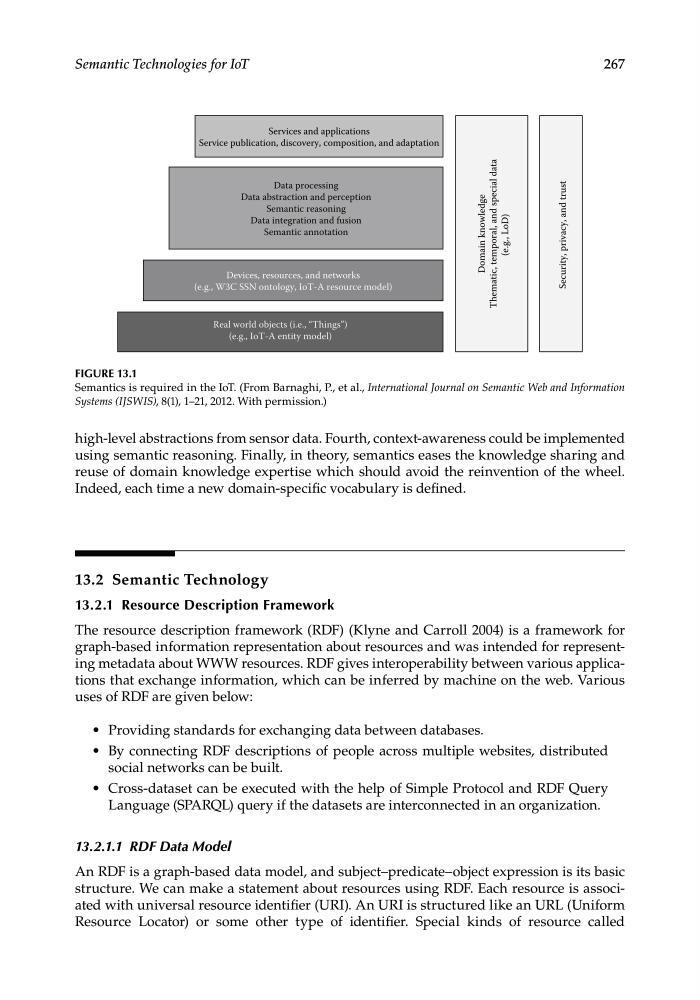
FIGURE 13.1
Semantics is required in the IoT. (From Barnaghi, P., et al., International Journal on Semantic Web and Information
Systems (IJSWIS), 8(1), 1–21, 2012. With permission.)
Semantic Technologies for IoT
high-level abstractions from sensor data. Fourth, context-awareness could be implemented
using semantic reasoning. Finally, in theory, semantics eases the knowledge sharing and
reuse of domain knowledge expertise which should avoid the reinvention of the wheel.
Indeed, each time a new domain-specific vocabulary is defined.
13.2 Semantic Technology
13.2.1 Resource Description Framework
The resource description framework (RDF) (Klyne and Carroll 2004) is a framework for
graph-based information representation about resources and was intended for representing metadata about WWW resources. RDF gives interoperability between various applications that exchange information, which can be inferred by machine on the web. Various
uses of RDF are given below:
• Providing standards for exchanging data between databases.
• By connecting RDF descriptions of people across multiple websites, distributed
social networks can be built.
• Cross-dataset can be executed with the help of Simple Protocol and RDF Query
Language (SPARQL) query if the datasets are interconnected in an organization.
13.2.1.1 RDF Data Model
An RDF is a graph-based data model, and subject–predicate–object expression is its basic
structure. We can make a statement about resources using RDF. Each resource is associated with universal resource identifier (URI). An URI is structured like an URL (Uniform
Resource Locator) or some other type of identifier. Special kinds of resource called
Services and applications
Service publication, discovery, composition, and adaptation
Data processing
Data abstraction and perception
Semantic reasoning
Data integration and fusion
Semantic annotation
Devices, resources, and networks
(e.g., W3C SSN ontology, IoT-A resource model)
Domain knowledge
Thematic, temporal, and special data
(e.g., LoD)
Security, privacy, and trust
Real world objects (i.e., “Things”)
(e.g., IoT-A entity model)
FIGURE 13.1
Semantics is required in the IoT. (From Barnaghi, P., et al., International Journal on Semantic Web and Information
Systems (IJSWIS), 8(1), 1–21, 2012. With permission.)