

228
Internet of Things (IoT)
intrusions: one that makes the system processes fail and one that inundates the system
processes. The distributed attacks are the most damaging ones [6].
11.9.1.7 Node Privacy Leak
Hackers can directly or indirectly steal compromising data in the end point. The devices
at home are situated at particular places and, instead of attacking them, the hackers try to
immorally obtain the information stored in those devices. They use a guerrilla approach to
take over the minor parts of someone’s system by eventually influencing the functioning
of the network [7].
Furthermore, the hardware framework for certain perceptual end points is very straightforward and uncomplicated, which gives a chance for the hackers to duplicate it. Because of
the restriction of the resources at the nodes, the dispersed framework, this perceptual layer
results in several damages, including annexing it manually, being jeopardized by annexation.
11.10 An Innovative Framework for IoT Security [8]
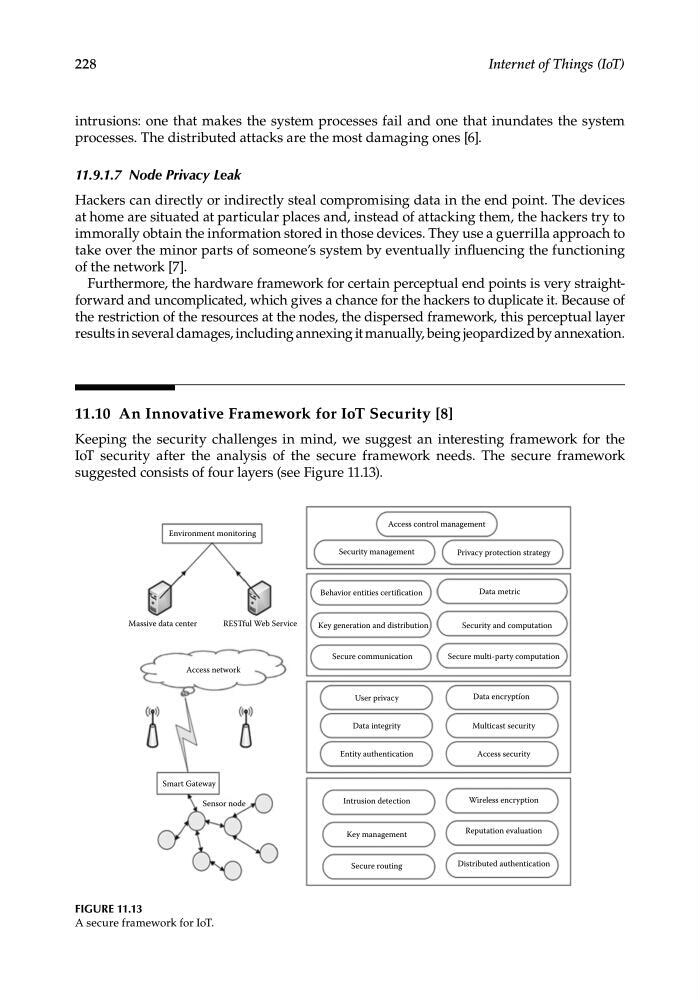
Keeping the security challenges in mind, we suggest an interesting framework for the
IoT security after the analysis of the secure framework needs. The secure framework
suggested consists of four layers (see Figure 11.13).
Environment monitoring
Massive data center
RESTful Web Service
Access network
Smart Gateway
Sensor node
Distributed authentication
User privacy
Secure communication
Access security
Privacy protection strategy
Access control management
Security management
Data metric
Secure multi-party computation
Data encryption
Wireless encryption
Reputation evaluation
Entity authentication
Data integrity
Key generation and distribution
Behavior entities certification
Secure routing
Key management
Intrusion detection
Security and computation
Multicast security
FIGURE 11.13
A secure framework for IoT.
Internet of Things (IoT)
intrusions: one that makes the system processes fail and one that inundates the system
processes. The distributed attacks are the most damaging ones [6].
11.9.1.7 Node Privacy Leak
Hackers can directly or indirectly steal compromising data in the end point. The devices
at home are situated at particular places and, instead of attacking them, the hackers try to
immorally obtain the information stored in those devices. They use a guerrilla approach to
take over the minor parts of someone’s system by eventually influencing the functioning
of the network [7].
Furthermore, the hardware framework for certain perceptual end points is very straightforward and uncomplicated, which gives a chance for the hackers to duplicate it. Because of
the restriction of the resources at the nodes, the dispersed framework, this perceptual layer
results in several damages, including annexing it manually, being jeopardized by annexation.
11.10 An Innovative Framework for IoT Security [8]
Keeping the security challenges in mind, we suggest an interesting framework for the
IoT security after the analysis of the secure framework needs. The secure framework
suggested consists of four layers (see Figure 11.13).
Environment monitoring
Massive data center
RESTful Web Service
Access network
Smart Gateway
Sensor node
Distributed authentication
User privacy
Secure communication
Access security
Privacy protection strategy
Access control management
Security management
Data metric
Secure multi-party computation
Data encryption
Wireless encryption
Reputation evaluation
Entity authentication
Data integrity
Key generation and distribution
Behavior entities certification
Secure routing
Key management
Intrusion detection
Security and computation
Multicast security
FIGURE 11.13
A secure framework for IoT.