

192
Internet of Things (IoT)
These standards provide fundamental protection to use medical devices in the IoT
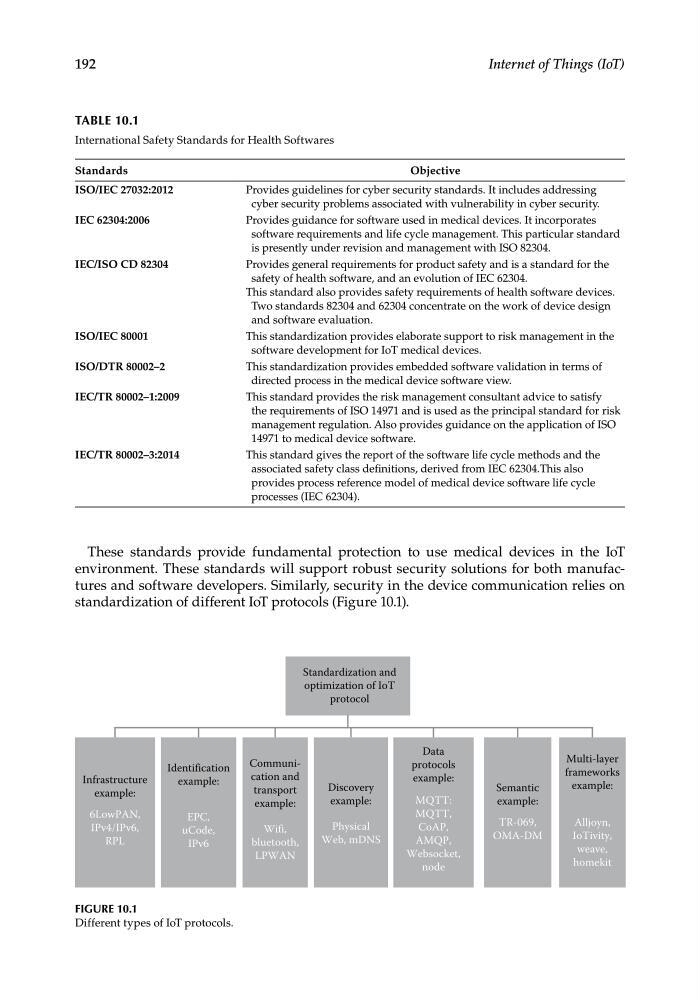
environment. These standards will support robust security solutions for both manufactures and software developers. Similarly, security in the device communication relies on
standardization of different IoT protocols (Figure 10.1).
Standardization and
optimization of IoT
protocol
Infrastructure
example:
6LowPAN,
IPv4/IPv6,
RPL
Identification
example:
EPC,
uCode,
IPv6
Communication and
transport
example:
Wifi,
bluetooth,
LPWAN
Discovery
example:
Physical
Web, mDNS
Data
protocols
example:
MQTT:
MQTT,
CoAP,
AMQP,
Websocket,
node
Semantic
example:
TR-069,
OMA-DM
Multi-layer
frameworks
example:
Alljoyn,
IoTivity,
weave,
homekit
FIGURE 10.1
Different types of IoT protocols.
TABLE 10.1
International Safety Standards for Health Softwares
Standards
Objective
ISO/IEC 27032:2012
Provides guidelines for cyber security standards. It includes addressing
cyber security problems associated with vulnerability in cyber security.
IEC 62304:2006
Provides guidance for software used in medical devices. It incorporates
software requirements and life cycle management. This particular standard
is presently under revision and management with ISO 82304.
IEC/ISO CD 82304
Provides general requirements for product safety and is a standard for the
safety of health software, and an evolution of IEC 62304.
This standard also provides safety requirements of health software devices.
Two standards 82304 and 62304 concentrate on the work of device design
and software evaluation.
ISO/IEC 80001
This standardization provides elaborate support to risk management in the
software development for IoT medical devices.
ISO/DTR 80002–2
This standardization provides embedded software validation in terms of
directed process in the medical device software view.
IEC/TR 80002–1:2009
This standard provides the risk management consultant advice to satisfy
the requirements of ISO 14971 and is used as the principal standard for risk
management regulation. Also provides guidance on the application of ISO
14971 to medical device software.
IEC/TR 80002–3:2014
This standard gives the report of the software life cycle methods and the
associated safety class definitions, derived from IEC 62304.This also
provides process reference model of medical device software life cycle
processes (IEC 62304).
Internet of Things (IoT)
These standards provide fundamental protection to use medical devices in the IoT
environment. These standards will support robust security solutions for both manufactures and software developers. Similarly, security in the device communication relies on
standardization of different IoT protocols (Figure 10.1).
Standardization and
optimization of IoT
protocol
Infrastructure
example:
6LowPAN,
IPv4/IPv6,
RPL
Identification
example:
EPC,
uCode,
IPv6
Communication and
transport
example:
Wifi,
bluetooth,
LPWAN
Discovery
example:
Physical
Web, mDNS
Data
protocols
example:
MQTT:
MQTT,
CoAP,
AMQP,
Websocket,
node
Semantic
example:
TR-069,
OMA-DM
Multi-layer
frameworks
example:
Alljoyn,
IoTivity,
weave,
homekit
FIGURE 10.1
Different types of IoT protocols.
TABLE 10.1
International Safety Standards for Health Softwares
Standards
Objective
ISO/IEC 27032:2012
Provides guidelines for cyber security standards. It includes addressing
cyber security problems associated with vulnerability in cyber security.
IEC 62304:2006
Provides guidance for software used in medical devices. It incorporates
software requirements and life cycle management. This particular standard
is presently under revision and management with ISO 82304.
IEC/ISO CD 82304
Provides general requirements for product safety and is a standard for the
safety of health software, and an evolution of IEC 62304.
This standard also provides safety requirements of health software devices.
Two standards 82304 and 62304 concentrate on the work of device design
and software evaluation.
ISO/IEC 80001
This standardization provides elaborate support to risk management in the
software development for IoT medical devices.
ISO/DTR 80002–2
This standardization provides embedded software validation in terms of
directed process in the medical device software view.
IEC/TR 80002–1:2009
This standard provides the risk management consultant advice to satisfy
the requirements of ISO 14971 and is used as the principal standard for risk
management regulation. Also provides guidance on the application of ISO
14971 to medical device software.
IEC/TR 80002–3:2014
This standard gives the report of the software life cycle methods and the
associated safety class definitions, derived from IEC 62304.This also
provides process reference model of medical device software life cycle
processes (IEC 62304).