

148
Internet of Things (IoT)
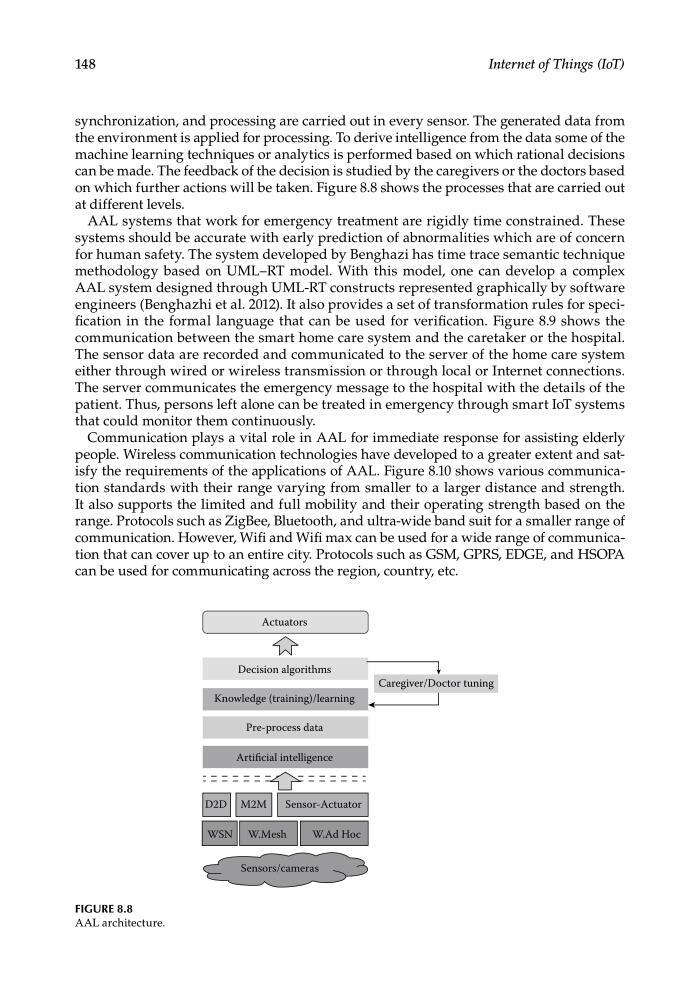
synchronization, and processing are carried out in every sensor. The generated data from
the environment is applied for processing. To derive intelligence from the data some of the
machine learning techniques or analytics is performed based on which rational decisions
can be made. The feedback of the decision is studied by the caregivers or the doctors based
on which further actions will be taken. Figure 8.8 shows the processes that are carried out
at different levels.
AAL systems that work for emergency treatment are rigidly time constrained. These
systems should be accurate with early prediction of abnormalities which are of concern
for human safety. The system developed by Benghazi has time trace semantic technique
methodology based on UML–RT model. With this model, one can develop a complex
AAL system designed through UML-RT constructs represented graphically by software
engineers (Benghazhi et al. 2012). It also provides a set of transformation rules for specification in the formal language that can be used for verification. Figure 8.9 shows the
communication between the smart home care system and the caretaker or the hospital.
The sensor data are recorded and communicated to the server of the home care system
either through wired or wireless transmission or through local or Internet connections.
The server communicates the emergency message to the hospital with the details of the
patient. Thus, persons left alone can be treated in emergency through smart IoT systems
that could monitor them continuously.
Communication plays a vital role in AAL for immediate response for assisting elderly
people. Wireless communication technologies have developed to a greater extent and satisfy the requirements of the applications of AAL. Figure 8.10 shows various communication standards with their range varying from smaller to a larger distance and strength.
It also supports the limited and full mobility and their operating strength based on the
range. Protocols such as ZigBee, Bluetooth, and ultra-wide band suit for a smaller range of
communication. However, Wifi and Wifi max can be used for a wide range of communication that can cover up to an entire city. Protocols such as GSM, GPRS, EDGE, and HSOPA
can be used for communicating across the region, country, etc.
Actuators
Decision algorithms
Knowledge (training)/learning
Pre-process data
Artificial intelligence
D2D M2M
Sensor-Actuator
WSN W.Mesh
W .Ad Hoc
Sensors/cameras
Caregiver/Doctor tuning
FIGURE 8.8
AAL architecture.
Internet of Things (IoT)
synchronization, and processing are carried out in every sensor. The generated data from
the environment is applied for processing. To derive intelligence from the data some of the
machine learning techniques or analytics is performed based on which rational decisions
can be made. The feedback of the decision is studied by the caregivers or the doctors based
on which further actions will be taken. Figure 8.8 shows the processes that are carried out
at different levels.
AAL systems that work for emergency treatment are rigidly time constrained. These
systems should be accurate with early prediction of abnormalities which are of concern
for human safety. The system developed by Benghazi has time trace semantic technique
methodology based on UML–RT model. With this model, one can develop a complex
AAL system designed through UML-RT constructs represented graphically by software
engineers (Benghazhi et al. 2012). It also provides a set of transformation rules for specification in the formal language that can be used for verification. Figure 8.9 shows the
communication between the smart home care system and the caretaker or the hospital.
The sensor data are recorded and communicated to the server of the home care system
either through wired or wireless transmission or through local or Internet connections.
The server communicates the emergency message to the hospital with the details of the
patient. Thus, persons left alone can be treated in emergency through smart IoT systems
that could monitor them continuously.
Communication plays a vital role in AAL for immediate response for assisting elderly
people. Wireless communication technologies have developed to a greater extent and satisfy the requirements of the applications of AAL. Figure 8.10 shows various communication standards with their range varying from smaller to a larger distance and strength.
It also supports the limited and full mobility and their operating strength based on the
range. Protocols such as ZigBee, Bluetooth, and ultra-wide band suit for a smaller range of
communication. However, Wifi and Wifi max can be used for a wide range of communication that can cover up to an entire city. Protocols such as GSM, GPRS, EDGE, and HSOPA
can be used for communicating across the region, country, etc.
Actuators
Decision algorithms
Knowledge (training)/learning
Pre-process data
Artificial intelligence
D2D M2M
Sensor-Actuator
WSN W.Mesh
W .Ad Hoc
Sensors/cameras
Caregiver/Doctor tuning
FIGURE 8.8
AAL architecture.