

136
Internet of Things (IoT)
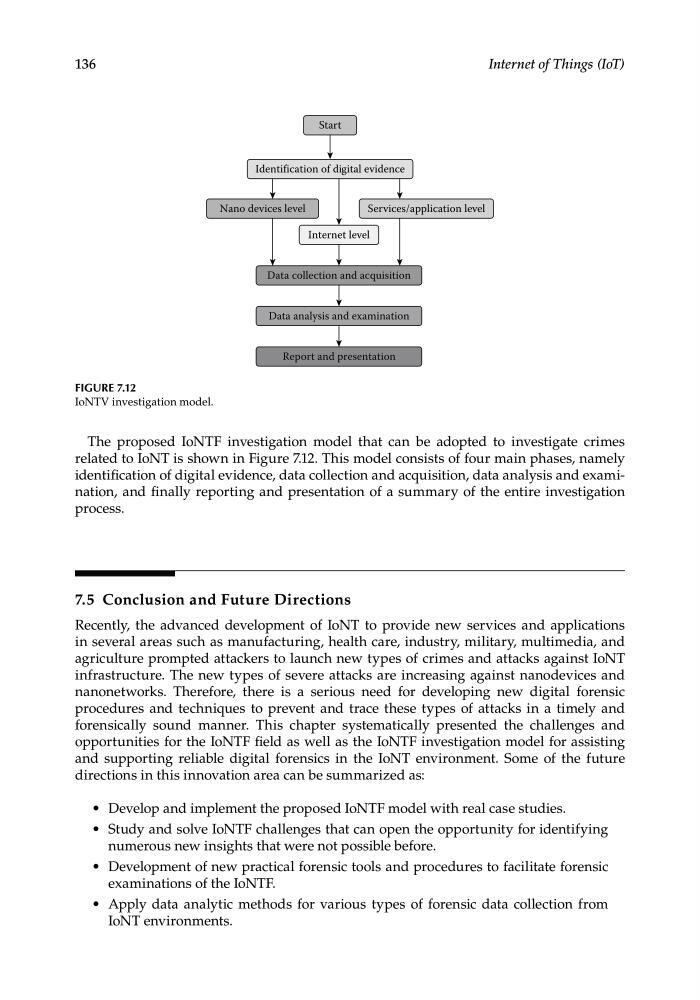
The proposed IoNTF investigation model that can be adopted to investigate crimes
related to IoNT is shown in Figure 7.12. This model consists of four main phases, namely
identification of digital evidence, data collection and acquisition, data analysis and examination, and finally reporting and presentation of a summary of the entire investigation
process.
7.5 Conclusion and Future Directions
Recently, the advanced development of IoNT to provide new services and applications
in several areas such as manufacturing, health care, industry, military, multimedia, and
agriculture prompted attackers to launch new types of crimes and attacks against IoNT
infrastructure. The new types of severe attacks are increasing against nanodevices and
nanonetworks. Therefore, there is a serious need for developing new digital forensic
procedures and techniques to prevent and trace these types of attacks in a timely and
forensically sound manner. This chapter systematically presented the challenges and
opportunities for the IoNTF field as well as the IoNTF investigation model for assisting
and supporting reliable digital forensics in the IoNT environment. Some of the future
directions in this innovation area can be summarized as:
• Develop and implement the proposed IoNTF model with real case studies.
• Study and solve IoNTF challenges that can open the opportunity for identifying
numerous new insights that were not possible before.
• Development of new practical forensic tools and procedures to facilitate forensic
examinations of the IoNTF.
• Apply data analytic methods for various types of forensic data collection from
IoNT environments.
Start
Identification of digital evidence
Data collection and acquisition
Data analysis and examination
Nano devices level
Services/application level
Internet level
Report and presentation
FIGURE 7.12
IoNTV investigation model.
Internet of Things (IoT)
The proposed IoNTF investigation model that can be adopted to investigate crimes
related to IoNT is shown in Figure 7.12. This model consists of four main phases, namely
identification of digital evidence, data collection and acquisition, data analysis and examination, and finally reporting and presentation of a summary of the entire investigation
process.
7.5 Conclusion and Future Directions
Recently, the advanced development of IoNT to provide new services and applications
in several areas such as manufacturing, health care, industry, military, multimedia, and
agriculture prompted attackers to launch new types of crimes and attacks against IoNT
infrastructure. The new types of severe attacks are increasing against nanodevices and
nanonetworks. Therefore, there is a serious need for developing new digital forensic
procedures and techniques to prevent and trace these types of attacks in a timely and
forensically sound manner. This chapter systematically presented the challenges and
opportunities for the IoNTF field as well as the IoNTF investigation model for assisting
and supporting reliable digital forensics in the IoNT environment. Some of the future
directions in this innovation area can be summarized as:
• Develop and implement the proposed IoNTF model with real case studies.
• Study and solve IoNTF challenges that can open the opportunity for identifying
numerous new insights that were not possible before.
• Development of new practical forensic tools and procedures to facilitate forensic
examinations of the IoNTF.
• Apply data analytic methods for various types of forensic data collection from
IoNT environments.
Start
Identification of digital evidence
Data collection and acquisition
Data analysis and examination
Nano devices level
Services/application level
Internet level
Report and presentation
FIGURE 7.12
IoNTV investigation model.