

128
Internet of Things (IoT)
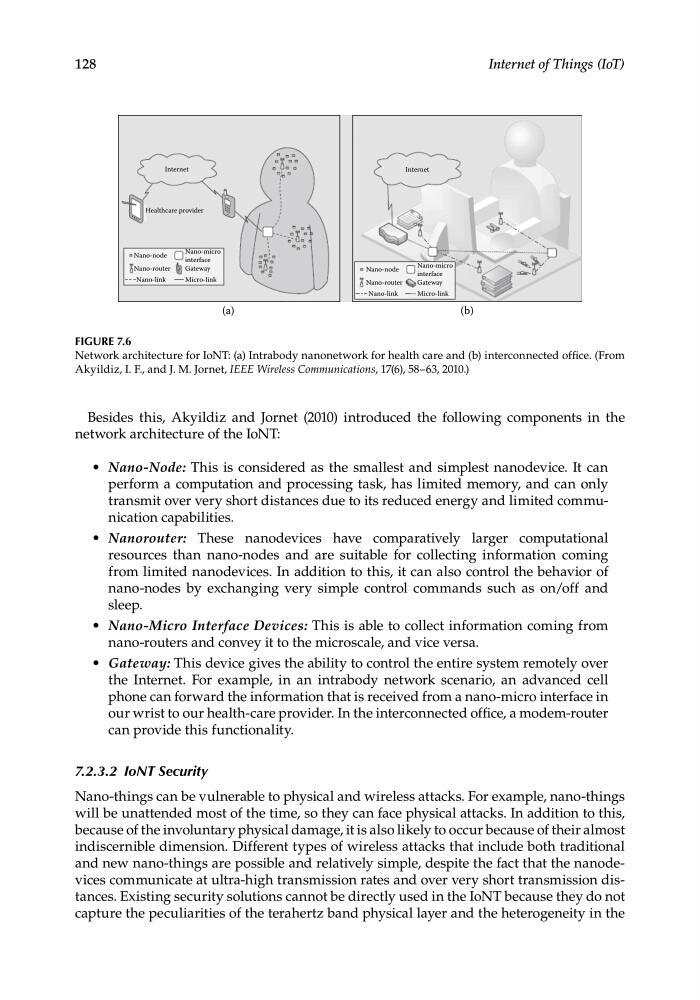
Besides this, Akyildiz and Jornet (2010) introduced the following components in the
network architecture of the IoNT:
• Nano-Node: This is considered as the smallest and simplest nanodevice. It can
perform a computation and processing task, has limited memory, and can only
transmit over very short distances due to its reduced energy and limited communication capabilities.
• Nanorouter: These nanodevices have comparatively larger computational
resources than nano-nodes and are suitable for collecting information coming
from limited nanodevices. In addition to this, it can also control the behavior of
nano-nodes by exchanging very simple control commands such as on/off and
sleep.
• Nano-Micro Interface Devices: This is able to collect information coming from
nano-routers and convey it to the microscale, and vice versa.
• Gateway: This device gives the ability to control the entire system remotely over
the Internet. For example, in an intrabody network scenario, an advanced cell
phone can forward the information that is received from a nano-micro interface in
our wrist to our health-care provider. In the interconnected office, a modem-router
can provide this functionality.
7.2.3.2 IoNT Security
Nano-things can be vulnerable to physical and wireless attacks. For example, nano-things
will be unattended most of the time, so they can face physical attacks. In addition to this,
because of the involuntary physical damage, it is also likely to occur because of their almost
indiscernible dimension. Different types of wireless attacks that include both traditional
and new nano-things are possible and relatively simple, despite the fact that the nanodevices communicate at ultra-high transmission rates and over very short transmission distances. Existing security solutions cannot be directly used in the IoNT because they do not
capture the peculiarities of the terahertz band physical layer and the heterogeneity in the
Internet
Healthcare provider
Nano-node
Nano-router
G ateway
Nano-micro
interface
Nano-link
M icro-link
Nano-node
Nano-router
G ateway
Nano-micro
interface
Internet
Nano-link
M icro-link
(a)
(b)
FIGURE 7.6
Network architecture for IoNT: (a) Intrabody nanonetwork for health care and (b) interconnected office. (From
Akyildiz, I. F., and J. M. Jornet, IEEE Wireless Communications, 17(6), 58–63, 2010.)
Internet of Things (IoT)
Besides this, Akyildiz and Jornet (2010) introduced the following components in the
network architecture of the IoNT:
• Nano-Node: This is considered as the smallest and simplest nanodevice. It can
perform a computation and processing task, has limited memory, and can only
transmit over very short distances due to its reduced energy and limited communication capabilities.
• Nanorouter: These nanodevices have comparatively larger computational
resources than nano-nodes and are suitable for collecting information coming
from limited nanodevices. In addition to this, it can also control the behavior of
nano-nodes by exchanging very simple control commands such as on/off and
sleep.
• Nano-Micro Interface Devices: This is able to collect information coming from
nano-routers and convey it to the microscale, and vice versa.
• Gateway: This device gives the ability to control the entire system remotely over
the Internet. For example, in an intrabody network scenario, an advanced cell
phone can forward the information that is received from a nano-micro interface in
our wrist to our health-care provider. In the interconnected office, a modem-router
can provide this functionality.
7.2.3.2 IoNT Security
Nano-things can be vulnerable to physical and wireless attacks. For example, nano-things
will be unattended most of the time, so they can face physical attacks. In addition to this,
because of the involuntary physical damage, it is also likely to occur because of their almost
indiscernible dimension. Different types of wireless attacks that include both traditional
and new nano-things are possible and relatively simple, despite the fact that the nanodevices communicate at ultra-high transmission rates and over very short transmission distances. Existing security solutions cannot be directly used in the IoNT because they do not
capture the peculiarities of the terahertz band physical layer and the heterogeneity in the
Internet
Healthcare provider
Nano-node
Nano-router
G ateway
Nano-micro
interface
Nano-link
M icro-link
Nano-node
Nano-router
G ateway
Nano-micro
interface
Internet
Nano-link
M icro-link
(a)
(b)
FIGURE 7.6
Network architecture for IoNT: (a) Intrabody nanonetwork for health care and (b) interconnected office. (From
Akyildiz, I. F., and J. M. Jornet, IEEE Wireless Communications, 17(6), 58–63, 2010.)