

127
Internet of Nano-Things Forensics
2. Internet of Multimedia Nano-Things: Currently, nanotechnology is able to
help in the development of new devices in nanoscale which are able to generate, process, and transmit multimedia content. The interconnection of pervasively
deployed multimedia nanodevices with existing communication networks and
ultimately the Internet to introduce a new field called the internet of multimedia
nano-things (IoMNT). The IoMNT is a powerful field that can be used in many
applications in the areas of security, defense, environment, and industry, among
others (Jornet and Akyildiz 2012).
7.2.3.1 Network Architecture in IoNT
In the IoNT, the network is the interconnection of nanodevices to each other to facilitate communication between them through the existing communication networks and
systems. Akyildiz and Jornet (2010) introduced a network architecture for the IoNT for
two applications which are intrabody nanonetworks for remote health care and future
interconnected office as shown in Figure 7.6:
1. Intrabody Networks: In intrabody networks, nanodevices like nanoactuators
and nanosensors deployed inside the human body are remotely controlled over
the Internet by an external operator as a health-care provider. The nanoscale
is the natural domain of molecules, proteins, DNA, organelles, and the major
components of cells. Among others, existing biological nanodevices can provide
an interface between biological phenomena and electronic nanodevices, which
can be exploited through this new networking paradigm.
2. Interconnected Office: In the interconnected office, each element found in an
office and even its internal components are provided a nano-transceiver which
allow them to be constantly connected to the Internet. As a result, a user can keep
track of the location and status of all its belongings in an easy manner.
Services layer
Context
management layer
Microgateway
Microgateway
Molecular
nanonetworks
Sweat
blood
Query routing
Phone surface
sensors
Electromagnetic
nanocommunication
Monitoring
Chemicals
allergens
Pathogens
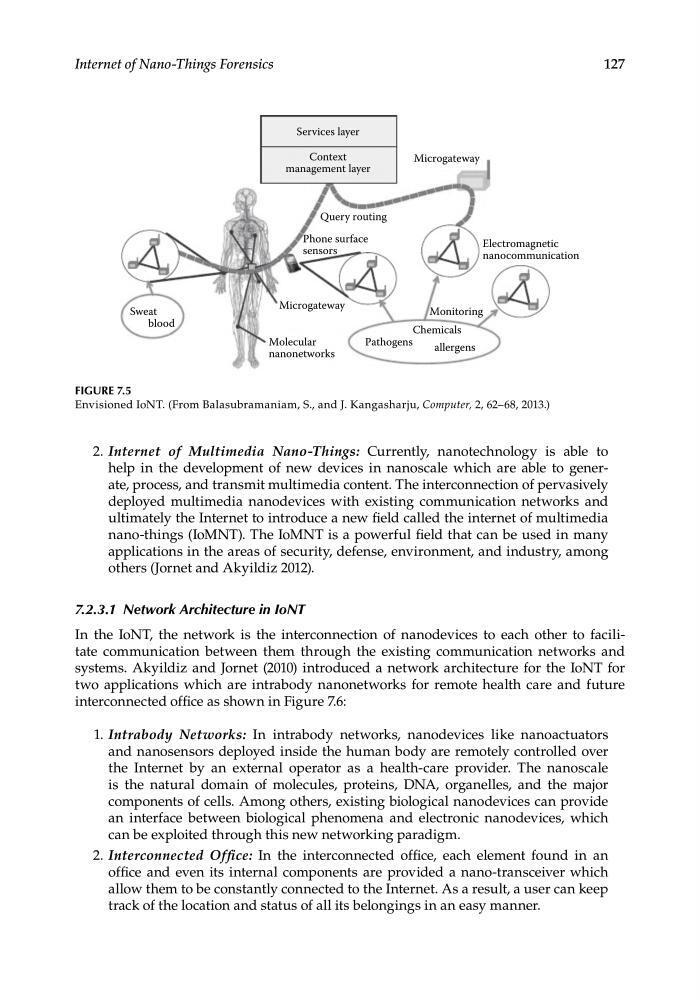
FIGURE 7.5
Envisioned IoNT. (From Balasubramaniam, S., and J. Kangasharju, Computer, 2, 62–68, 2013.)
Internet of Nano-Things Forensics
2. Internet of Multimedia Nano-Things: Currently, nanotechnology is able to
help in the development of new devices in nanoscale which are able to generate, process, and transmit multimedia content. The interconnection of pervasively
deployed multimedia nanodevices with existing communication networks and
ultimately the Internet to introduce a new field called the internet of multimedia
nano-things (IoMNT). The IoMNT is a powerful field that can be used in many
applications in the areas of security, defense, environment, and industry, among
others (Jornet and Akyildiz 2012).
7.2.3.1 Network Architecture in IoNT
In the IoNT, the network is the interconnection of nanodevices to each other to facilitate communication between them through the existing communication networks and
systems. Akyildiz and Jornet (2010) introduced a network architecture for the IoNT for
two applications which are intrabody nanonetworks for remote health care and future
interconnected office as shown in Figure 7.6:
1. Intrabody Networks: In intrabody networks, nanodevices like nanoactuators
and nanosensors deployed inside the human body are remotely controlled over
the Internet by an external operator as a health-care provider. The nanoscale
is the natural domain of molecules, proteins, DNA, organelles, and the major
components of cells. Among others, existing biological nanodevices can provide
an interface between biological phenomena and electronic nanodevices, which
can be exploited through this new networking paradigm.
2. Interconnected Office: In the interconnected office, each element found in an
office and even its internal components are provided a nano-transceiver which
allow them to be constantly connected to the Internet. As a result, a user can keep
track of the location and status of all its belongings in an easy manner.
Services layer
Context
management layer
Microgateway
Microgateway
Molecular
nanonetworks
Sweat
blood
Query routing
Phone surface
sensors
Electromagnetic
nanocommunication
Monitoring
Chemicals
allergens
Pathogens
FIGURE 7.5
Envisioned IoNT. (From Balasubramaniam, S., and J. Kangasharju, Computer, 2, 62–68, 2013.)