

113
User Authentication
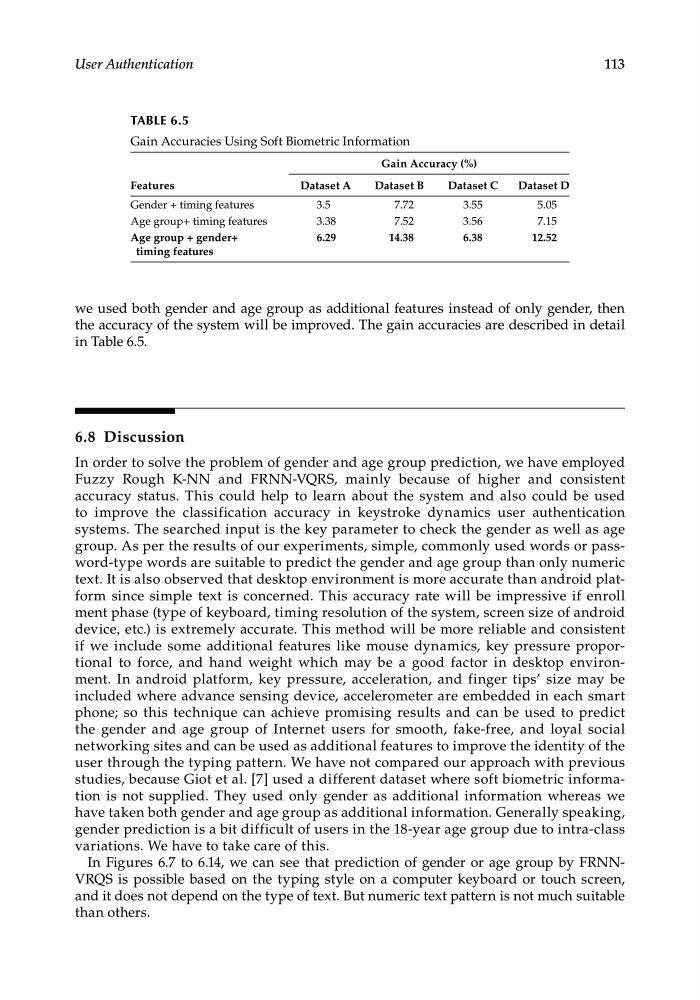
we used both gender and age group as additional features instead of only gender, then
the accuracy of the system will be improved. The gain accuracies are described in detail
in Table 6.5.
6.8 Discussion
In order to solve the problem of gender and age group prediction, we have employed
Fuzzy Rough K-NN and FRNN-VQRS, mainly because of higher and consistent
accuracy status. This could help to learn about the system and also could be used
to improve the classification accuracy in keystroke dynamics user authentication
systems. The searched input is the key parameter to check the gender as well as age
group. As per the results of our experiments, simple, commonly used words or password-type words are suitable to predict the gender and age group than only numeric
text. It is also observed that desktop environment is more accurate than android platform since simple text is concerned. This accuracy rate will be impressive if enroll
ment phase (type of keyboard, timing resolution of the system, screen size of android
device, etc.) is extremely accurate. This method will be more reliable and consistent
if we include some additional features like mouse dynamics, key pressure proportional to force, and hand weight which may be a good factor in desktop environment. In android platform, key pressure, acceleration, and finger tips’ size may be
included where advance sensing device, accelerometer are embedded in each smart
phone; so this technique can achieve promising results and can be used to predict
the gender and age group of Internet users for smooth, fake-free, and loyal social
networking sites and can be used as additional features to improve the identity of the
user through the typing pattern. We have not compared our approach with previous
studies, because Giot et al. [7] used a different dataset where soft biometric information is not supplied. They used only gender as additional information whereas we
have taken both gender and age group as additional information. Generally speaking,
gender prediction is a bit difficult of users in the 18-year age group due to intra-class
variations. We have to take care of this.
In Figures 6.7 to 6.14, we can see that prediction of gender or age group by FRNNVRQS is possible based on the typing style on a computer keyboard or touch screen,
and it does not depend on the type of text. But numeric text pattern is not much suitable
than others.
TABLE 6.5
Gain Accuracies Using Soft Biometric Information
Features
Gain Accuracy (%)
Dataset A
Dataset B
Dataset C
Dataset D
Gender + timing features
3.5
7.72
3.55
5.05
Age group+ timing features
3.38
7.52
3.56
7.15
Age group + gender+
timing features
6.29
14.38
6.38
12.52
User Authentication
we used both gender and age group as additional features instead of only gender, then
the accuracy of the system will be improved. The gain accuracies are described in detail
in Table 6.5.
6.8 Discussion
In order to solve the problem of gender and age group prediction, we have employed
Fuzzy Rough K-NN and FRNN-VQRS, mainly because of higher and consistent
accuracy status. This could help to learn about the system and also could be used
to improve the classification accuracy in keystroke dynamics user authentication
systems. The searched input is the key parameter to check the gender as well as age
group. As per the results of our experiments, simple, commonly used words or password-type words are suitable to predict the gender and age group than only numeric
text. It is also observed that desktop environment is more accurate than android platform since simple text is concerned. This accuracy rate will be impressive if enroll
ment phase (type of keyboard, timing resolution of the system, screen size of android
device, etc.) is extremely accurate. This method will be more reliable and consistent
if we include some additional features like mouse dynamics, key pressure proportional to force, and hand weight which may be a good factor in desktop environment. In android platform, key pressure, acceleration, and finger tips’ size may be
included where advance sensing device, accelerometer are embedded in each smart
phone; so this technique can achieve promising results and can be used to predict
the gender and age group of Internet users for smooth, fake-free, and loyal social
networking sites and can be used as additional features to improve the identity of the
user through the typing pattern. We have not compared our approach with previous
studies, because Giot et al. [7] used a different dataset where soft biometric information is not supplied. They used only gender as additional information whereas we
have taken both gender and age group as additional information. Generally speaking,
gender prediction is a bit difficult of users in the 18-year age group due to intra-class
variations. We have to take care of this.
In Figures 6.7 to 6.14, we can see that prediction of gender or age group by FRNNVRQS is possible based on the typing style on a computer keyboard or touch screen,
and it does not depend on the type of text. But numeric text pattern is not much suitable
than others.
TABLE 6.5
Gain Accuracies Using Soft Biometric Information
Features
Gain Accuracy (%)
Dataset A
Dataset B
Dataset C
Dataset D
Gender + timing features
3.5
7.72
3.55
5.05
Age group+ timing features
3.38
7.52
3.56
7.15
Age group + gender+
timing features
6.29
14.38
6.38
12.52