

112
Internet of Things (IoT)
6.6.4 Classification and Decision
Machine learning methods are widely used in pattern recognition domain. The purpose
of classification is to find the closest or the near-closest class to the claimed class. Statistical
methods such as mean, median, and standard deviation; distance-based algorithms
such as Euclidean, Manhattan, scaled Manhattan, Mohanobolis, z score, Canberra, and
Chebycev; and some machine learning algorithms such as SVM, multi layer perceptron,
OneR, J48, naïve bayes, nearest neighbor, fuzzy, neural network, and random forest can
be used. But in our experiment, FRNN-VQRS has proved that it is an efficient approach
in this domain.
Here, the claimant’s feature data are compared to the reference template using classification algorithm, and a final decision will be made based upon the classification accuracy.
To increase the user authentication accuracy, we have integrated gender and age group as
soft biometric features with timing features.
6.7 Experimental Results
In this section, we present the results obtained from our evaluation process. Eleven
machine learning algorithms were applied on each dataset and accuracy with 10-fold
cross-validation were listed to predict the gender identity in the Table 6.3 and to predict
the age group identity in the Table 6.4. As per obtained results, FRNN and FRNN-VQRS
have proved that they are suitable learning methods to predict the gender as well as age
group in both desktop and android environments. Accuracies were recorded by Weka 3.7.4
simulator with default parameter values.
From the literature survey, it has been observed that gender information as additional
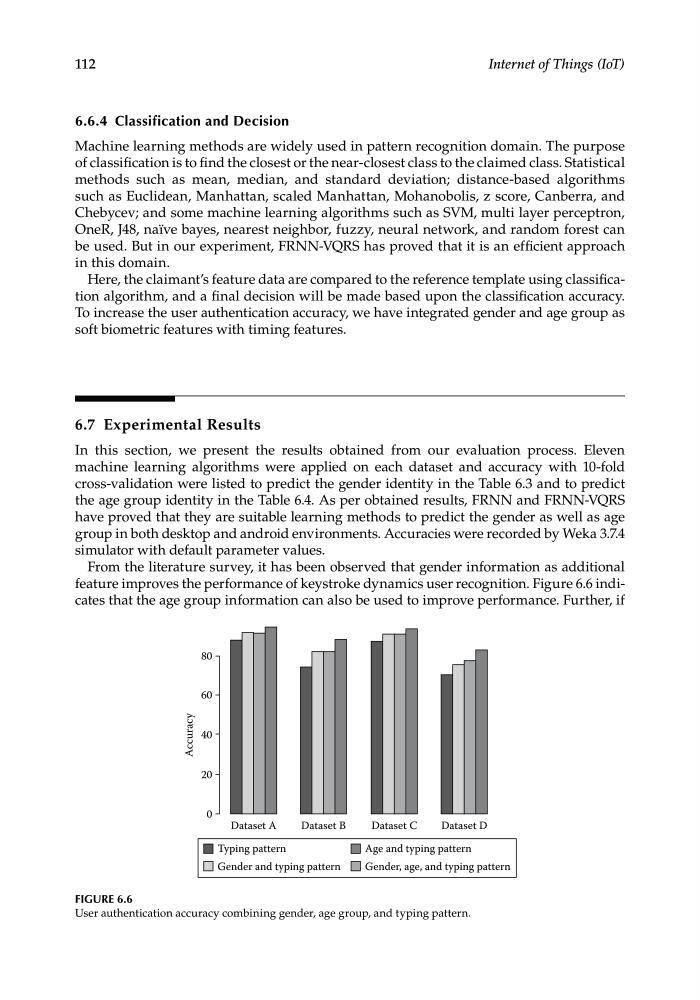
feature improves the performance of keystroke dynamics user recognition. Figure 6.6 indicates that the age group information can also be used to improve performance. Further, if
Dataset A
0
20
40
60
80
Accuracy
Dataset B
Dataset C
Dataset D
Typing pattern
Gender and typing pattern
Age and typing pattern
Gender, age, and typing pattern
FIGURE 6.6
User authentication accuracy combining gender, age group, and typing pattern.
Internet of Things (IoT)
6.6.4 Classification and Decision
Machine learning methods are widely used in pattern recognition domain. The purpose
of classification is to find the closest or the near-closest class to the claimed class. Statistical
methods such as mean, median, and standard deviation; distance-based algorithms
such as Euclidean, Manhattan, scaled Manhattan, Mohanobolis, z score, Canberra, and
Chebycev; and some machine learning algorithms such as SVM, multi layer perceptron,
OneR, J48, naïve bayes, nearest neighbor, fuzzy, neural network, and random forest can
be used. But in our experiment, FRNN-VQRS has proved that it is an efficient approach
in this domain.
Here, the claimant’s feature data are compared to the reference template using classification algorithm, and a final decision will be made based upon the classification accuracy.
To increase the user authentication accuracy, we have integrated gender and age group as
soft biometric features with timing features.
6.7 Experimental Results
In this section, we present the results obtained from our evaluation process. Eleven
machine learning algorithms were applied on each dataset and accuracy with 10-fold
cross-validation were listed to predict the gender identity in the Table 6.3 and to predict
the age group identity in the Table 6.4. As per obtained results, FRNN and FRNN-VQRS
have proved that they are suitable learning methods to predict the gender as well as age
group in both desktop and android environments. Accuracies were recorded by Weka 3.7.4
simulator with default parameter values.
From the literature survey, it has been observed that gender information as additional
feature improves the performance of keystroke dynamics user recognition. Figure 6.6 indicates that the age group information can also be used to improve performance. Further, if
Dataset A
0
20
40
60
80
Accuracy
Dataset B
Dataset C
Dataset D
Typing pattern
Gender and typing pattern
Age and typing pattern
Gender, age, and typing pattern
FIGURE 6.6
User authentication accuracy combining gender, age group, and typing pattern.