

102
Internet of Things (IoT)
interesting results. Giot et al. [7] showed that the gender of an individual user can be identified based on who types a predefined text. Epp et al. [8] showed that it is possible to get the
emotional state of an individual through keystroke dynamics. Khanna and Sasikumar [9]
showed that 70% of users decrease their typing speed while they are in a negative state, and
84% of users increase their typing speed when they are in a positive emotional state. Joyce
and Gupta [3] observed that shorter and easy to type login texts were easier to impersonate.
Killourhy et al. [4] conducted experiments to investigate the effect of clock resolution on
keystroke dynamics. They observed that the equal error rate (EER) increased by approximately 4.2% when using a 15 ms resolution clock instead of a 1 ms resolution clock. Ru and
Eloff [10] observed that password and user ID with normal “English-like” text seemed less
discernible from each other than string combining special characters such as &, %, @, ! etc.
Roy et al. [11,12] showed that it can be used as a password recovery mechanism and also
can be applied in cryptosystem. In another paper, Roy et al. [12,13] applied 22 different classification algorithms on keystroke dynamics and showed that distance-based algorithms,
namely Canberra, Lorentzian, scaled Manhattan, and outlier count, are the suitable classifiers on keystroke dynamics in identification/authentication.
Data acquisition technique is the primary and most essential stage in keystroke dynamics; here subjects are required to type only character-based text, purely numeric-based text,
or alpha-numeric-based text. Character-based text can be further sub divided into short
text, long text, and paragraph. Alpha-numeric text can be further sub divided into strong
text or password-type text and logically strong text. Figure 6.2 indicates the percentage
distribution of the type of texts used in literature.
Most of the time, simple, common, fixed-size words used daily were used along with
multiple predefined words (long text) in literature. As per the experiment, if we consider
familiar words for all subjects in our experiment, we can get a consistent typing style
across different sessions and each repetition from all the subjects. Performance of keystroke dynamics in user authentication/identification depends on type of text: familiar words are suitable than password-type texts and password-type texts achieve more
1980
Number of publications
0
10
20
30
40
50
60
70
1990
2000
Year
Recent trends in keystroke dynamics research
2010
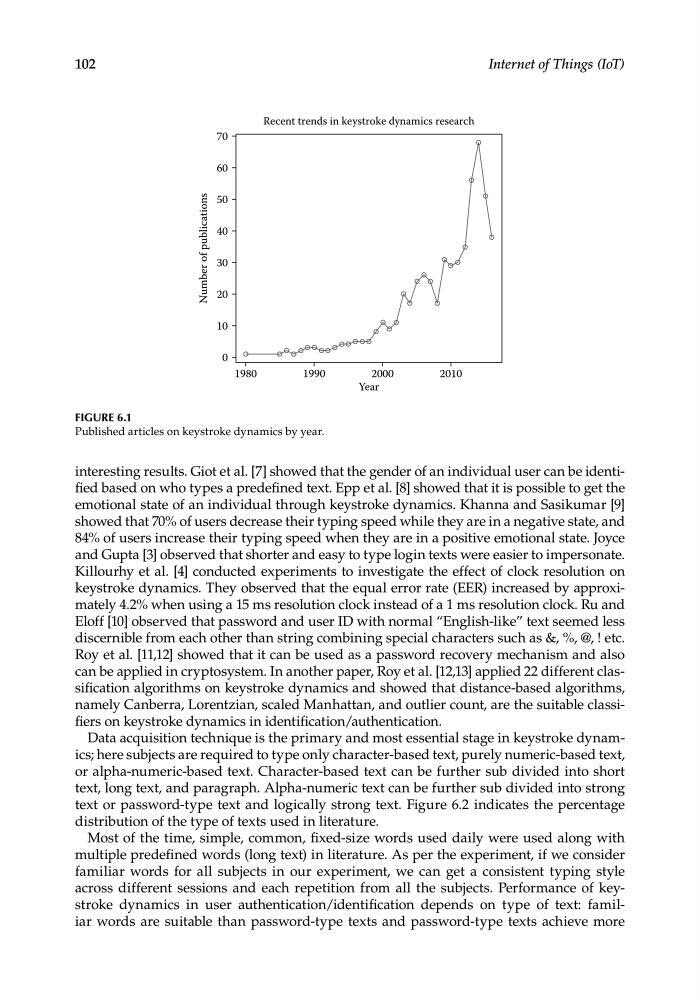
FIGURE 6.1
Published articles on keystroke dynamics by year.
Internet of Things (IoT)
interesting results. Giot et al. [7] showed that the gender of an individual user can be identified based on who types a predefined text. Epp et al. [8] showed that it is possible to get the
emotional state of an individual through keystroke dynamics. Khanna and Sasikumar [9]
showed that 70% of users decrease their typing speed while they are in a negative state, and
84% of users increase their typing speed when they are in a positive emotional state. Joyce
and Gupta [3] observed that shorter and easy to type login texts were easier to impersonate.
Killourhy et al. [4] conducted experiments to investigate the effect of clock resolution on
keystroke dynamics. They observed that the equal error rate (EER) increased by approximately 4.2% when using a 15 ms resolution clock instead of a 1 ms resolution clock. Ru and
Eloff [10] observed that password and user ID with normal “English-like” text seemed less
discernible from each other than string combining special characters such as &, %, @, ! etc.
Roy et al. [11,12] showed that it can be used as a password recovery mechanism and also
can be applied in cryptosystem. In another paper, Roy et al. [12,13] applied 22 different classification algorithms on keystroke dynamics and showed that distance-based algorithms,
namely Canberra, Lorentzian, scaled Manhattan, and outlier count, are the suitable classifiers on keystroke dynamics in identification/authentication.
Data acquisition technique is the primary and most essential stage in keystroke dynamics; here subjects are required to type only character-based text, purely numeric-based text,
or alpha-numeric-based text. Character-based text can be further sub divided into short
text, long text, and paragraph. Alpha-numeric text can be further sub divided into strong
text or password-type text and logically strong text. Figure 6.2 indicates the percentage
distribution of the type of texts used in literature.
Most of the time, simple, common, fixed-size words used daily were used along with
multiple predefined words (long text) in literature. As per the experiment, if we consider
familiar words for all subjects in our experiment, we can get a consistent typing style
across different sessions and each repetition from all the subjects. Performance of keystroke dynamics in user authentication/identification depends on type of text: familiar words are suitable than password-type texts and password-type texts achieve more
1980
Number of publications
0
10
20
30
40
50
60
70
1990
2000
Year
Recent trends in keystroke dynamics research
2010
FIGURE 6.1
Published articles on keystroke dynamics by year.