

101
User Authentication
• Compare our results with other leading approaches.
• Integrate both soft biometric features with keystroke dynamics user authentication systems and show the impact and effectiveness of our approach.
In essence, this study is one of the approaches to recognize the gender and age group of
Internet users. The secret behind this technique is physical structure, hand weight, finger
tips’ size, and neuro-physiological and neuro-psychological factors reflecting on the computer keyboard which discriminate the gender and age group of the users.
We have used published and authentic CMU keystroke dynamics dataset [4] along with
the datasets collected through android hand held devices [5]. The classification results
to determine the gender and age group by using FRNN-VQRS showed that more than
94% accuracy can be achieved through a computer keyboard while a touch screen device
offered more than 84% accuracy. The details of the datasets are summarized in Table 6.1.
We have used Weka GUI 3.7.4 to evaluate and compare the leading machine learning
algorithms on public keystroke dynamics datasets. Obtained results are reported with
default parameter values in Weka.
This chapter is organized as follows. Related works have been described in Section 6.2.
Section 6.3 describes the basic idea about keystroke dynamics. Section 6.4 compares the
performance of keystroke dynamics with other behavioral biometric systems. Section 6.5
represents the details of the datasets which have been used in our experiments. Our proposed methodology has been clearly explained in Section 6.6. All experimental results are
reported in Section 6.7. Results and Discussion have been explained in Section 6.8. The last
section compares our system with that of others and highlights its achievements.
6.2 Related Works
Keystroke dynamics technique started in 1980. Many journal articles, conference articles,
and master theses were published. Figure 6.1 clearly indicates the increasing trends in keystroke dynamics research. Many datasets have been created considering different types of
texts with different lengths from different subjects; many methods have been applied and
many innovative ideas have come out from the previous studies. Some studies showed that
keystroke dynamics holds better performance when using common words used daily than
strong password-type texts. Modi and Elliott [6] showed that nonfamiliar words do not give
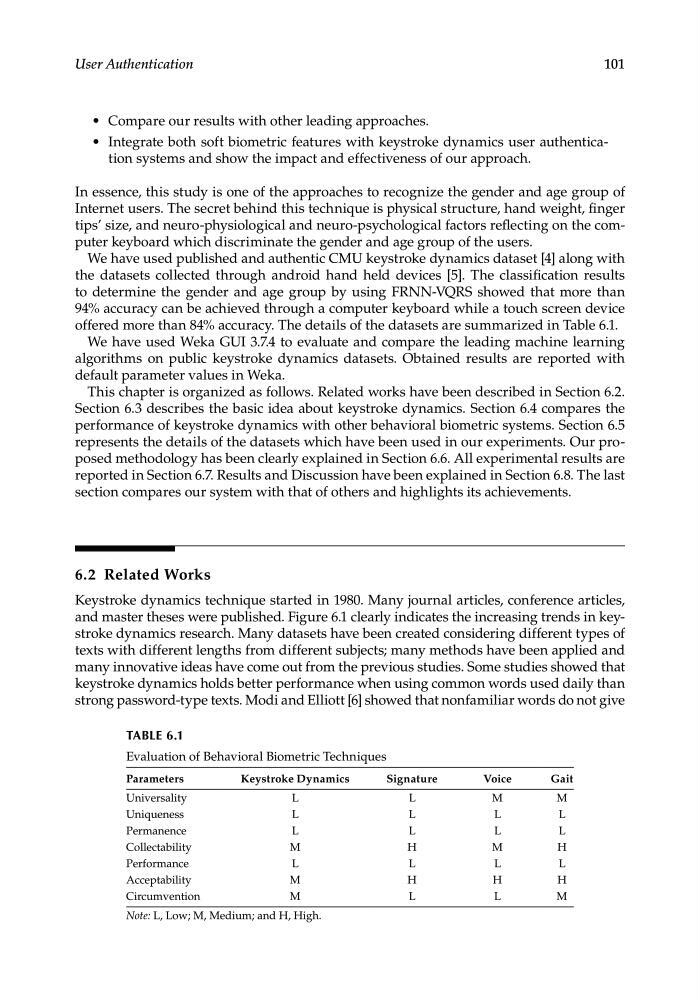
TABLE 6.1
Evaluation of Behavioral Biometric Techniques
Parameters
Keystroke Dynamics
Signature
Voice
Gait
Universality
L
L
M
M
Uniqueness
L
L
L
L
Permanence
L
L
L
L
Collectability
M
H
M
H
Performance
L
L
L
L
Acceptability
M
H
H
H
Circumvention
M
L
L
M
Note: L, Low; M, Medium; and H, High.
User Authentication
• Compare our results with other leading approaches.
• Integrate both soft biometric features with keystroke dynamics user authentication systems and show the impact and effectiveness of our approach.
In essence, this study is one of the approaches to recognize the gender and age group of
Internet users. The secret behind this technique is physical structure, hand weight, finger
tips’ size, and neuro-physiological and neuro-psychological factors reflecting on the computer keyboard which discriminate the gender and age group of the users.
We have used published and authentic CMU keystroke dynamics dataset [4] along with
the datasets collected through android hand held devices [5]. The classification results
to determine the gender and age group by using FRNN-VQRS showed that more than
94% accuracy can be achieved through a computer keyboard while a touch screen device
offered more than 84% accuracy. The details of the datasets are summarized in Table 6.1.
We have used Weka GUI 3.7.4 to evaluate and compare the leading machine learning
algorithms on public keystroke dynamics datasets. Obtained results are reported with
default parameter values in Weka.
This chapter is organized as follows. Related works have been described in Section 6.2.
Section 6.3 describes the basic idea about keystroke dynamics. Section 6.4 compares the
performance of keystroke dynamics with other behavioral biometric systems. Section 6.5
represents the details of the datasets which have been used in our experiments. Our proposed methodology has been clearly explained in Section 6.6. All experimental results are
reported in Section 6.7. Results and Discussion have been explained in Section 6.8. The last
section compares our system with that of others and highlights its achievements.
6.2 Related Works
Keystroke dynamics technique started in 1980. Many journal articles, conference articles,
and master theses were published. Figure 6.1 clearly indicates the increasing trends in keystroke dynamics research. Many datasets have been created considering different types of
texts with different lengths from different subjects; many methods have been applied and
many innovative ideas have come out from the previous studies. Some studies showed that
keystroke dynamics holds better performance when using common words used daily than
strong password-type texts. Modi and Elliott [6] showed that nonfamiliar words do not give
TABLE 6.1
Evaluation of Behavioral Biometric Techniques
Parameters
Keystroke Dynamics
Signature
Voice
Gait
Universality
L
L
M
M
Uniqueness
L
L
L
L
Permanence
L
L
L
L
Collectability
M
H
M
H
Performance
L
L
L
L
Acceptability
M
H
H
H
Circumvention
M
L
L
M
Note: L, Low; M, Medium; and H, High.