

96
Internet of Things (IoT)
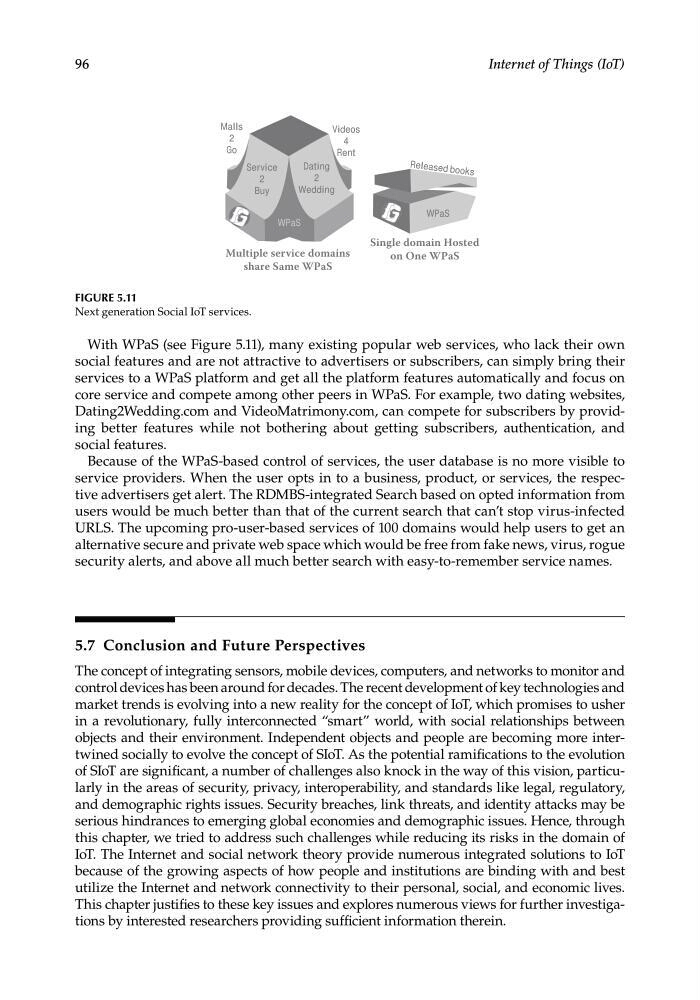
With WPaS (see Figure 5.11), many existing popular web services, who lack their own
social features and are not attractive to advertisers or subscribers, can simply bring their
services to a WPaS platform and get all the platform features automatically and focus on
core service and compete among other peers in WPaS. For example, two dating websites,
Dating2Wedding.com and VideoMatrimony.com, can compete for subscribers by providing better features while not bothering about getting subscribers, authentication, and
social features.
Because of the WPaS-based control of services, the user database is no more visible to
service providers. When the user opts in to a business, product, or services, the respective advertisers get alert. The RDMBS-integrated Search based on opted information from
users would be much better than that of the current search that can’t stop virus-infected
URLS. The upcoming pro-user-based services of 100 domains would help users to get an
alternative secure and private web space which would be free from fake news, virus, rogue
security alerts, and above all much better search with easy-to-remember service names.
5.7 Conclusion and Future Perspectives
The concept of integrating sensors, mobile devices, computers, and networks to monitor and
control devices has been around for decades. The recent development of key technologies and
market trends is evolving into a new reality for the concept of IoT, which promises to usher
in a revolutionary, fully interconnected “smart” world, with social relationships between
objects and their environment. Independent objects and people are becoming more intertwined socially to evolve the concept of SIoT. As the potential ramifications to the evolution
of SIoT are significant, a number of challenges also knock in the way of this vision, particularly in the areas of security, privacy, interoperability, and standards like legal, regulatory,
and demographic rights issues. Security breaches, link threats, and identity attacks may be
serious hindrances to emerging global economies and demographic issues. Hence, through
this chapter, we tried to address such challenges while reducing its risks in the domain of
IoT. The Internet and social network theory provide numerous integrated solutions to IoT
because of the growing aspects of how people and institutions are binding with and best
utilize the Internet and network connectivity to their personal, social, and economic lives.
This chapter justifies to these key issues and explores numerous views for further investigations by interested researchers providing sufficient information therein.
Malls
2
Go
Rel eas ed boo ks
Videos
4
Rent
Dating
2
Wedding
Service
2
Buy
WPaS
WPaS
Multiple service domains
share Same WPaS
Single domain Hosted
on One WPaS
FIGURE 5.11
Next generation Social IoT services.
Internet of Things (IoT)
With WPaS (see Figure 5.11), many existing popular web services, who lack their own
social features and are not attractive to advertisers or subscribers, can simply bring their
services to a WPaS platform and get all the platform features automatically and focus on
core service and compete among other peers in WPaS. For example, two dating websites,
Dating2Wedding.com and VideoMatrimony.com, can compete for subscribers by providing better features while not bothering about getting subscribers, authentication, and
social features.
Because of the WPaS-based control of services, the user database is no more visible to
service providers. When the user opts in to a business, product, or services, the respective advertisers get alert. The RDMBS-integrated Search based on opted information from
users would be much better than that of the current search that can’t stop virus-infected
URLS. The upcoming pro-user-based services of 100 domains would help users to get an
alternative secure and private web space which would be free from fake news, virus, rogue
security alerts, and above all much better search with easy-to-remember service names.
5.7 Conclusion and Future Perspectives
The concept of integrating sensors, mobile devices, computers, and networks to monitor and
control devices has been around for decades. The recent development of key technologies and
market trends is evolving into a new reality for the concept of IoT, which promises to usher
in a revolutionary, fully interconnected “smart” world, with social relationships between
objects and their environment. Independent objects and people are becoming more intertwined socially to evolve the concept of SIoT. As the potential ramifications to the evolution
of SIoT are significant, a number of challenges also knock in the way of this vision, particularly in the areas of security, privacy, interoperability, and standards like legal, regulatory,
and demographic rights issues. Security breaches, link threats, and identity attacks may be
serious hindrances to emerging global economies and demographic issues. Hence, through
this chapter, we tried to address such challenges while reducing its risks in the domain of
IoT. The Internet and social network theory provide numerous integrated solutions to IoT
because of the growing aspects of how people and institutions are binding with and best
utilize the Internet and network connectivity to their personal, social, and economic lives.
This chapter justifies to these key issues and explores numerous views for further investigations by interested researchers providing sufficient information therein.
Malls
2
Go
Rel eas ed boo ks
Videos
4
Rent
Dating
2
Wedding
Service
2
Buy
WPaS
WPaS
Multiple service domains
share Same WPaS
Single domain Hosted
on One WPaS
FIGURE 5.11
Next generation Social IoT services.