

83
Evolution of Social IoT World
From various empirical studies on analysis of service and application typologies, built upon the envisaged SIoT, we find some relationships of socialization
(Tripathy et al. 2016) that are presented in Table 5.1 within the reference system
architecture.
5.4.1 SIoT System Architecture
The three-layer architecture of SIoT system shown in Figure 5.5 is based on the simple
architectural model of IoT (Zheng et al. 2011), having distinct components such as SIoT
Server, the Object, and the Gateway.
In the SIoT Server, the network layer comprises various types of communication channels
associated with the SIoT. The base sub-layer of application layer includes the database for
the storage and the management of the data and the relevant descriptors. These records
encompass the social member profiles and their relationships, as well as the activities carried out by the objects in the real and virtual worlds. Such a view is extracted through
appropriate semantic engines. Indeed, these semantic services are necessary to provide
a machine interpretable framework for representing functional and nonfunctional attributes and operations of the IoT devices. The top layer of the application layer consists of
SIoT applications, the social agent, and the service management agent. The social agent is
devoted to the communication with the SIoT servers to update profile, to update friendships, and to request services from the social network. It also implements the methods to
communicate with objects. The service management agent is responsible for the interfaces
with the humans that can control the behavior of the objects while communicating within
their social network.
As to the Object and Gateway systems, the combination of layers may vary mainly
depending on the device characteristics. The following three scenarios can be foreseen.
Social
information
processing
center
Fire and theft
prevention
systems
Central
information
processing
system
Electronic
guard
Image/smoke
monitoring
Television
network
Telecommunications
network
Smart traffic
interface
system
.....................
Car In/Out
parking
guide
Fires alarm
......................
......................
Electronic
fence
Public facilities
monitoring
Security patrol
monitoring
...................
....................
Vehicle
management
system
Property
management
center
Surrounding
security
system
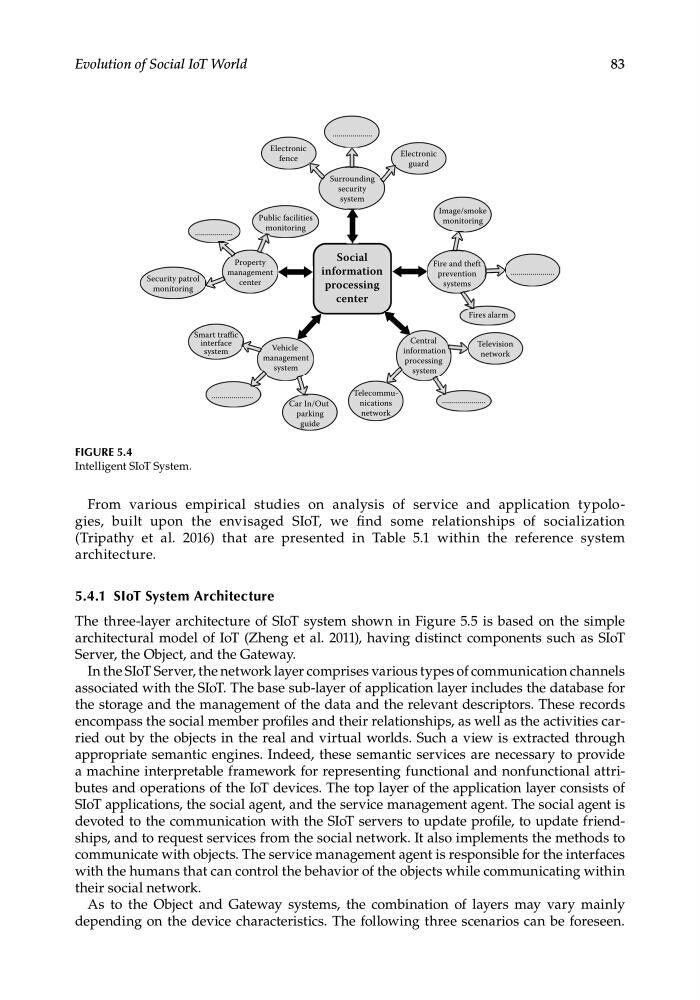
FIGURE 5.4
Intelligent SIoT System.
Evolution of Social IoT World
From various empirical studies on analysis of service and application typologies, built upon the envisaged SIoT, we find some relationships of socialization
(Tripathy et al. 2016) that are presented in Table 5.1 within the reference system
architecture.
5.4.1 SIoT System Architecture
The three-layer architecture of SIoT system shown in Figure 5.5 is based on the simple
architectural model of IoT (Zheng et al. 2011), having distinct components such as SIoT
Server, the Object, and the Gateway.
In the SIoT Server, the network layer comprises various types of communication channels
associated with the SIoT. The base sub-layer of application layer includes the database for
the storage and the management of the data and the relevant descriptors. These records
encompass the social member profiles and their relationships, as well as the activities carried out by the objects in the real and virtual worlds. Such a view is extracted through
appropriate semantic engines. Indeed, these semantic services are necessary to provide
a machine interpretable framework for representing functional and nonfunctional attributes and operations of the IoT devices. The top layer of the application layer consists of
SIoT applications, the social agent, and the service management agent. The social agent is
devoted to the communication with the SIoT servers to update profile, to update friendships, and to request services from the social network. It also implements the methods to
communicate with objects. The service management agent is responsible for the interfaces
with the humans that can control the behavior of the objects while communicating within
their social network.
As to the Object and Gateway systems, the combination of layers may vary mainly
depending on the device characteristics. The following three scenarios can be foreseen.
Social
information
processing
center
Fire and theft
prevention
systems
Central
information
processing
system
Electronic
guard
Image/smoke
monitoring
Television
network
Telecommunications
network
Smart traffic
interface
system
.....................
Car In/Out
parking
guide
Fires alarm
......................
......................
Electronic
fence
Public facilities
monitoring
Security patrol
monitoring
...................
....................
Vehicle
management
system
Property
management
center
Surrounding
security
system
FIGURE 5.4
Intelligent SIoT System.