

82
Internet of Things (IoT)
Social network analysis facilitates the methodologies to uncover patterns in
its connections or relations among related entities. It has been widely applied to
organizational networks to classify the influence or popularity of individuals and to
detect collusion and fraud.
5.4 On Emergence of Social IoT
There is scientific evidence that a large number of individuals connected in social
network can provide far more accurate answers to complex problems than a single
individual. Even this makes more sense in comparison to a small group of knowledgeable individuals (Surowiecki 2004). Social Network (SN) has already been solving these
issues through friends’ selection, community finding, dynamic interactivity, profiling,
online grouping, recommendations, and sentiment analysis since three decades. Thus,
it makes sense on integration of SN into the IoT solutions, with unique addressing
schemes, standard communication protocols, interaction with other objects (local/
global neighbors) to reach common goals (Sarma et al. 1999; Atzori et al. 2010). This
would bring tremendous opportunities of research and development in the evolution
of new paradigm of SIoT.
The emergence of the SN and IoT, which were up to now thought to be in parallel by
both scientific and industrial communities, is gaining momentum for integration very
quickly (Atzori et al. 2012). This is due to the increase in the awareness that IoT provides
the connection to the physical world by sensing and actuating while SNs contribute
toward many of the daily aspects of the human world. It may lead to desirable implications in a future world populated by smart objects permeating the everyday life of
human beings catering economic and social issues (see Figure 5.4). Such prolific integration needs an improvement on the connectivity of all the relationships between users
and things (smart objects), and to enhance the availability of computational power via
sets of things surrounding us. IoT objects should be socialized to establish relationships
with them and to predict the link based on trust in the community. It is analogous to
the fact that increasing the availability of processing power would be accompanied by
decreasing the visibility (Weiser 1991; Strategy 2005).
(b)
(c)
A
B
C
D
E
F
E
D
A
B
7
2
5 1
9 41 42
49
40
47
8
32
33
36
38
31 37
26
22
58
55
51
54
57
19
15
14
13
16
27
c
b
d
a
24
6
G
C
F
G
H
I
(a)
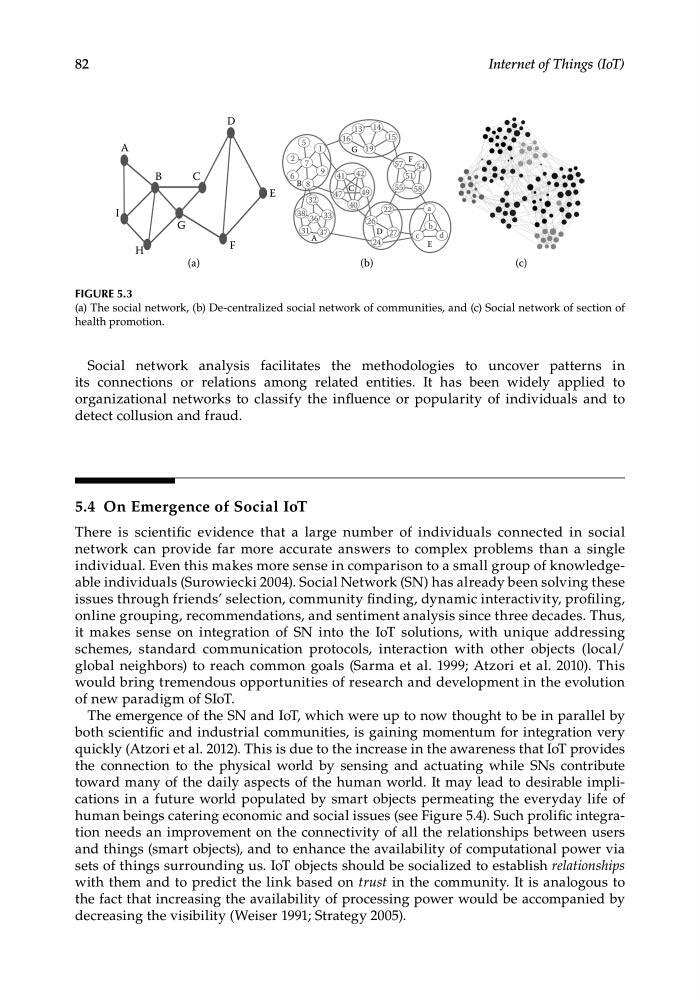
FIGURE 5.3
(a) The social network, (b) De-centralized social network of communities, and (c) Social network of section of
health promotion.
Internet of Things (IoT)
Social network analysis facilitates the methodologies to uncover patterns in
its connections or relations among related entities. It has been widely applied to
organizational networks to classify the influence or popularity of individuals and to
detect collusion and fraud.
5.4 On Emergence of Social IoT
There is scientific evidence that a large number of individuals connected in social
network can provide far more accurate answers to complex problems than a single
individual. Even this makes more sense in comparison to a small group of knowledgeable individuals (Surowiecki 2004). Social Network (SN) has already been solving these
issues through friends’ selection, community finding, dynamic interactivity, profiling,
online grouping, recommendations, and sentiment analysis since three decades. Thus,
it makes sense on integration of SN into the IoT solutions, with unique addressing
schemes, standard communication protocols, interaction with other objects (local/
global neighbors) to reach common goals (Sarma et al. 1999; Atzori et al. 2010). This
would bring tremendous opportunities of research and development in the evolution
of new paradigm of SIoT.
The emergence of the SN and IoT, which were up to now thought to be in parallel by
both scientific and industrial communities, is gaining momentum for integration very
quickly (Atzori et al. 2012). This is due to the increase in the awareness that IoT provides
the connection to the physical world by sensing and actuating while SNs contribute
toward many of the daily aspects of the human world. It may lead to desirable implications in a future world populated by smart objects permeating the everyday life of
human beings catering economic and social issues (see Figure 5.4). Such prolific integration needs an improvement on the connectivity of all the relationships between users
and things (smart objects), and to enhance the availability of computational power via
sets of things surrounding us. IoT objects should be socialized to establish relationships
with them and to predict the link based on trust in the community. It is analogous to
the fact that increasing the availability of processing power would be accompanied by
decreasing the visibility (Weiser 1991; Strategy 2005).
(b)
(c)
A
B
C
D
E
F
E
D
A
B
7
2
5 1
9 41 42
49
40
47
8
32
33
36
38
31 37
26
22
58
55
51
54
57
19
15
14
13
16
27
c
b
d
a
24
6
G
C
F
G
H
I
(a)
FIGURE 5.3
(a) The social network, (b) De-centralized social network of communities, and (c) Social network of section of
health promotion.