

79
Evolution of Social IoT World
5.2 Technological Evolution of IoT
The first ever internet connected coke machine (at Carnegie Mellon University) could able
to report its inventory and quantified the temperature of newly loaded drinks, which led
to the concept of a network of smart devices (1982). The field started gathering momentum
in 1999 by Kevin Ashton.
According to Cisco (Cisco IBSG 2011), the Internet of Things (IoT) was born sometime
between 2008 and 2009. Today, IoT is well under way and would cross 50 billion connected
devices (sensors to the internet) by 2020. Furthermore, the IoT is evolving toward a new era
of technology in collaboration with networks of smart devices over the wired or mobile
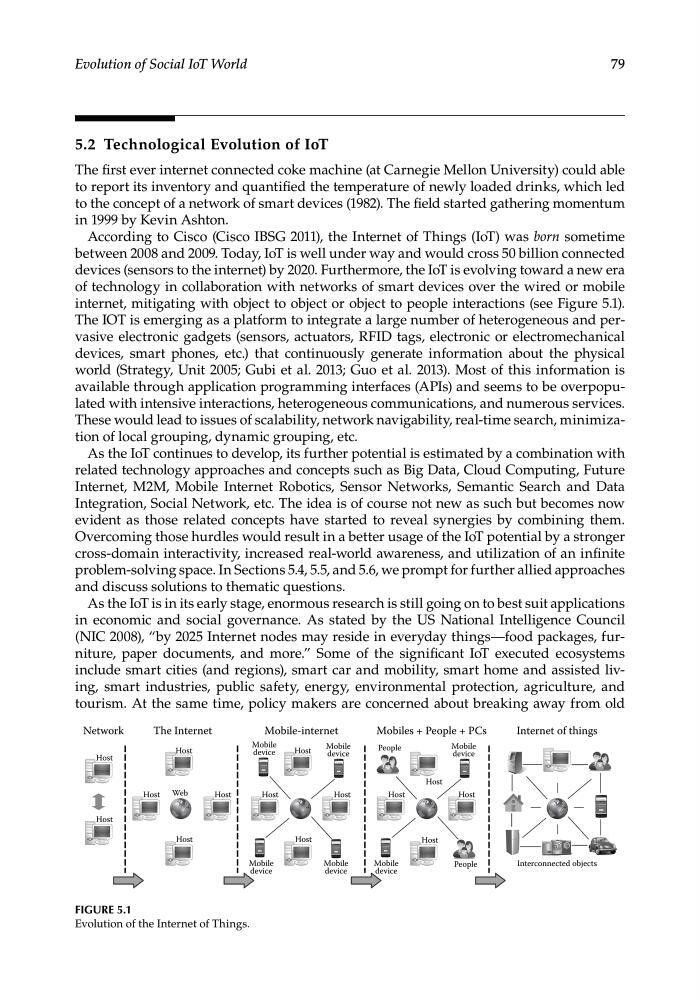
internet, mitigating with object to object or object to people interactions (see Figure 5.1).
The IOT is emerging as a platform to integrate a large number of heterogeneous and pervasive electronic gadgets (sensors, actuators, RFID tags, electronic or electromechanical
devices, smart phones, etc.) that continuously generate information about the physical
world (Strategy, Unit 2005; Gubi et al. 2013; Guo et al. 2013). Most of this information is
available through application programming interfaces (APIs) and seems to be overpopulated with intensive interactions, heterogeneous communications, and numerous services.
These would lead to issues of scalability, network navigability, real-time search, minimization of local grouping, dynamic grouping, etc.
As the IoT continues to develop, its further potential is estimated by a combination with
related technology approaches and concepts such as Big Data, Cloud Computing, Future
Internet, M2M, Mobile Internet Robotics, Sensor Networks, Semantic Search and Data
Integration, Social Network, etc. The idea is of course not new as such but becomes now
evident as those related concepts have started to reveal synergies by combining them.
Overcoming those hurdles would result in a better usage of the IoT potential by a stronger
cross-domain interactivity, increased real-world awareness, and utilization of an infinite
problem-solving space. In Sections 5.4, 5.5, and 5.6, we prompt for further allied approaches
and discuss solutions to thematic questions.
As the IoT is in its early stage, enormous research is still going on to best suit applications
in economic and social governance. As stated by the US National Intelligence Council
(NIC 2008), “by 2025 Internet nodes may reside in everyday things—food packages, furniture, paper documents, and more.” Some of the significant IoT executed ecosystems
include smart cities (and regions), smart car and mobility, smart home and assisted living, smart industries, public safety, energy, environmental protection, agriculture, and
tourism. At the same time, policy makers are concerned about breaking away from old
Network
T he Internet
Mobile-internet
Mobiles + People + PCs
I nternet of things
Host
Host
Host
Host
Host
Mobile
device
Mobile
device
Mobile
device
Mobile
device
People
Mobile
device
Mobile
device
Host
Host
Host
Host
Host
Host
Host
People
Interconnected objects
Host
Host
Web
FIGURE 5.1
Evolution of the Internet of Things.
Evolution of Social IoT World
5.2 Technological Evolution of IoT
The first ever internet connected coke machine (at Carnegie Mellon University) could able
to report its inventory and quantified the temperature of newly loaded drinks, which led
to the concept of a network of smart devices (1982). The field started gathering momentum
in 1999 by Kevin Ashton.
According to Cisco (Cisco IBSG 2011), the Internet of Things (IoT) was born sometime
between 2008 and 2009. Today, IoT is well under way and would cross 50 billion connected
devices (sensors to the internet) by 2020. Furthermore, the IoT is evolving toward a new era
of technology in collaboration with networks of smart devices over the wired or mobile
internet, mitigating with object to object or object to people interactions (see Figure 5.1).
The IOT is emerging as a platform to integrate a large number of heterogeneous and pervasive electronic gadgets (sensors, actuators, RFID tags, electronic or electromechanical
devices, smart phones, etc.) that continuously generate information about the physical
world (Strategy, Unit 2005; Gubi et al. 2013; Guo et al. 2013). Most of this information is
available through application programming interfaces (APIs) and seems to be overpopulated with intensive interactions, heterogeneous communications, and numerous services.
These would lead to issues of scalability, network navigability, real-time search, minimization of local grouping, dynamic grouping, etc.
As the IoT continues to develop, its further potential is estimated by a combination with
related technology approaches and concepts such as Big Data, Cloud Computing, Future
Internet, M2M, Mobile Internet Robotics, Sensor Networks, Semantic Search and Data
Integration, Social Network, etc. The idea is of course not new as such but becomes now
evident as those related concepts have started to reveal synergies by combining them.
Overcoming those hurdles would result in a better usage of the IoT potential by a stronger
cross-domain interactivity, increased real-world awareness, and utilization of an infinite
problem-solving space. In Sections 5.4, 5.5, and 5.6, we prompt for further allied approaches
and discuss solutions to thematic questions.
As the IoT is in its early stage, enormous research is still going on to best suit applications
in economic and social governance. As stated by the US National Intelligence Council
(NIC 2008), “by 2025 Internet nodes may reside in everyday things—food packages, furniture, paper documents, and more.” Some of the significant IoT executed ecosystems
include smart cities (and regions), smart car and mobility, smart home and assisted living, smart industries, public safety, energy, environmental protection, agriculture, and
tourism. At the same time, policy makers are concerned about breaking away from old
Network
T he Internet
Mobile-internet
Mobiles + People + PCs
I nternet of things
Host
Host
Host
Host
Host
Mobile
device
Mobile
device
Mobile
device
Mobile
device
People
Mobile
device
Mobile
device
Host
Host
Host
Host
Host
Host
Host
People
Interconnected objects
Host
Host
Web
FIGURE 5.1
Evolution of the Internet of Things.